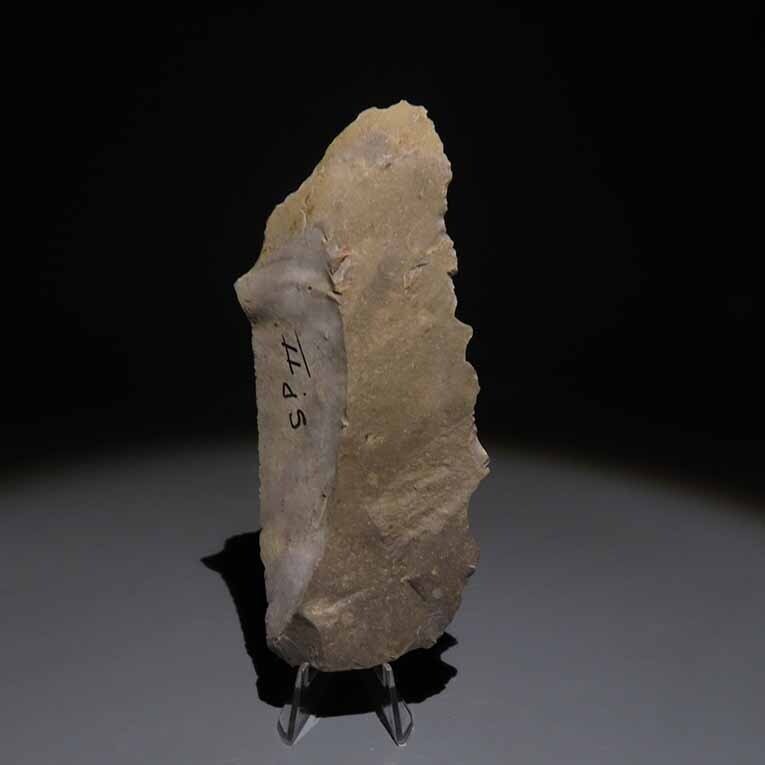
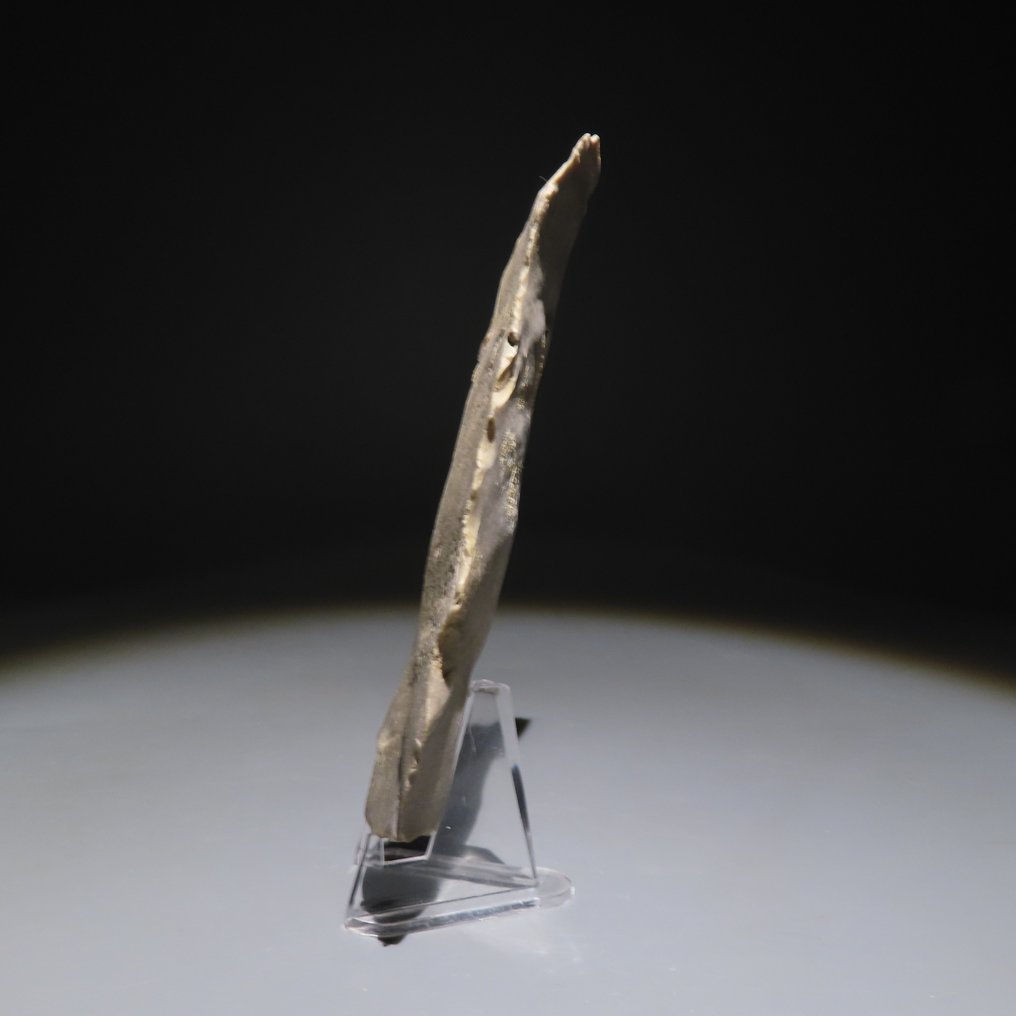
Neolitisk Flint Værktøj. Spiennes, 4500-3500 f.Kr. Højde 10,8 cm. Spansk importlicens. (Ingen mindstepris)


01
dag
00
timer
48
minutter
05
sekunder
Nuværende bud
€ 16
Ingen mindstepris

Ekspert
Udvalgt af Peter Reynaers
Har næsten 30 års erfaring og har været moderator for flere online kunstforskningsgrupper.
Estimat € 150 - € 200
4 andre mennesker holder øje med dette objekt
 Byder 6561 Byder 6561 | € 16 | |
|---|---|---|
 Byder 4160 Byder 4160 | € 11 | |
| Byder 6561 | € 11 | |
Catawikis køberbeskyttelse
Din betaling er sikker hos os, indtil du modtager din genstand.Se flere oplysninger
Trustpilot 4.4 | %{antal} anmeldelser
Bedømt som Fremragende på Trustpilot.
Dette neolitiske flintværktøj fra Spiennes (4500–3500 f.Kr.) er 10,8 cm højt og viser det største tidlige minekompleks i nordvestlige Europa, hvilket giver historisk værdi.
AI-assisteret oversigt
Beskrivelse fra sælger
Tool.
Neolithic Period, Spiennes, 4500-3500 BC.
Flint
10.8 cm Height.
CONDITION: It is preserved in its original state.
PROVENANCE: Private Collection, Belgium. Acquired before the 1970's.
DESCRIPTION:
The Neolithic Flint Mines of Spiennes occupy two chalk plateaux located to the south-east of the city of Mons. They cover an area essentially devoted to agriculture. The site appears on the surface as a large area of meadows and fields strewn with millions of scraps of worked flint. Underground, the site is an immense network of galleries linked to the surface by vertical shafts dug by Neolithic populations.
The Neolithic Flint Mines of Spiennes are the largest and earliest concentration of ancient mines of north-west Europe. The mines were in operation for many centuries and the remains vividly illustrate the development and adaptation of mining techniques employed by prehistoric populations in order to exploit large deposits of a material that was essential for the production of tools and cultural evolution generally. They are also remarkable by the diversity of technical mining solutions implemented and by the fact that they are directly linked to a habitat contemporary to them.
In the Neolithic period, (from the last third of the 5th millennium until the first half of the 3rd millennium), the site was the centre of intensive flint mining present underground. Different techniques were used, the most spectacular and characteristic of which was the digging out of shafts of 0.8 to 1.20m in diameter with a depth down to 16 metres. Neolithic populations could thus pass below levels made up of large blocks of flint (up to 2m in length) that they extracted using a particular technique called ‘striking’ (freeing from below with support of a central chalk wall, shoring up of the block, removal of the wall, removal of the props and lowering of the block). The density of the shafts is important, as many as 5,000 in the zone called Petit Spiennes (14 ha), leading to criss-crossing of pits and shafts in some sectors.
The neolithic flint mines near Spienne in Belgium are part of UNESCO's world heritage since the year 2000 (Id. N°: 1006). With the second half of the 5. Millenium BC stone from the Spienne mine was worked in socially increasingly complex neolithic groups in that region. No doubt a source of wealth to that cultures.
The groups of that area are refered to as Michaelsberg culture. They flourished from the mid 5th Millenium BC until the mid 4th Millenium BC in middle Europe. Their culture streched from Germany, northern France to Belgium. Around Spienne, it was finally replaced by the Seine-Oise-Marne culture, which did not use the nearby mine anymore
Notes:
The seller guarantees that he acquired this piece according to all national and international laws related to the ownership of cultural property. Provenance statement seen by Catawiki.
The piece includes authenticity certificate.
The piece includes Spanish Export License.
Sælger's Historie
Gallery of Ancient Art - Arkæologi baseret i Barcelona med mere end femten års erfaring. Specialiseret i klassisk kunst, egyptisk kunst, asiatisk kunst og præcolumbiansk kunst. Det garanterer ægtheden af alle dens stykker. Det deltager i de vigtigste kunstmesser i Spanien, såsom Feriarte, samt på messer i udlandet, BRAFA, Parcours des Mondes, Cultures Brussels.
Alle stykkerne sendes med en eksporttilladelse udstedt af det spanske kulturministerium.
Vi er hurtige til at sende via DHL Express eller Direct Art Transport.
Oversat af Google OversætTool.
Neolithic Period, Spiennes, 4500-3500 BC.
Flint
10.8 cm Height.
CONDITION: It is preserved in its original state.
PROVENANCE: Private Collection, Belgium. Acquired before the 1970's.
DESCRIPTION:
The Neolithic Flint Mines of Spiennes occupy two chalk plateaux located to the south-east of the city of Mons. They cover an area essentially devoted to agriculture. The site appears on the surface as a large area of meadows and fields strewn with millions of scraps of worked flint. Underground, the site is an immense network of galleries linked to the surface by vertical shafts dug by Neolithic populations.
The Neolithic Flint Mines of Spiennes are the largest and earliest concentration of ancient mines of north-west Europe. The mines were in operation for many centuries and the remains vividly illustrate the development and adaptation of mining techniques employed by prehistoric populations in order to exploit large deposits of a material that was essential for the production of tools and cultural evolution generally. They are also remarkable by the diversity of technical mining solutions implemented and by the fact that they are directly linked to a habitat contemporary to them.
In the Neolithic period, (from the last third of the 5th millennium until the first half of the 3rd millennium), the site was the centre of intensive flint mining present underground. Different techniques were used, the most spectacular and characteristic of which was the digging out of shafts of 0.8 to 1.20m in diameter with a depth down to 16 metres. Neolithic populations could thus pass below levels made up of large blocks of flint (up to 2m in length) that they extracted using a particular technique called ‘striking’ (freeing from below with support of a central chalk wall, shoring up of the block, removal of the wall, removal of the props and lowering of the block). The density of the shafts is important, as many as 5,000 in the zone called Petit Spiennes (14 ha), leading to criss-crossing of pits and shafts in some sectors.
The neolithic flint mines near Spienne in Belgium are part of UNESCO's world heritage since the year 2000 (Id. N°: 1006). With the second half of the 5. Millenium BC stone from the Spienne mine was worked in socially increasingly complex neolithic groups in that region. No doubt a source of wealth to that cultures.
The groups of that area are refered to as Michaelsberg culture. They flourished from the mid 5th Millenium BC until the mid 4th Millenium BC in middle Europe. Their culture streched from Germany, northern France to Belgium. Around Spienne, it was finally replaced by the Seine-Oise-Marne culture, which did not use the nearby mine anymore
Notes:
The seller guarantees that he acquired this piece according to all national and international laws related to the ownership of cultural property. Provenance statement seen by Catawiki.
The piece includes authenticity certificate.
The piece includes Spanish Export License.
Sælger's Historie
Gallery of Ancient Art - Arkæologi baseret i Barcelona med mere end femten års erfaring. Specialiseret i klassisk kunst, egyptisk kunst, asiatisk kunst og præcolumbiansk kunst. Det garanterer ægtheden af alle dens stykker. Det deltager i de vigtigste kunstmesser i Spanien, såsom Feriarte, samt på messer i udlandet, BRAFA, Parcours des Mondes, Cultures Brussels.
Alle stykkerne sendes med en eksporttilladelse udstedt af det spanske kulturministerium.
Vi er hurtige til at sende via DHL Express eller Direct Art Transport.
Oversat af Google OversætDetaljer
Kultur
Neolitisk
Århundrede/ Tidsramme
Spiennes, 4500-3500 BC
Name of object
Tool. Spiennes, 4500-3500 BC. 10.8 cm height. Spanish Import License.
Erhvervet fra
Privat samling
År erhvervet
2025
Materiale
Flint
Land erhvervet fra
Belgien
Stand
Meget god
Tidligere ejer erhvervet fra
Privat samling
Tidligere ejer – år erhvervet
1970
Tidligere ejer – land erhvervet fra
Belgien
Jeg bekræfter, at jeg har erhvervet denne genstand lovligt, og at jeg har lov til at sælge det
Ja
Disclaimer
Sælgeren er blevet informeret af Catawiki om dokumentationskrav og garanterer følgende: - genstanden er lovligt erhvervet - sælgeren har ret til at sælge og/eller eksportere genstanden, alt efter hvad der er relevant - sælgeren vil give de nødvendige herkomstoplysninger og arrangere påkrævet dokumentation og tilladelser/licenser, som det er relevant og i henhold til lokal lovgivning - sælgeren vil underrette køberen om eventuelle forsinkelser i opnåelsen af tilladelser/licenser Ved at byde anerkender du, at importdokumentation kan være påkrævet afhængigt af dit bopælsland, og at opnåelse af tilladelser/licenser kan forårsage forsinkelser i leveringen af dit objekt.
Sælgeren er blevet informeret af Catawiki om dokumentationskrav og garanterer følgende: - genstanden er lovligt erhvervet - sælgeren har ret til at sælge og/eller eksportere genstanden, alt efter hvad der er relevant - sælgeren vil give de nødvendige herkomstoplysninger og arrangere påkrævet dokumentation og tilladelser/licenser, som det er relevant og i henhold til lokal lovgivning - sælgeren vil underrette køberen om eventuelle forsinkelser i opnåelsen af tilladelser/licenser Ved at byde anerkender du, at importdokumentation kan være påkrævet afhængigt af dit bopælsland, og at opnåelse af tilladelser/licenser kan forårsage forsinkelser i leveringen af dit objekt.
