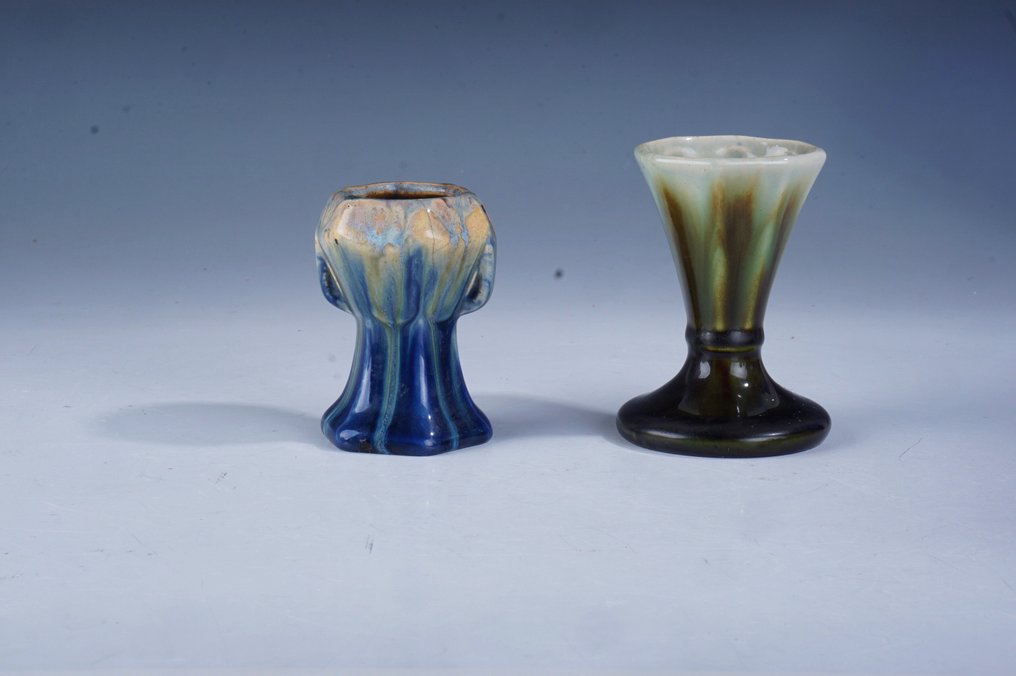
Faienceries de Thulin - Vase - Art Deco decorative vases with polychrome drip glaze - Ceramic


04
days
19
hours
18
minutes
43
seconds
Current bid
€ 5
No reserve price

Expert
Selected by Michel Karis
Art historian with extensive experience working at various auction houses in antiques.
Estimate € 140 - € 210
17 other people are watching this object
 Bidder 2799 Bidder 2799 | €5 | |
|---|---|---|
 Bidder 3500 Bidder 3500 | €4 | |
 Bidder 4095 Bidder 4095 | €3 | |
Catawiki Buyer Protection
Your payment’s safe with us until you receive your object.View details
Trustpilot 4.4 | 122028 reviews
Rated Excellent on Trustpilot.
Art Deco ceramic vases by Faienceries de Thulin, Belgium, in good light-used condition with minor signs of age and small stains.
AI-assisted summary
Description from the seller
Beautiful Art Deco Faience from Thulin, vases with a polychrome drip glaze decoration.
The vases are in good, lightly used condition. Noted on the underside:
1 7.5 x 5 Belgium 200?
2 8.5 x 6 Belgium 180
3 8.5 x 8 Belgium?
4 7 x 7.5 Belgium?
5 8x8?
6 7.5 x 8.5. Belgium 2.5?
The Thulin pottery factory near Bergen was established in 1887, opposite the Saint-Martin church in the city center.
It was installed by industrialist Victor Ducobu-Decaudin in a former sugar refinery. Thanks to significant capital, he transformed the buildings and introduced three coal-fired ovens and a steam engine.
Victor Ducobu died in 1897, and his two children became owners. The company name is Faïencerie de Thulin-A.Ducobu et Cie. It was run by Arthur Decobu until 1918, and after his death, by his sister Victoria Legay-Decobu. She transformed the company into a joint-stock company in 1920.
Upon the death of Victoria Decobu, the company was liquidated; the Société Anonyme des Faïenceries de Thulin followed in 1923. The capital was set at 450,000 francs and then increased to 600,000 francs in 1924.
Between the two world wars, the factory employed 70 to 100 workers. It managed to sell its products in Belgium, but also in Paris, where a reseller, Eugène Val Faubourg Saint Martin, established distribution.
The offered products are numerous: brown ovenproof dinnerware called Tellurite; fancy objects in Art Deco style: vases, planters, jugs, smoking sets, mantels, and various trinkets.
These objects are made by casting fine earthenware and coating them with glazes or colored enamel.
In May 1947, the capital was increased to 3,000,000 francs; the factory was modernized in 1955 by replacing the coal-fired ovens with electric ones. However, competition was fierce in the 1960s, and the financial statements turned negative.
Your package will be carefully packed, sent registered and insured, and delivered right to your door.
Seller's Story
DECO-RATED EU: dealer in art nouveau / art deco / collectables / antiques / religious and decorative items.
Please bookmark our page.
Beautiful Art Deco Faience from Thulin, vases with a polychrome drip glaze decoration.
The vases are in good, lightly used condition. Noted on the underside:
1 7.5 x 5 Belgium 200?
2 8.5 x 6 Belgium 180
3 8.5 x 8 Belgium?
4 7 x 7.5 Belgium?
5 8x8?
6 7.5 x 8.5. Belgium 2.5?
The Thulin pottery factory near Bergen was established in 1887, opposite the Saint-Martin church in the city center.
It was installed by industrialist Victor Ducobu-Decaudin in a former sugar refinery. Thanks to significant capital, he transformed the buildings and introduced three coal-fired ovens and a steam engine.
Victor Ducobu died in 1897, and his two children became owners. The company name is Faïencerie de Thulin-A.Ducobu et Cie. It was run by Arthur Decobu until 1918, and after his death, by his sister Victoria Legay-Decobu. She transformed the company into a joint-stock company in 1920.
Upon the death of Victoria Decobu, the company was liquidated; the Société Anonyme des Faïenceries de Thulin followed in 1923. The capital was set at 450,000 francs and then increased to 600,000 francs in 1924.
Between the two world wars, the factory employed 70 to 100 workers. It managed to sell its products in Belgium, but also in Paris, where a reseller, Eugène Val Faubourg Saint Martin, established distribution.
The offered products are numerous: brown ovenproof dinnerware called Tellurite; fancy objects in Art Deco style: vases, planters, jugs, smoking sets, mantels, and various trinkets.
These objects are made by casting fine earthenware and coating them with glazes or colored enamel.
In May 1947, the capital was increased to 3,000,000 francs; the factory was modernized in 1955 by replacing the coal-fired ovens with electric ones. However, competition was fierce in the 1960s, and the financial statements turned negative.
Your package will be carefully packed, sent registered and insured, and delivered right to your door.
Seller's Story
DECO-RATED EU: dealer in art nouveau / art deco / collectables / antiques / religious and decorative items.
Please bookmark our page.
Details
Era
1900-2000
Country of Origin
Belgium
Model
Art Deco decorative vases with polychrome drip glaze
Material
Ceramic
Style
Art Deco
Manufacturer/ Brand
Faienceries de Thulin
Condition
Good condition - used with small signs of aging & blemishes
Height
7.5 cm
Width
5 cm
Depth
0 cm
Estimated Period
1920-1930
Sold by
