"Tsubo to Nashi" - XL size! - Mabuchi Toru (1920–1994) - Japan (No Reserve Price)


07
days
19
hours
59
minutes
53
seconds
Current bid
€ 75
No reserve price

Expert
Selected by Giovanni Bottero
Holds a master’s in Japanese art history with over 10 years’ expertise in Asian art.
Estimate € 250 - € 350
15 other people are watching this object
 Bidder 8828 Bidder 8828 | €75 | |
|---|---|---|
| Bidder 1195 | €70 | |
| Bidder 8828 | €65 | |
Catawiki Buyer Protection
Your payment’s safe with us until you receive your object.View details
Trustpilot 4.4 | 122028 reviews
Rated Excellent on Trustpilot.
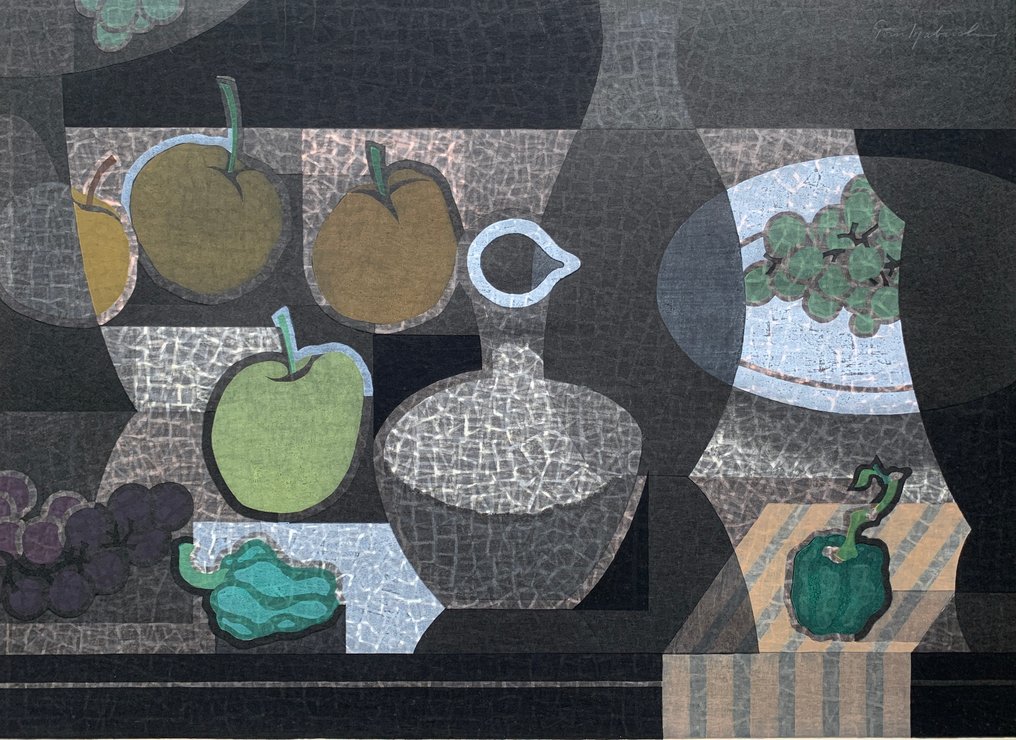
Mabuchi Toru’s 1962 woodcut print titled “Tsubo to Nashi” (XL size), limited edition 50/100, hand signed, depicts an interior scene in a Symbolism style, 407 × 560 mm (full paper 475 × 620 mm), Japan, good condition.
AI-assisted summary
Description from the seller
Artist: Mabuchi Toru (1920–1994)
Titled: "Tsubo to Nashi" - Vase and Pears
Technique: Woodblock print
Japan, 1962
Edition: 50/100
Size within the margin: 407 x 560 mm
Full paper size: 475 x 620 mm
A refined modern still life by Mabuchi Toru, one of Japan’s foremost sōsaku-hanga printmakers active during the postwar period. Executed in 1962, Jar and Pears reveals Mabuchi’s masterful synthesis of Japanese craftsmanship and Western modernism.
The composition, structured through overlapping planes and soft muted tones, reflects a clear cubist influence reminiscent of Georges Braque’s still lifes, yet with a uniquely Japanese sense of quiet balance and material texture. Mabuchi translates Braque’s analytical geometry into a more meditative rhythm—using the tactile grain of wood and layered color blocks to evoke both solidity and serenity.
His use of restrained color harmonies—olive greens, greys, and soft blues—further enhances the sense of stillness and depth. Like Braque, Mabuchi transforms everyday vessels and fruit into abstract forms of timeless beauty, bridging European modernism with the subtle discipline of Japanese design.
Born in Tokyo in 1920, died in 1994.
Studied Western-style painting before turning to woodblock printing.
Active in the sōsaku hanga (creative print) movement, emphasizing the artist's own carving and printing.
Known for his mosaic-like textures, geometric abstraction, and archaeological themes, often inspired by dogū (prehistoric clay figurines) and haniwa (ancient burial sculptures).
Participated in major exhibitions in Japan and abroad during the 1950s–1970s.
His work is included in prominent collections such as:
- The British Museum
- National Museum of Modern Art, Tokyo.
Condition: light mat toning as noted, otherwise good.
This work is framed before.
A fine and scarce example of Mabuchi's exploration of Japan's ancient heritage through a modern artistic lens.
The print will be send between hardboard and carton plates to prevent any damage in transport.
Due to the size, higher transport costs.
Sending nearly worldwide, insured with tracking post.
Artist: Mabuchi Toru (1920–1994)
Titled: "Tsubo to Nashi" - Vase and Pears
Technique: Woodblock print
Japan, 1962
Edition: 50/100
Size within the margin: 407 x 560 mm
Full paper size: 475 x 620 mm
A refined modern still life by Mabuchi Toru, one of Japan’s foremost sōsaku-hanga printmakers active during the postwar period. Executed in 1962, Jar and Pears reveals Mabuchi’s masterful synthesis of Japanese craftsmanship and Western modernism.
The composition, structured through overlapping planes and soft muted tones, reflects a clear cubist influence reminiscent of Georges Braque’s still lifes, yet with a uniquely Japanese sense of quiet balance and material texture. Mabuchi translates Braque’s analytical geometry into a more meditative rhythm—using the tactile grain of wood and layered color blocks to evoke both solidity and serenity.
His use of restrained color harmonies—olive greens, greys, and soft blues—further enhances the sense of stillness and depth. Like Braque, Mabuchi transforms everyday vessels and fruit into abstract forms of timeless beauty, bridging European modernism with the subtle discipline of Japanese design.
Born in Tokyo in 1920, died in 1994.
Studied Western-style painting before turning to woodblock printing.
Active in the sōsaku hanga (creative print) movement, emphasizing the artist's own carving and printing.
Known for his mosaic-like textures, geometric abstraction, and archaeological themes, often inspired by dogū (prehistoric clay figurines) and haniwa (ancient burial sculptures).
Participated in major exhibitions in Japan and abroad during the 1950s–1970s.
His work is included in prominent collections such as:
- The British Museum
- National Museum of Modern Art, Tokyo.
Condition: light mat toning as noted, otherwise good.
This work is framed before.
A fine and scarce example of Mabuchi's exploration of Japan's ancient heritage through a modern artistic lens.
The print will be send between hardboard and carton plates to prevent any damage in transport.
Due to the size, higher transport costs.
Sending nearly worldwide, insured with tracking post.
Details
Artist
Mabuchi Toru (1920–1994)
Sold by
Gallery
Edition
Limited edition
Edition number
50/100
Title of artwork
"Tsubo to Nashi" - XL size!
Technique
Woodcut print
Signature
Hand signed
Country of Origin
Japan
Year
1962
Condition
Good condition
Height
407 mm
Width
560 mm
Depiction/Theme
Interior scene
Style
Symbolism
Period
1960-1970
Sold with frame
No
Sold by
