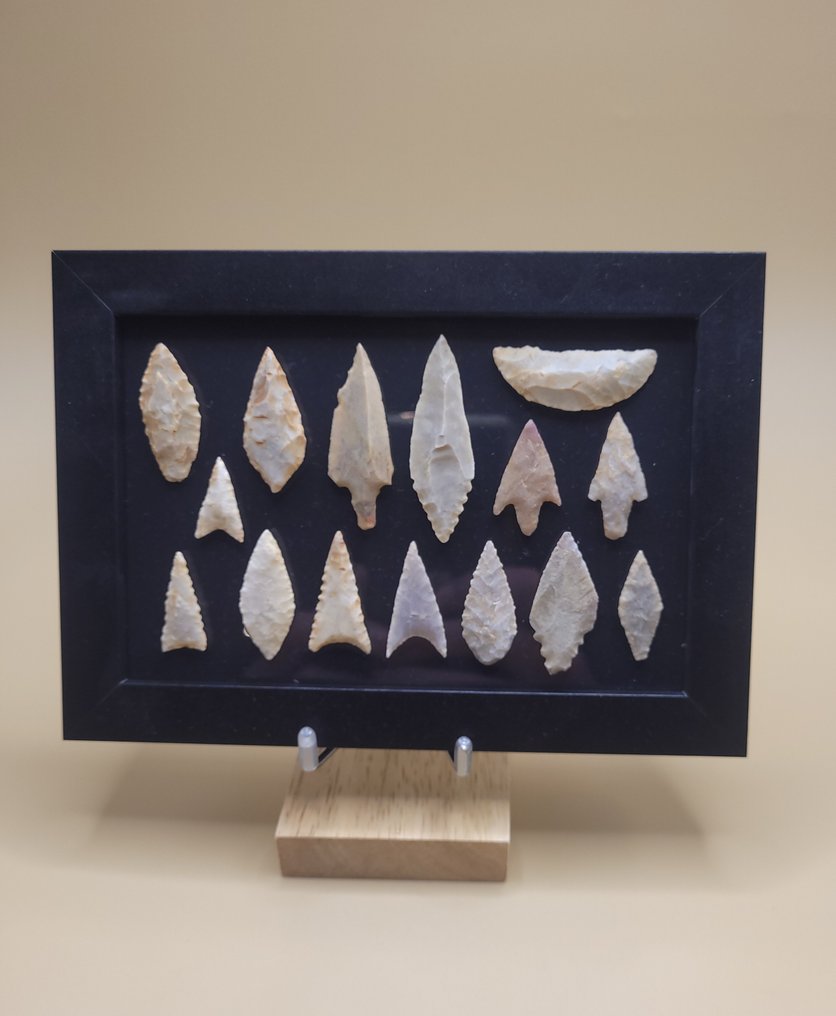
Neolithic Flint Collection of 15 Neolithic arrow points (no reserve price) (No Reserve Price)



01
day
15
hours
45
minutes
36
seconds
Current bid
€ 55
No reserve price

Expert
Selected by Peter Reynaers
Has nearly 30 years’ experience and moderated multiple online art research groups.
Estimate € 210 - € 250
32 other people are watching this object
 Bidder 8676 Bidder 8676 | €55 | |
|---|---|---|
 Bidder 9570 Bidder 9570 | €50 | |
| Bidder 8243 | €45 | |
Catawiki Buyer Protection
Your payment’s safe with us until you receive your object.View details
Trustpilot 4.4 | 121980 reviews
Rated Excellent on Trustpilot.
Collection of 15 Neolithic arrow points in flint and agate, in very good condition, from Néolithique (-5200 to -2500 BC), acquired from a private collection in 2012.
AI-assisted summary
Description from the seller
Collection of 15 Neolithic arrow tips
No reserve price
Material: flint and agate.
Period: -5200; -2500 BC
Dimensions included in the shipment: 17 cm x 12 cm.
Arrow tip dimensions between 5 x 2.
cm
Neolithic arrowheads are a testament to human innovation and hunting prowess. Their design is suitable for both hunting and defense. They symbolize the ability of humans to adapt and thrive in the harsh Neolithic environment.
The sophistication of this ancient tool-making technique sheds light on the prehistoric lifestyles, survival strategies, hunting practices and cultural development of early humans on the African continent.
The definition of the different material cultures is essentially based on the lithic industry, and in particular on the shape of the microliths (for example: points with retouched or unretouched bases, isosceles and scalene triangles, segments of circles, so-called Sauveterre points, etc.). We also find scrapers, burins, and sometimes massive tools similar to axes made of flint. Many raw debitage products are also used. Depending on the region and the period, different sandstones are transformed into elongated or beveled pebbles, prismatic picks or grooved polishers.
The working of hard animal materials involves bones, teeth, and deer antlers. In northern Europe, these are transformed into a wide range of projectile elements. While in France, apart from a few rare harpoons and bone points reported here and there, production is limited to simple beveled or pointed pieces, linked to domestic activities.
Collection of 15 Neolithic arrow tips
No reserve price
Material: flint and agate.
Period: -5200; -2500 BC
Dimensions included in the shipment: 17 cm x 12 cm.
Arrow tip dimensions between 5 x 2.
cm
Neolithic arrowheads are a testament to human innovation and hunting prowess. Their design is suitable for both hunting and defense. They symbolize the ability of humans to adapt and thrive in the harsh Neolithic environment.
The sophistication of this ancient tool-making technique sheds light on the prehistoric lifestyles, survival strategies, hunting practices and cultural development of early humans on the African continent.
The definition of the different material cultures is essentially based on the lithic industry, and in particular on the shape of the microliths (for example: points with retouched or unretouched bases, isosceles and scalene triangles, segments of circles, so-called Sauveterre points, etc.). We also find scrapers, burins, and sometimes massive tools similar to axes made of flint. Many raw debitage products are also used. Depending on the region and the period, different sandstones are transformed into elongated or beveled pebbles, prismatic picks or grooved polishers.
The working of hard animal materials involves bones, teeth, and deer antlers. In northern Europe, these are transformed into a wide range of projectile elements. While in France, apart from a few rare harpoons and bone points reported here and there, production is limited to simple beveled or pointed pieces, linked to domestic activities.
Details
Culture
Neolithic
Century/ Timeframe
Néolithique
Name of object
Collection of 15 Neolithic arrow points (no reserve price)
Acquired from
Private collection
Year acquired
2012
Material
Flint
Country acquired from
France
Condition
Very good
Previous owner acquired from
Private collection
Previous owner - year acquired
1972
Previous owner - country acquired from
France
I verify that I have obtained this object legally and that I am allowed to sell it
Yes
Disclaimer
The seller was informed by Catawiki about documentation requirements and guarantees the following: - the object was legally obtained, - the seller has the right to sell and/or export the object, as relevant, - the seller will provide the necessary provenance information and arrange required documentation and permits/licenses, as applicable and as per local laws, - the seller will notify the buyer of any delays in obtaining permits/licenses. By bidding, you acknowledge that import documentation may be required depending on your country of residence and that obtaining permits/licenses may cause delays in the delivery of your object.
The seller was informed by Catawiki about documentation requirements and guarantees the following: - the object was legally obtained, - the seller has the right to sell and/or export the object, as relevant, - the seller will provide the necessary provenance information and arrange required documentation and permits/licenses, as applicable and as per local laws, - the seller will notify the buyer of any delays in obtaining permits/licenses. By bidding, you acknowledge that import documentation may be required depending on your country of residence and that obtaining permits/licenses may cause delays in the delivery of your object.
