Whale - Fossilised jaw - Basilosaurus - 13 cm (No Reserve Price)


05
days
16
hours
54
minutes
30
seconds
Current bid
€ 2
No reserve price

Expert
Selected by Jonas Rathaj
Has worked with taxidermy since childhood and gained retailer experience.
Estimate € 300 - € 350
3 other people are watching this object
 Bidder 7515 Bidder 7515 | €2 | |
|---|---|---|
 Bidder 2868 Bidder 2868 | €1 |
Catawiki Buyer Protection
Your payment’s safe with us until you receive your object.View details
Trustpilot 4.4 | 121980 reviews
Rated Excellent on Trustpilot.
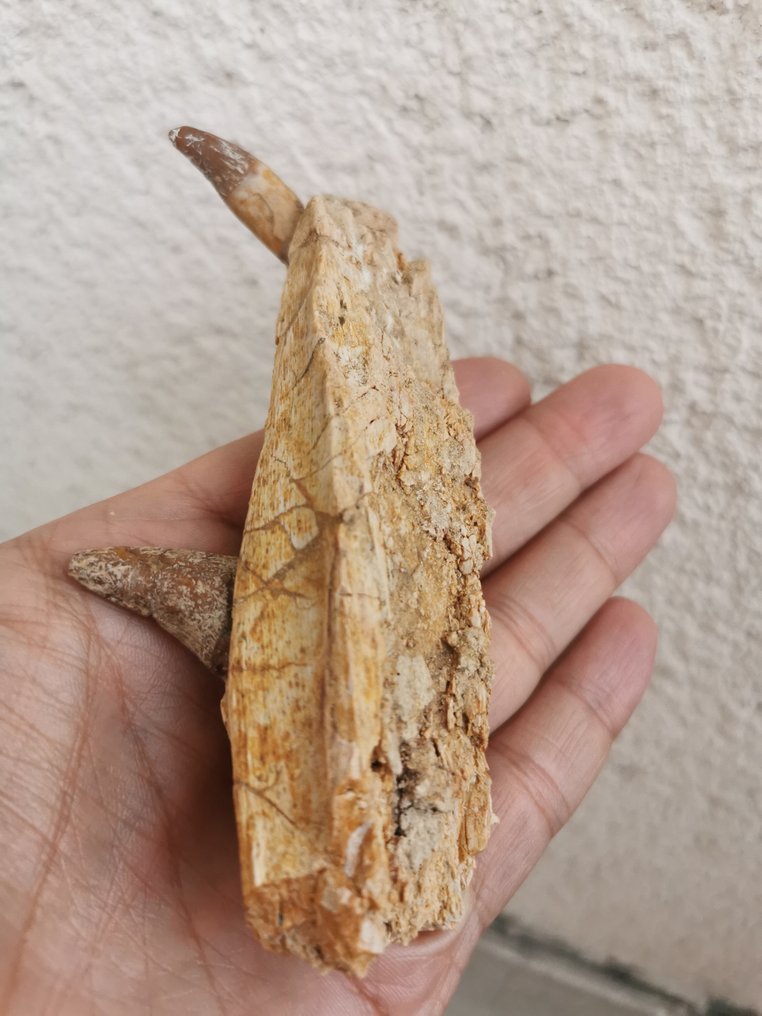
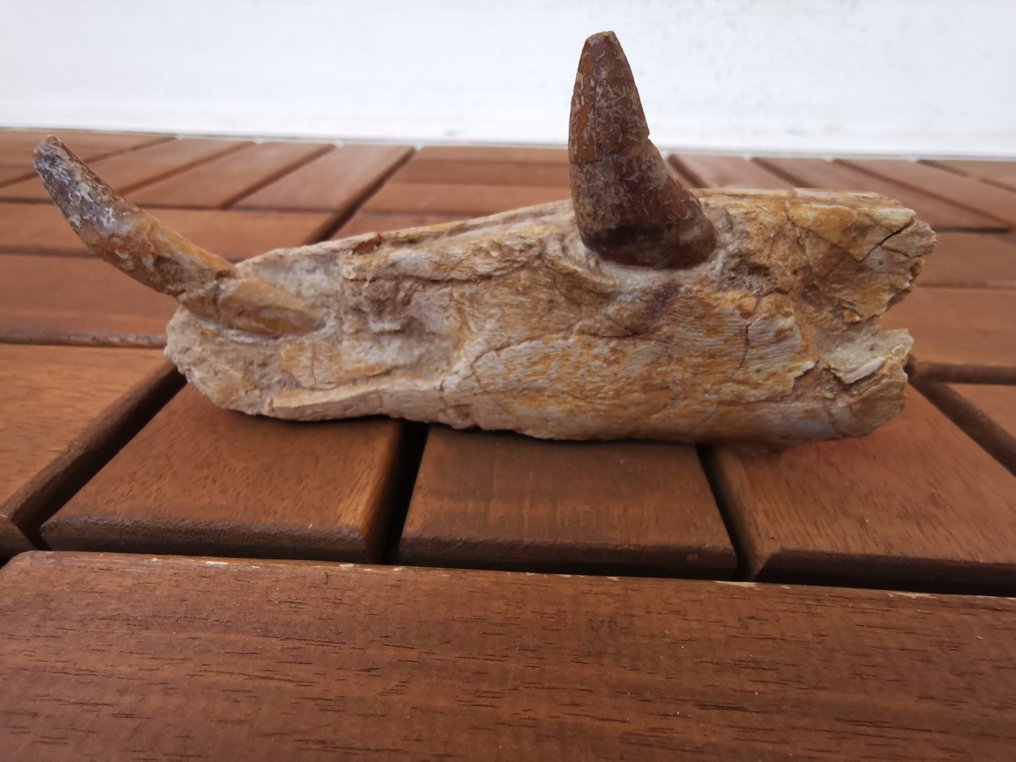
Specimen: Whale; Scientific name: Basilosaurus; front jaw section of Basilosauridae from Morocco, Paleogene Eocene, 13 cm high, Restored and Conserved.
AI-assisted summary
Description from the seller
Basilosauridae family is amazing. Its largest member Basilosaurus was a predatory whale and looked like a giant lizard somewhat resembling mososaurus, yet it was a pure mammal. Alot can be written about this fantastic animal of Late Eocene epoch, approximately 34 to 40 million years ago.
The presented fossil is a beautiful piece of front jaw section of a Basilosauridae. We have two theories as to exactly which member of Basilosauridae family this jaw might belong
Theory-1) This front jaw section belongs to a juvenile Basilosaurus. As adult Basilosaurus jaws are way more bigger with huge teeth so definitely it does not belong to an adult Basilosaurus
Theory-2)This front jaw section belongs to a smaller Basilosauridae lets say Dorudon. It is well known fact that the Dorudons were favourite prey of Basilosaurus as it is proven by fossil findings that Basilosaurus crushed Durodon skulls to deliver fatal bite with its enormous bite force and formidable canines & molars. This brings up another important question and a hypothesis..
Whether the presented partial jaw section belong to Durodon which fell prey to Basilosaurus?. This is an open question...
As Basilosaurus and Durodon jaws are very similar except for the size, therefore its hard to tell and that is why we proposed the above two theories.
The presented jaw section is nevertheless front-most incisors of the Basilosauridae. Again its hard to tell whether its upper jaw or lower jaw. We beleive its lower jaw!!
The incisors were used to deliver the bite & puncture the prey skin and together with canines, the prey was further immobilized and held firmly. The jaws of Basilosauridae was very unique, as it had very special molars as well for ripping away the flesh and breaking bones. Moreover, scientists now beleive that those molars helped in filter feeding as welll. So, all in all, Basilosauridae exhibited features of Baleen whales as well as tooth whale. This makes them one of the most interesting mammal to study.
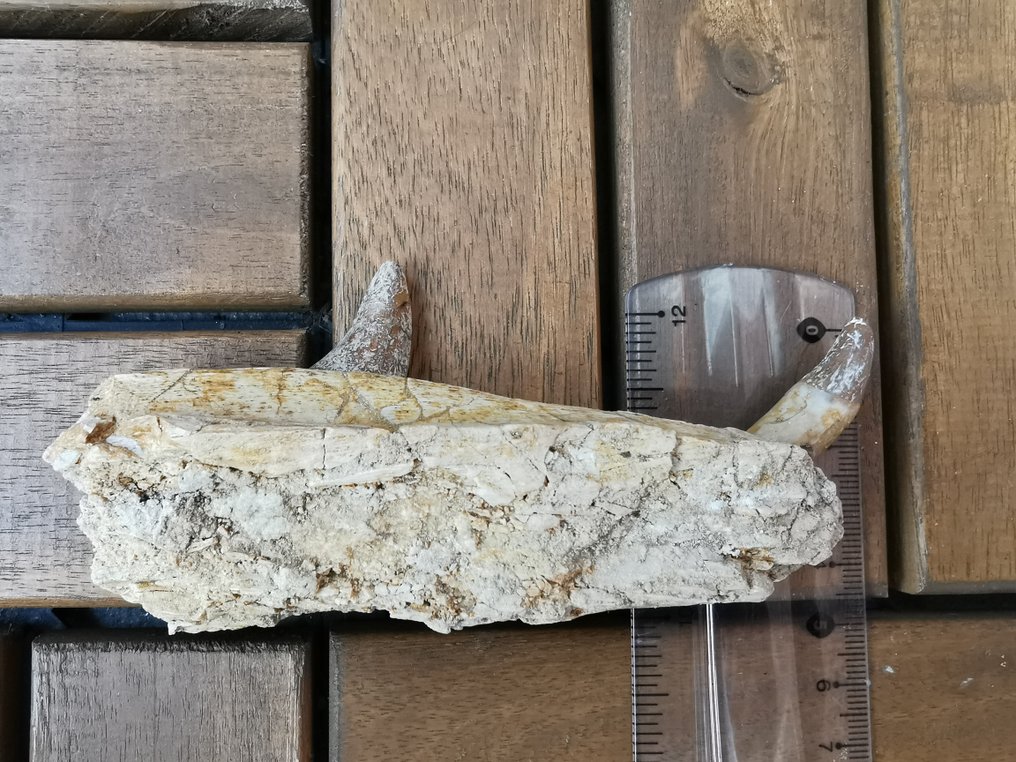
The presented fossil is 13 cm long and features the two characteristic incisors along-with the jaw section and the stunning underside. The frontmost incisor has a very special curvature as well.
The underside is also very beautiful with unique mix fossilization, mineralization and crystallization and very nice colors & structures. Looking close at the outer surface, there are small streamlined impressions on the outer surface possibly belonging to bone structure or may be skin impression although no skin impression have ever been found , so we avoid making such a bold claim with confidence.
Detailed photos have been provided for reference about the color, size, shape and various aspects of this fossil.
Basilosauridae family is amazing. Its largest member Basilosaurus was a predatory whale and looked like a giant lizard somewhat resembling mososaurus, yet it was a pure mammal. Alot can be written about this fantastic animal of Late Eocene epoch, approximately 34 to 40 million years ago.
The presented fossil is a beautiful piece of front jaw section of a Basilosauridae. We have two theories as to exactly which member of Basilosauridae family this jaw might belong
Theory-1) This front jaw section belongs to a juvenile Basilosaurus. As adult Basilosaurus jaws are way more bigger with huge teeth so definitely it does not belong to an adult Basilosaurus
Theory-2)This front jaw section belongs to a smaller Basilosauridae lets say Dorudon. It is well known fact that the Dorudons were favourite prey of Basilosaurus as it is proven by fossil findings that Basilosaurus crushed Durodon skulls to deliver fatal bite with its enormous bite force and formidable canines & molars. This brings up another important question and a hypothesis..
Whether the presented partial jaw section belong to Durodon which fell prey to Basilosaurus?. This is an open question...
As Basilosaurus and Durodon jaws are very similar except for the size, therefore its hard to tell and that is why we proposed the above two theories.
The presented jaw section is nevertheless front-most incisors of the Basilosauridae. Again its hard to tell whether its upper jaw or lower jaw. We beleive its lower jaw!!
The incisors were used to deliver the bite & puncture the prey skin and together with canines, the prey was further immobilized and held firmly. The jaws of Basilosauridae was very unique, as it had very special molars as well for ripping away the flesh and breaking bones. Moreover, scientists now beleive that those molars helped in filter feeding as welll. So, all in all, Basilosauridae exhibited features of Baleen whales as well as tooth whale. This makes them one of the most interesting mammal to study.
The presented fossil is 13 cm long and features the two characteristic incisors along-with the jaw section and the stunning underside. The frontmost incisor has a very special curvature as well.
The underside is also very beautiful with unique mix fossilization, mineralization and crystallization and very nice colors & structures. Looking close at the outer surface, there are small streamlined impressions on the outer surface possibly belonging to bone structure or may be skin impression although no skin impression have ever been found , so we avoid making such a bold claim with confidence.
Detailed photos have been provided for reference about the color, size, shape and various aspects of this fossil.
Details
Number of items
1
Specimen
Whale
Scientific name
Basilosaurus
Country of Origin
Morocco
Geological Period
Paleogene, Eocene (56 - 33.9 million years)
Condition
Restored
Treatment
Conserved
Height
13 cm
Sold by