Bench - Mafrash (tas) - Wool



05
days
21
hours
06
minutes
20
seconds
Starting bid
€ 1
Reserve price not met

Expert
Selected by Richard Ebbers
Certified appraiser at Federation TMV with 30 years' professional antiques experience.
Estimate € 850 - € 950
No bids placed
Catawiki Buyer Protection
Your payment’s safe with us until you receive your object.View details
Trustpilot 4.4 | 121980 reviews
Rated Excellent on Trustpilot.
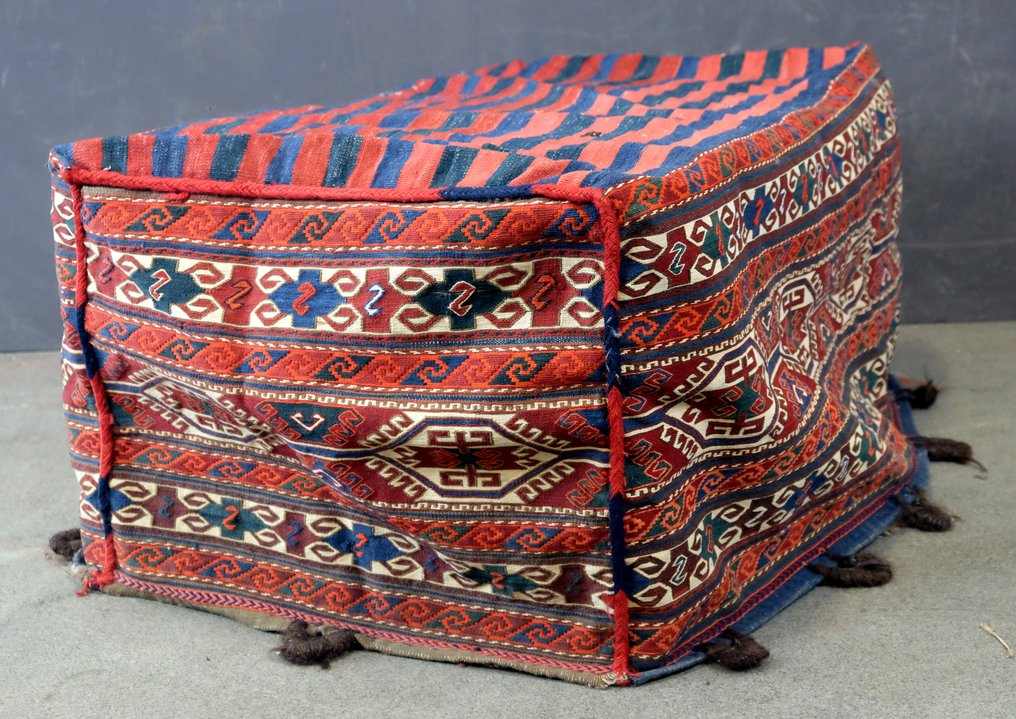
Origin: Azerbaijan; Model: Mafrash (tas); a circa 1850–1900 mafrash made from kelim fabric by Shahsevan nomads, in good condition with small signs of age and minor stains; dimensions 105 x 55 x 45 cm, seating height 45 cm.
AI-assisted summary
Description from the seller
Mafrash of the Shahsevan nomads.
Specially made from kelim fabric that they produced on a primitive loom in the tent.
At the beginning of the 20th century, about 100 years ago, these nomads still roamed.
South Azerbaijan and North Iran with their livestock.
These people lived very autonomously.
The livestock was the foundation of their entire economy.
Women held a socially strong position and made their own carpets, kelims, and soumacks from their own wool, dyed with homemade dyes from plants.
The tradition and the patterns are centuries old.
Mafrassen are made with an open top and a flap that can be secured.
This has an open top that I turned upside down and placed over a box for the display.
You can make a box yourself to use as a bench.
A mafrash was made to serve as a bag for carrying household items when the group moved on.
In the tent, it could be used upside down (as shown in the photo here) to sit on as a bench or pouf.
Made for own use and in a tradition in which these women were proud of their culture and work, which was reflected in the quality.
This mafrash is about 100 years old and still looks very fresh and good.
In very good condition.
Loops that you see on the underside are made of very strong horsehair and are intended to close the Mafrash.
Mafrash of the Shahsevan nomads.
Specially made from kelim fabric that they produced on a primitive loom in the tent.
At the beginning of the 20th century, about 100 years ago, these nomads still roamed.
South Azerbaijan and North Iran with their livestock.
These people lived very autonomously.
The livestock was the foundation of their entire economy.
Women held a socially strong position and made their own carpets, kelims, and soumacks from their own wool, dyed with homemade dyes from plants.
The tradition and the patterns are centuries old.
Mafrassen are made with an open top and a flap that can be secured.
This has an open top that I turned upside down and placed over a box for the display.
You can make a box yourself to use as a bench.
A mafrash was made to serve as a bag for carrying household items when the group moved on.
In the tent, it could be used upside down (as shown in the photo here) to sit on as a bench or pouf.
Made for own use and in a tradition in which these women were proud of their culture and work, which was reflected in the quality.
This mafrash is about 100 years old and still looks very fresh and good.
In very good condition.
Loops that you see on the underside are made of very strong horsehair and are intended to close the Mafrash.
Details
Era
1400-1900
Country of Origin
Azerbaijan
Model
Mafrash (tas)
Material
Wool
Condition
Good condition - used with small signs of aging & blemishes
Height
45 cm
Width
105 cm
Depth
55 cm
Estimated period
1850-1900
Seating Height
45 cm
Sold by