Nicola Grassi (1682-1748), Cerchia di - Fuga in Egitto



01
day
04
hours
36
minutes
31
seconds
Current bid
€ 1,105
Reserve price met

25 other people are watching this object
 Bidder 7379 Bidder 7379 | €1,105 | |
|---|---|---|
| Bidder 7379 | €653 | |
| Bidder 7379 | €553 | |
Catawiki Buyer Protection
Your payment’s safe with us until you receive your object.View details
Trustpilot 4.4 | 122028 reviews
Rated Excellent on Trustpilot.
Description from the seller
Description
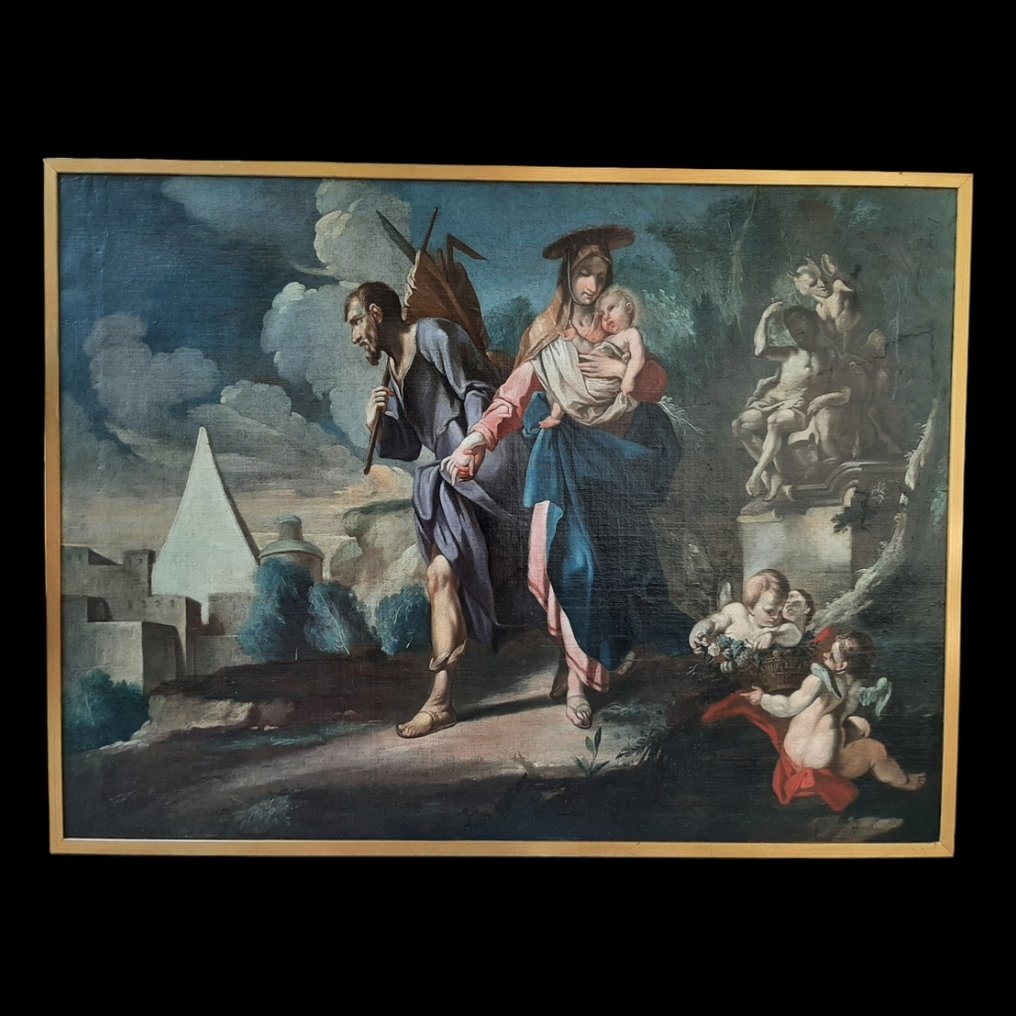
"Fuga in Egitto", oil on canvas, 94*126cm with frame, 89*121cm the canvas alone, circle of Nicola Grassi (1682-1748), datable to the mid-18th century.
At the center of the scene, Joseph holds Mary by the hand, guiding her to the left of the painting, where a pyramid clearly modeled after the Pyramid of Cestius in Rome identifies the landscape as part of the land of Egypt. Mary holds the small Jesus in her arms, slightly turning to the right, her gaze resting on the three winged putti playing among garlands of flowers. On the right, there is the forest and a statue of the god Bacco along with a satyr placed on a high pedestal. These elements are not random or merely decorative but are part of a more complex figurative metaphor. Joseph, Mary, and the little Jesus can be identified with the people of Christ on their journey; the flight into Egypt symbolizes the many necessary stages of the path that will lead to the affirmation of God's word. The dense, dark thicket together with the statue of Bacco represent superstition and paganism, which Joseph and Mary leave behind—an allegory of humanity that, by following the path of faith, abandons the old and false pagan gods.
The composition is rich in elements, refined and balanced overall. The visual fulcrum is the clasped hands of Joseph and Mary, placed almost perfectly at the intersection of the painting's diagonals. The organization of space and volume is well-considered, with a movement from the right, with the density of the forest, the statue of Bacchus, and the group of cherubs, moving toward the left, following Joseph's progress, encountering the more open spaces and more sparse volumes of the city and the sky above. The construction of the Holy Family group is remarkable: Joseph and Mary hold hands, but each with their own movement and figurative autonomy, which enhance the dynamism and organic harmony of the group itself. The anonymous artist clearly belongs to Nicola Grassi's circle; the master's influence is visible in the light and delicate chromaticism, yet accompanied by strong chiaroscuro contrasts, as well as in a certain lyricism that pervades the work. note that Grassi absorbed in his maturity when he began to approach the models of Giambattista Pittoni.
A painting of beautiful and refined composition, remarkable for its construction and pictorial skill. The refined aesthetic and ornamental impact is further enhanced by the painting's generous dimensions.
REFERENCE SCHOOL
Nicola Grassi (1682-1748) was a Venetian painter. Born in Friuli, he moved to Venice and trained there, where he became a key figure of the 18th century. He carried out most of his artistic activity in the lagoon. His early style was profoundly influenced by Giambattista Piazzetta, and for this reason he used strong chiaroscuro to create a dramatic atmosphere. Later, his painting style evolved, becoming more luminous and delicate, in line with the Rococo style.
This evolution was the result of the influence of masters such as Sebastiano Ricci and Giambattista Pittoni. His rich, textured brushwork was often described as "foamy" for its ability to create striking effects of light and movement. Grassi excelled in religious and genre scenes, leaving a legacy that combined Baroque solemnity with Rococo grace. His most important commissions include fresco cycles and altarpieces in churches in Friuli and Veneto, such as the altarpiece with the Madonna del Carmine in the church of Santa Maria di Castello in Udine and the works for the church of Santa Maria a Formeaso.
Condition Report
The overall condition is excellent, the work is intact throughout, with vivid, clearly legible colors. Before being put up for auction, the painting underwent a thorough cleaning and conservative restoration, including the replacement of the old, now completely damaged stretcher (see photo of the back). The frame is complimentary.
Tracked and insured shipment with adequate packaging.
Description
"Fuga in Egitto", oil on canvas, 94*126cm with frame, 89*121cm the canvas alone, circle of Nicola Grassi (1682-1748), datable to the mid-18th century.
At the center of the scene, Joseph holds Mary by the hand, guiding her to the left of the painting, where a pyramid clearly modeled after the Pyramid of Cestius in Rome identifies the landscape as part of the land of Egypt. Mary holds the small Jesus in her arms, slightly turning to the right, her gaze resting on the three winged putti playing among garlands of flowers. On the right, there is the forest and a statue of the god Bacco along with a satyr placed on a high pedestal. These elements are not random or merely decorative but are part of a more complex figurative metaphor. Joseph, Mary, and the little Jesus can be identified with the people of Christ on their journey; the flight into Egypt symbolizes the many necessary stages of the path that will lead to the affirmation of God's word. The dense, dark thicket together with the statue of Bacco represent superstition and paganism, which Joseph and Mary leave behind—an allegory of humanity that, by following the path of faith, abandons the old and false pagan gods.
The composition is rich in elements, refined and balanced overall. The visual fulcrum is the clasped hands of Joseph and Mary, placed almost perfectly at the intersection of the painting's diagonals. The organization of space and volume is well-considered, with a movement from the right, with the density of the forest, the statue of Bacchus, and the group of cherubs, moving toward the left, following Joseph's progress, encountering the more open spaces and more sparse volumes of the city and the sky above. The construction of the Holy Family group is remarkable: Joseph and Mary hold hands, but each with their own movement and figurative autonomy, which enhance the dynamism and organic harmony of the group itself. The anonymous artist clearly belongs to Nicola Grassi's circle; the master's influence is visible in the light and delicate chromaticism, yet accompanied by strong chiaroscuro contrasts, as well as in a certain lyricism that pervades the work. note that Grassi absorbed in his maturity when he began to approach the models of Giambattista Pittoni.
A painting of beautiful and refined composition, remarkable for its construction and pictorial skill. The refined aesthetic and ornamental impact is further enhanced by the painting's generous dimensions.
REFERENCE SCHOOL
Nicola Grassi (1682-1748) was a Venetian painter. Born in Friuli, he moved to Venice and trained there, where he became a key figure of the 18th century. He carried out most of his artistic activity in the lagoon. His early style was profoundly influenced by Giambattista Piazzetta, and for this reason he used strong chiaroscuro to create a dramatic atmosphere. Later, his painting style evolved, becoming more luminous and delicate, in line with the Rococo style.
This evolution was the result of the influence of masters such as Sebastiano Ricci and Giambattista Pittoni. His rich, textured brushwork was often described as "foamy" for its ability to create striking effects of light and movement. Grassi excelled in religious and genre scenes, leaving a legacy that combined Baroque solemnity with Rococo grace. His most important commissions include fresco cycles and altarpieces in churches in Friuli and Veneto, such as the altarpiece with the Madonna del Carmine in the church of Santa Maria di Castello in Udine and the works for the church of Santa Maria a Formeaso.
Condition Report
The overall condition is excellent, the work is intact throughout, with vivid, clearly legible colors. Before being put up for auction, the painting underwent a thorough cleaning and conservative restoration, including the replacement of the old, now completely damaged stretcher (see photo of the back). The frame is complimentary.
Tracked and insured shipment with adequate packaging.
Details
Artist
Nicola Grassi (1682-1748), Cerchia di
Sold with frame
Yes
Title of artwork
Fuga in Egitto
Technique
Oil painting
Signature
Not signed
Country of Origin
Italy
Condition
Excellent condition
Height
94 cm
Width
126 cm
Style
Rococo
Period
18th century
Sold by
