Titus Lucretius Carus - De rerum natura - 1631



01
day
09
hours
25
minutes
57
seconds
Current bid
€ 150
Reserve price not met

Expert
Selected by Volker Riepenhausen
Specialist in travel literature and pre-1600 rare prints with 28 years experience.
Estimate € 190 - € 350
17 other people are watching this object
 Bidder 2341 Bidder 2341 | €150 | |
|---|---|---|
| Bidder 2341 | €140 | |
 Bidder 9423 Bidder 9423 | €130 | |
Catawiki Buyer Protection
Your payment’s safe with us until you receive your object.View details
Trustpilot 4.4 | 121980 reviews
Rated Excellent on Trustpilot.
De rerum natura by Titus Lucretius Carus.
AI-assisted summary
Description from the seller
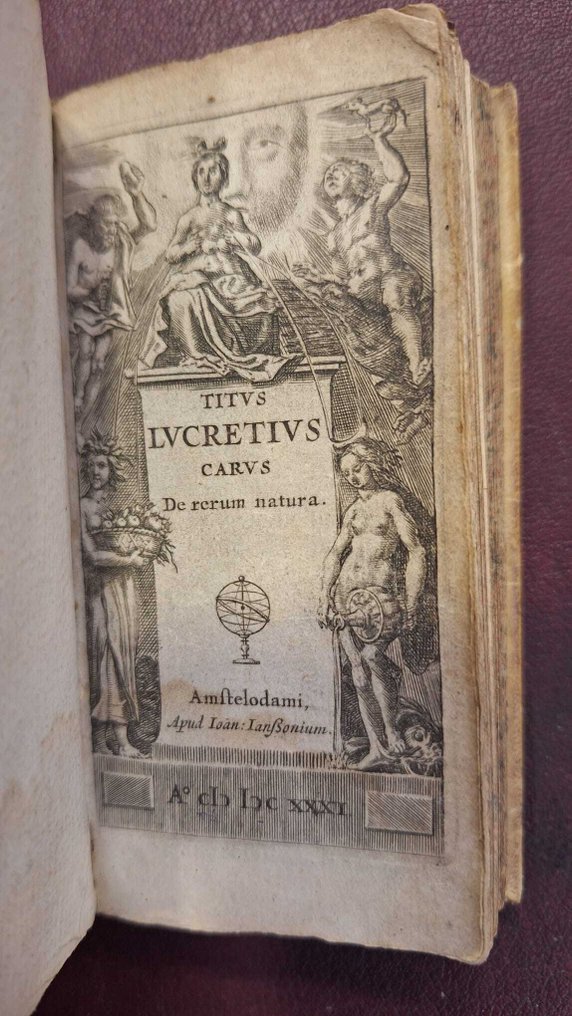
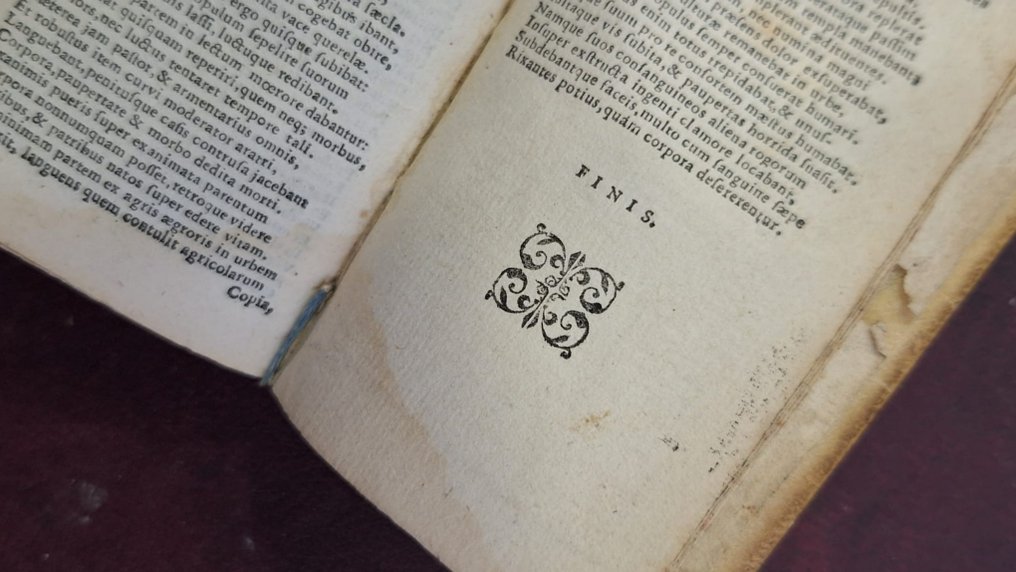
Titus Lucretius Carus. De Rerum Natura. Amsterdam, published by Johannes Janssonius, 1631. in 32° (approximately 6 x 11 inches), pp. 165 pages. Contemporary binding in full soft parchment. Rare and in better-than-good condition. The edition is situated within the peak of Dutch publishing, characterized by the production of small-format volumes (duodecimo or sixteenth). These books were extremely popular among scholars, merchants, and European travelers because they were portable, affordable (compared to large folios), and printed with clear, clean type. Johannes Janssonius was one of the leading printers, cartographers, and publishers in Amsterdam, known for his competition with the famous Elzevir family. While the Elzevirs dominated the market for pocket editions, Janssonius also produced high-quality humanist editions, often using very fine copper engravings for the title pages, as seen in this book. The illustrated title page of the booklet is a distinctive feature of high-quality Dutch editions of the seventeenth century. The allegorical engraved scene depicts: Probably a personification of Nature or Venus, central figures in the proem and in Lucretius's philosophy, as they are the motors of the world.
The armillary sphere (visible below the title) is a symbol of astronomy and cosmology, disciplines crucial to Lucretius's work (De rerum natura).
Lucretius's poem, which expounds Epicurus's atomistic philosophy and rejects the fear of gods and death, was a central text for humanism, emerging science, and the most advanced intellectual circles. Janssonius's edition aimed therefore at an educated readership interested in rediscovering classical philosophy and its implications for science.
Titus Lucretius Carus. De Rerum Natura. Amsterdam, published by Johannes Janssonius, 1631. in 32° (approximately 6 x 11 inches), pp. 165 pages. Contemporary binding in full soft parchment. Rare and in better-than-good condition. The edition is situated within the peak of Dutch publishing, characterized by the production of small-format volumes (duodecimo or sixteenth). These books were extremely popular among scholars, merchants, and European travelers because they were portable, affordable (compared to large folios), and printed with clear, clean type. Johannes Janssonius was one of the leading printers, cartographers, and publishers in Amsterdam, known for his competition with the famous Elzevir family. While the Elzevirs dominated the market for pocket editions, Janssonius also produced high-quality humanist editions, often using very fine copper engravings for the title pages, as seen in this book. The illustrated title page of the booklet is a distinctive feature of high-quality Dutch editions of the seventeenth century. The allegorical engraved scene depicts: Probably a personification of Nature or Venus, central figures in the proem and in Lucretius's philosophy, as they are the motors of the world.
The armillary sphere (visible below the title) is a symbol of astronomy and cosmology, disciplines crucial to Lucretius's work (De rerum natura).
Lucretius's poem, which expounds Epicurus's atomistic philosophy and rejects the fear of gods and death, was a central text for humanism, emerging science, and the most advanced intellectual circles. Janssonius's edition aimed therefore at an educated readership interested in rediscovering classical philosophy and its implications for science.
Details
Number of Books
1
Subject
Literature, Philosophy
Book Title
De rerum natura
Author/ Illustrator
Titus Lucretius Carus
Condition
Very good
Publication year oldest item
1631
Height
11 cm
Edition
1st Edition Thus
Width
6 cm
Language
Latin
Original language
Yes
Publisher
Amstelodami, Apud Ioan. Janssonium
Binding/ Material
Vellum
Number of pages
165
Sold by
