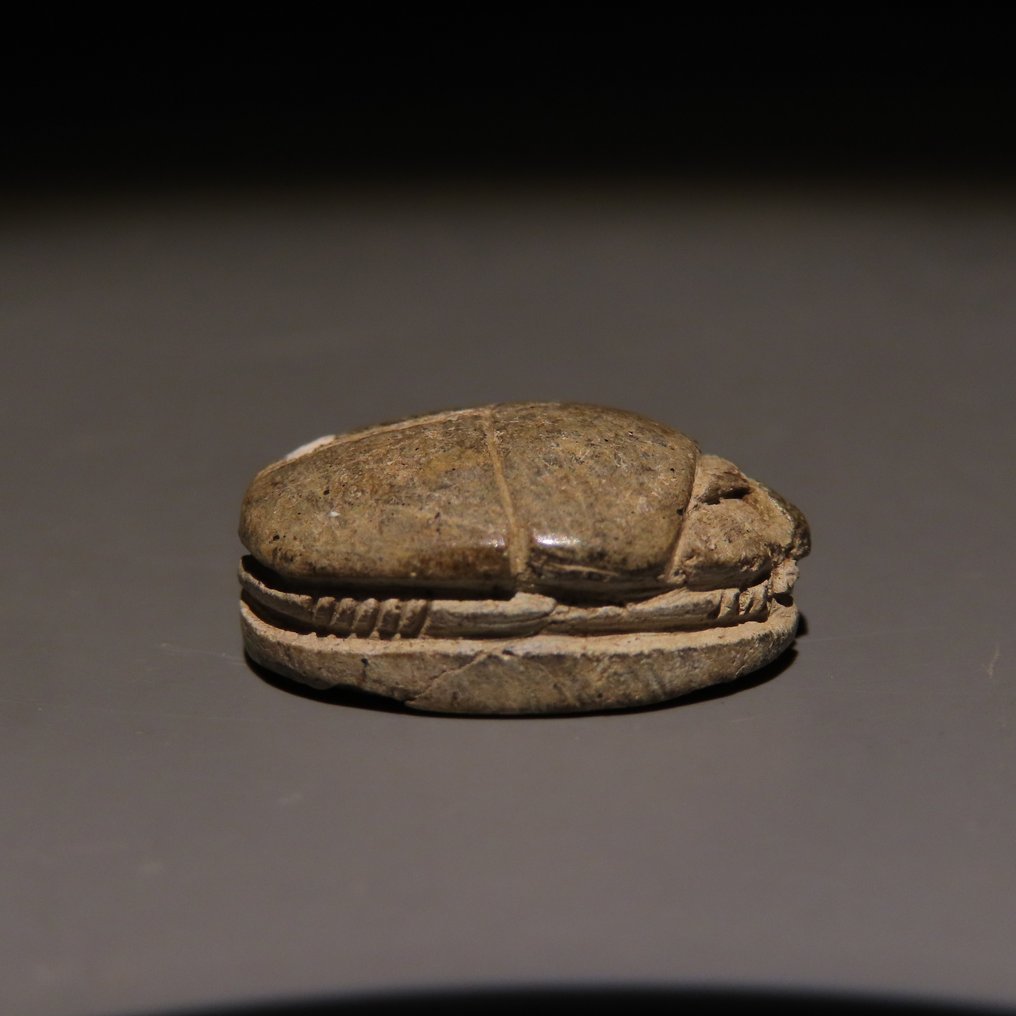
Ancient Egyptian Steatite Scarab. Hyksos Period, 1782-1570 BC. 2.2 cm length.


12
days
08
hours
57
minutes
11
seconds
Current bid
€ 14
Reserve price not met

Expert
Selected by Ruth Garrido Vila
Directed the Ifergan Collection Museum, specialising in Phoenician and Mediterranean archaeology.
Estimate € 450 - € 550
10 other people are watching this object
 Bidder 4698 Bidder 4698 | €14 |
|---|
Catawiki Buyer Protection
Your payment’s safe with us until you receive your object.View details
Trustpilot 4.4 | 122053 reviews
Rated Excellent on Trustpilot.
Ancient Egyptian heart scarab amulet, Hyksos Period (1782–1570 BC), steatite, 2.2 cm long, in good condition; provenance Private collection, Paris, France, acquired before 1970, acquired from auction house; includes authenticity certificate and Spanish export license.
AI-assisted summary
Description from the seller
Scarab.
Ancient Egypt, Hyksos Period, 1782-1570 BC.
Steatite.
2.2 cm length.
Condition: Good condition.
Provenance: Private collection, Paris, France. Acquired before 1970.
Description:
The heart scarab is an oval, scarab artifact dating from ancient Egypt. Mostly an amulet, it was also used as jewelry, a memorializing artifact, or a grave good. The heart scarab was used by referring to Chapter 30 from the Book of the Dead and the weighing of the heart, being balanced by Maat, goddess of truth, justice, order, wisdom, and cosmic balance. The function of the heart scarab was to bind the heart to silence while it was being weighed in the underworld to ensure that the heart did not bear false witness against the deceased. As in many current religions, the individual had to show 'worthiness' to achieve the afterlife. The heart was extremely important to ancient Egyptians as the seat of intelligence and the storehouse of memory. It was the only organ left in place during mummification. Heart scarab amulets were meant as substitutes for the heart should the deceased be deprived of the organ in the afterlife. For example, when a person died, a heart scarab was often placed on their heart and bound underneath the bandages of the mummy. This was to ensure that it could not be physically removed from their person.
The significance of the heart scarab to the ancient Egyptians also stems from the religious importance of the scarab beetle, Scarabaeus sacer. The scarab beetle represented rebirth and creation. As the beetle larvae grow, they eat their way out of the balls of dung where they were laid and emerge. The Egyptians saw this as the beetles emerging from nothingness into new life, which aligns with their beliefs in an afterlife and rebirth.
The amulets are described in the Book of the Dead to be made (per Andrews, Amulets of Ancient Egypt) of a stone: nmhf, nemehef (not now identified); typically green stones, green jasper, serpentine, and basalt. Andrews continues to say they are in fact made from: green or dark-green materials, such as glazed steatite, schist, feldspar, hematite and obsidian; also blue-glazed composition (faience), Egyptian blue, rock crystal, alabaster or red jasper. Instead of the head of a scarab, heart scarabs had the head of a human and were often inscribed with chapter 30B of the Book of Going Forth by Day. Heart scarabs were also used in the design of pectorals, which were a rectangular chest ornament.
The alternate heart amulet itself represents similar ideas, but is made in the form of the heart as used by the Egyptian language hieroglyph.
Notes:
The piece includes authenticity certificate.
The piece includes Spanish Export License.
Seller's Story
Gallery of Ancient Art - Archeology based in Barcelona with more than fifteen years of experience. Specialized in classical art, Egyptian art, Asian art and pre-Columbian art. It guarantees the authenticity of all its pieces. It participates in the most important art fairs in Spain, such as Feriarte, as well as in fairs abroad, BRAFA, Parcours des Mondes, Cultures Brussels.
All the pieces are sent with an Export Permit issued by the Spanish Ministry of Culture.
We are quick to ship via DHL Express or Direct Art Transport.
Translated by Google TranslateScarab.
Ancient Egypt, Hyksos Period, 1782-1570 BC.
Steatite.
2.2 cm length.
Condition: Good condition.
Provenance: Private collection, Paris, France. Acquired before 1970.
Description:
The heart scarab is an oval, scarab artifact dating from ancient Egypt. Mostly an amulet, it was also used as jewelry, a memorializing artifact, or a grave good. The heart scarab was used by referring to Chapter 30 from the Book of the Dead and the weighing of the heart, being balanced by Maat, goddess of truth, justice, order, wisdom, and cosmic balance. The function of the heart scarab was to bind the heart to silence while it was being weighed in the underworld to ensure that the heart did not bear false witness against the deceased. As in many current religions, the individual had to show 'worthiness' to achieve the afterlife. The heart was extremely important to ancient Egyptians as the seat of intelligence and the storehouse of memory. It was the only organ left in place during mummification. Heart scarab amulets were meant as substitutes for the heart should the deceased be deprived of the organ in the afterlife. For example, when a person died, a heart scarab was often placed on their heart and bound underneath the bandages of the mummy. This was to ensure that it could not be physically removed from their person.
The significance of the heart scarab to the ancient Egyptians also stems from the religious importance of the scarab beetle, Scarabaeus sacer. The scarab beetle represented rebirth and creation. As the beetle larvae grow, they eat their way out of the balls of dung where they were laid and emerge. The Egyptians saw this as the beetles emerging from nothingness into new life, which aligns with their beliefs in an afterlife and rebirth.
The amulets are described in the Book of the Dead to be made (per Andrews, Amulets of Ancient Egypt) of a stone: nmhf, nemehef (not now identified); typically green stones, green jasper, serpentine, and basalt. Andrews continues to say they are in fact made from: green or dark-green materials, such as glazed steatite, schist, feldspar, hematite and obsidian; also blue-glazed composition (faience), Egyptian blue, rock crystal, alabaster or red jasper. Instead of the head of a scarab, heart scarabs had the head of a human and were often inscribed with chapter 30B of the Book of Going Forth by Day. Heart scarabs were also used in the design of pectorals, which were a rectangular chest ornament.
The alternate heart amulet itself represents similar ideas, but is made in the form of the heart as used by the Egyptian language hieroglyph.
Notes:
The piece includes authenticity certificate.
The piece includes Spanish Export License.
Seller's Story
Gallery of Ancient Art - Archeology based in Barcelona with more than fifteen years of experience. Specialized in classical art, Egyptian art, Asian art and pre-Columbian art. It guarantees the authenticity of all its pieces. It participates in the most important art fairs in Spain, such as Feriarte, as well as in fairs abroad, BRAFA, Parcours des Mondes, Cultures Brussels.
All the pieces are sent with an Export Permit issued by the Spanish Ministry of Culture.
We are quick to ship via DHL Express or Direct Art Transport.
Translated by Google TranslateDetails
Culture
Ancient Egyptian
Century/ Timeframe
Hyksos Period, 1782 - 1570 BC.
Name of object
Scarab. Hyksos Period, 1782-1570 BC. 2.2 cm length.
Acquired from
Auction house
Year acquired
2025
Material
Steatite
Country acquired from
France
Condition
Good
Previous owner acquired from
Private collection
Previous owner - year acquired
1970
Previous owner - country acquired from
France
I verify that I have obtained this object legally and that I am allowed to sell it
Yes
Disclaimer
The seller was informed by Catawiki about documentation requirements and guarantees the following: - the object was legally obtained, - the seller has the right to sell and/or export the object, as relevant, - the seller will provide the necessary provenance information and arrange required documentation and permits/licenses, as applicable and as per local laws, - the seller will notify the buyer of any delays in obtaining permits/licenses. By bidding, you acknowledge that import documentation may be required depending on your country of residence and that obtaining permits/licenses may cause delays in the delivery of your object.
The seller was informed by Catawiki about documentation requirements and guarantees the following: - the object was legally obtained, - the seller has the right to sell and/or export the object, as relevant, - the seller will provide the necessary provenance information and arrange required documentation and permits/licenses, as applicable and as per local laws, - the seller will notify the buyer of any delays in obtaining permits/licenses. By bidding, you acknowledge that import documentation may be required depending on your country of residence and that obtaining permits/licenses may cause delays in the delivery of your object.
