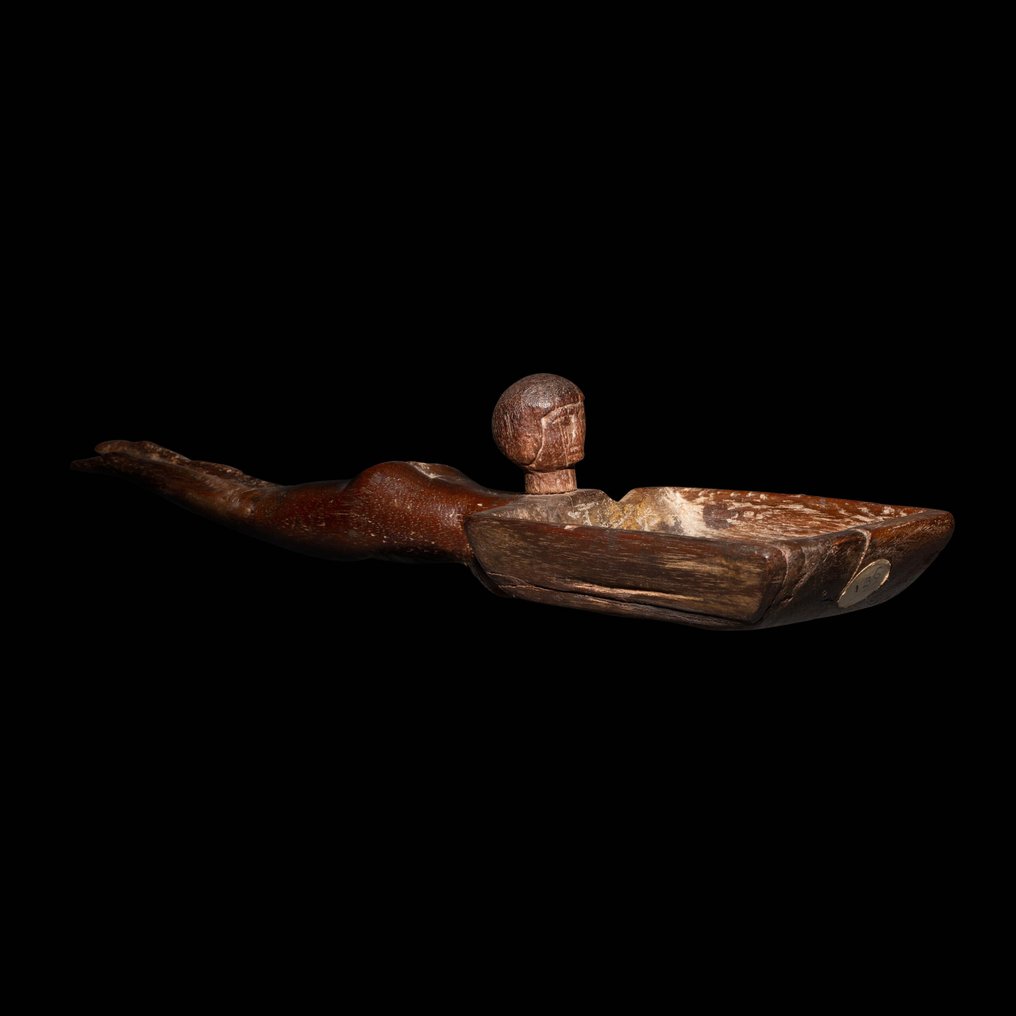
Ancient Egyptian Wood Spoon with a swimmer. New Kingdom, 1550 - 1069 BC. 27 cm length.


14
days
03
hours
35
minutes
47
seconds
Starting bid
€ 1
Reserve price not met

Expert
Selected by Ruth Garrido Vila
Directed the Ifergan Collection Museum, specialising in Phoenician and Mediterranean archaeology.
Estimate € 44,000 - € 49,000
No bids placed
Catawiki Buyer Protection
Your payment’s safe with us until you receive your object.View details
Trustpilot 4.4 | 122028 reviews
Rated Excellent on Trustpilot.
Ancient Egyptian wooden spoon with a swimmer from the New Kingdom (c. 1550–1069 BC), 27 cm long, in good condition with two tears restored, acquired from a private collection in Normandy, France.
AI-assisted summary
Description from the seller
Spoon with a swimmer.
Ancient Egypt, New Kingdom, 1550 - 1069 BC.
Wood.
27 cm length.
CONDITION: Good condition, with two lines of tears in the area of the spoon, restored, and on the lower part of the right-hand edge.
PROVENANCE: Private collection, Normandy, France. Old label with the number 136 on the lower front.
DESCRIPTION:
Wooden carved spoon of the so-called swimmer's type, with a large rectangular well with a hollowed-out bottom and handle that takes the form of the rounded figure of a naked young woman, both parts carved from the same piece of wood. The girl is shown with her body fully extended, her legs straight and together and her arms stretched out in front of her to hold the bowl, in a position that could be identified as an offerer. The head is carved separately and applied, as is usual within the typology. The arms, as they are below the bowl of the spoon, are carved in relief rather than in rounded relief. The face of the figure has been considerably eroded, but the main features can still be seen. The eyes are worked in relief and are almond-shaped and elongated, typical of this type of representation. The eyebrows form two soft arches, also highlighted in relief, and the mouth is straight, expressionless, with full lips. The nose has been completely lost.
The modelling of the figure is notable for its elegant slenderness, with stylised yet soft and delicate forms. The artist has also managed to give the figure a certain naturalistic movement by slightly separating her legs from the calves. The treatment of the anatomy is synthetic, but includes details such as the trepanned navel and the delicate folds at the junction of the back and buttocks. The sexual features are clearly emphasised: the breasts are bulging, with small nipples carved in relief, and the sex is depicted as an excavated triangle. The arms are notably disproportionate, as they extend across the entire length of the bowl. The hands are depicted flat, with the thumbs facing outwards. Comparison with similar pieces (fig. 1) suggests that this spoon was probably originally decorated with polychrome.
The head stands out in the composition, arranged vertically in a position that moves away from naturalism in favour of a correct overall view, so that the young woman's face is always visible. Within the group formed by these swimmers' spoons, the position of the head is always similar, although on occasions the bowl is moved away from the figure's shoulders in order to raise her head in a more naturalistic manner (fig. 2). The girl wears a short, rounded, layered wig with fringes, known as a Nubian wig. It was worn by young women of the 18th Dynasty, and appears frequently in all types of depictions of the period, including pieces similar to the spoon under study (fig. 3). It can also be found in the images of young women on the Amarna reliefs, as well as in a depiction of Princess Sitamen, daughter of Amenhotep III, placed on the back of her chair.
Swimmer's spoons appear in the early 18th Dynasty, with the beginning of the New Empire; the earliest surviving example dates from the reign of Akhenaten, although the model probably dates even earlier. It remained in use for centuries, reaching into the early Christian period. There are also some surviving examples from the Sudan from the Napatean period (ca. 700-300 BC). It was a model that spread eastwards across the Mediterranean, as evidenced by a spoon of this type found in Cyprus, which is very close to Egyptian models (fig. 4). Generally polychrome, either by the application of paint or by the combination of materials, these pieces are made of wood, ivory, stone or even faience (fig. 5).
The girl who forms the handle, known generically as the swimmer, may have Egyptian or Nubian features, wears a wig and is always nude, although occasionally she is adorned with a necklace or a sash or belt. The pose is always identical, with her legs together and outstretched, her feet also outstretched and her arms facing forward, holding a bowl which may be rectangular, oval or cartridge-shaped, although on numerous occasions it will take the form of a water bird, often with the wings forming a lid. Other, rarer examples depict aquatic plants, fish or even an antelope (fig. 6). The spoons with simple bowls could be interpreted as depicting women carrying offerings. Among the second group, the most numerous are those in which the bowl takes the form of a duck or goose; in this case, the position of the arms suggests that the girl would not be swimming, but would be dragged over the water by the bird.
Traditionally these pieces were interpreted as cosmetic spoons, but as early as the 1960s Ingrid Wallert defined their use as ritual; they would have been used as ladles for libations or offerings or, in the case of those with lids, as containers for small quantities of myrrh or wine to be offered to the gods. They may also have been used to offer the deceased a type of secret ointment made in the temples, which ensured resurrection in the other world. This ritual interpretation is based both on texts and graphic representations and on the fact that most of them have been found in tombs, and not only of women, but also of men and children. Some fragments of these tools have also been found in houses and palaces, but none intact. This theory is also supported by the excellent state of preservation in which they have survived to the present day, despite being particularly fragile objects.
The fact that the swimmers' spoons belong to the sacred sphere, both in temples and in funerary contexts, is also supported by the ritual interpretation of the motifs. The formula in which the swimmer is carried by a goose (fig. 7), the most widespread, can be read as a hieroglyphic text alluding directly to the Beyond, since the hieroglyph of the goose can be read literally as the name of Geb, the god of the Earth. The girl would then be identified with his wife, Nut, the goddess of heaven, being carried by her husband across the eternal waters of the other world. Other such spoons have been associated with Hathor, the celestial deity and mother of the pharaohs, as well as a psychopomp goddess and therefore closely linked to funerary rituals. In the case of a spoon preserved in Moscow (fig. 8), a schematic representation of the god Bes, associated with music and dance, appears on the thigh of the young woman, sometimes tattooed on the thighs of musicians and dancers, possibly as a way of invoking his protection. On the other hand, the figure of the girl was in Egypt an emblem of youth and fertility, of vital energy, aspects of particular importance in the funerary sphere.
BIBLIOGRAPHY:
- FREED, R. Egypt’s Golden Age: The Art of Living in the New Kingdom. 1558-1085 B.C. Boston Museum of Fine Arts. 1982.
- GRAJETZKI, W. Burial Customs in Ancient Egypt: Life and Death for the Rich and Poor. Bristol Classical Press. 2003.
- HAYES, W.C. The Scepter of Egypt II: The Hyksos Period and the New Kingdom (1675-1080 B.C.). The Metropolitan Museum of Art. 1968.
- LACOVARA, P. “A Swimming Girl Spoon from Sheikh Farag”, en Up and Down The Nile – ägyptologische Studien für Regine Schulz. Zaphon. 2021.
- LOBSTEIN, D. “Objets de toilette ou objets de culte? A propos des cuillers ‘à la nageuse’”, en Revue du Louvre et des Musées de France, 34 (4). 1984. 235-237.
- ROBINS, G. The Art of Ancient Egypt. Harvard University Press. 2008.
- WALLERT, I. “Der verzierte Löffel: seine Formgeschichte und Verwendung im alten Ägypten”, en Ägyptologische Abhandlungen 16. 1967.
PARALLELS:
Fig. 1 Spoon with swimmer and water bird. El-Fayoum, Egypt. New Kingdom, 18th dynasty, 1575-1295 BC, wood and pigments. Egyptian Museum in Cairo, gallery 34.
Fig. 2 Spoon with swimmer and water bird. Egypt, New Kingdom, 1550-1069 BC, wood. Musée du Louvre, Paris, inv. DUT 235.
Fig. 3 Spoon with swimmer. Egypt, New Kingdom-Late Period, 1352-332 BC, wood. Musée du Louvre, Paris, inv. E 11122.
Fig. 4 Spoon with swimmer. Cyprus, 1340-1050 BC, ivory. British Museum, London, inv. 1897,0401.11.25.
Fig. 5 Spoon with swimmer. Egypt, III Intermediate Period or Kushite Dynasty, 1070-664 BC, faience. Metropolitan Museum, New York, inv. 44.4.14.
Fig. 6 Spoon with swimmer and antelope. Egypt, New Kingdom, 18th Dynasty, 1390-1352 BC, travertine and soapstone. Metropolitan Museum, New York, inv. 26.2.47.
Fig. 7 Spoon with swimmer and goose. Egypt, New Kingdom, 18th dynasty, reign of Amenhotep III, c. 1391-1353 BC Wood and ivory. Musée du Louvre, Paris, inv. E 218; N 1725 B; Clot bey C 22 n°69.
Fig. 8 Spoon with swimmer and lotus flower. Egypt, New Kingdom, 18th-19th dynasties, 1550-1185 BC, ivory and ebony. Pushkin Museum, Moscow, inv. I.1.a 3627.
Notes:
- The piece includes authenticity certificate.
- The piece includes Spanish Export License.
- The seller guarantees that he acquired this piece according to all national and international laws related to the ownership of cultural property. Provenance statement seen by Catawiki.
#ExclusiveCabinetofCuriosities
Seller's Story
Gallery of Ancient Art - Archeology based in Barcelona with more than fifteen years of experience. Specialized in classical art, Egyptian art, Asian art and pre-Columbian art. It guarantees the authenticity of all its pieces. It participates in the most important art fairs in Spain, such as Feriarte, as well as in fairs abroad, BRAFA, Parcours des Mondes, Cultures Brussels.
All the pieces are sent with an Export Permit issued by the Spanish Ministry of Culture.
We are quick to ship via DHL Express or Direct Art Transport.
Translated by Google TranslateSpoon with a swimmer.
Ancient Egypt, New Kingdom, 1550 - 1069 BC.
Wood.
27 cm length.
CONDITION: Good condition, with two lines of tears in the area of the spoon, restored, and on the lower part of the right-hand edge.
PROVENANCE: Private collection, Normandy, France. Old label with the number 136 on the lower front.
DESCRIPTION:
Wooden carved spoon of the so-called swimmer's type, with a large rectangular well with a hollowed-out bottom and handle that takes the form of the rounded figure of a naked young woman, both parts carved from the same piece of wood. The girl is shown with her body fully extended, her legs straight and together and her arms stretched out in front of her to hold the bowl, in a position that could be identified as an offerer. The head is carved separately and applied, as is usual within the typology. The arms, as they are below the bowl of the spoon, are carved in relief rather than in rounded relief. The face of the figure has been considerably eroded, but the main features can still be seen. The eyes are worked in relief and are almond-shaped and elongated, typical of this type of representation. The eyebrows form two soft arches, also highlighted in relief, and the mouth is straight, expressionless, with full lips. The nose has been completely lost.
The modelling of the figure is notable for its elegant slenderness, with stylised yet soft and delicate forms. The artist has also managed to give the figure a certain naturalistic movement by slightly separating her legs from the calves. The treatment of the anatomy is synthetic, but includes details such as the trepanned navel and the delicate folds at the junction of the back and buttocks. The sexual features are clearly emphasised: the breasts are bulging, with small nipples carved in relief, and the sex is depicted as an excavated triangle. The arms are notably disproportionate, as they extend across the entire length of the bowl. The hands are depicted flat, with the thumbs facing outwards. Comparison with similar pieces (fig. 1) suggests that this spoon was probably originally decorated with polychrome.
The head stands out in the composition, arranged vertically in a position that moves away from naturalism in favour of a correct overall view, so that the young woman's face is always visible. Within the group formed by these swimmers' spoons, the position of the head is always similar, although on occasions the bowl is moved away from the figure's shoulders in order to raise her head in a more naturalistic manner (fig. 2). The girl wears a short, rounded, layered wig with fringes, known as a Nubian wig. It was worn by young women of the 18th Dynasty, and appears frequently in all types of depictions of the period, including pieces similar to the spoon under study (fig. 3). It can also be found in the images of young women on the Amarna reliefs, as well as in a depiction of Princess Sitamen, daughter of Amenhotep III, placed on the back of her chair.
Swimmer's spoons appear in the early 18th Dynasty, with the beginning of the New Empire; the earliest surviving example dates from the reign of Akhenaten, although the model probably dates even earlier. It remained in use for centuries, reaching into the early Christian period. There are also some surviving examples from the Sudan from the Napatean period (ca. 700-300 BC). It was a model that spread eastwards across the Mediterranean, as evidenced by a spoon of this type found in Cyprus, which is very close to Egyptian models (fig. 4). Generally polychrome, either by the application of paint or by the combination of materials, these pieces are made of wood, ivory, stone or even faience (fig. 5).
The girl who forms the handle, known generically as the swimmer, may have Egyptian or Nubian features, wears a wig and is always nude, although occasionally she is adorned with a necklace or a sash or belt. The pose is always identical, with her legs together and outstretched, her feet also outstretched and her arms facing forward, holding a bowl which may be rectangular, oval or cartridge-shaped, although on numerous occasions it will take the form of a water bird, often with the wings forming a lid. Other, rarer examples depict aquatic plants, fish or even an antelope (fig. 6). The spoons with simple bowls could be interpreted as depicting women carrying offerings. Among the second group, the most numerous are those in which the bowl takes the form of a duck or goose; in this case, the position of the arms suggests that the girl would not be swimming, but would be dragged over the water by the bird.
Traditionally these pieces were interpreted as cosmetic spoons, but as early as the 1960s Ingrid Wallert defined their use as ritual; they would have been used as ladles for libations or offerings or, in the case of those with lids, as containers for small quantities of myrrh or wine to be offered to the gods. They may also have been used to offer the deceased a type of secret ointment made in the temples, which ensured resurrection in the other world. This ritual interpretation is based both on texts and graphic representations and on the fact that most of them have been found in tombs, and not only of women, but also of men and children. Some fragments of these tools have also been found in houses and palaces, but none intact. This theory is also supported by the excellent state of preservation in which they have survived to the present day, despite being particularly fragile objects.
The fact that the swimmers' spoons belong to the sacred sphere, both in temples and in funerary contexts, is also supported by the ritual interpretation of the motifs. The formula in which the swimmer is carried by a goose (fig. 7), the most widespread, can be read as a hieroglyphic text alluding directly to the Beyond, since the hieroglyph of the goose can be read literally as the name of Geb, the god of the Earth. The girl would then be identified with his wife, Nut, the goddess of heaven, being carried by her husband across the eternal waters of the other world. Other such spoons have been associated with Hathor, the celestial deity and mother of the pharaohs, as well as a psychopomp goddess and therefore closely linked to funerary rituals. In the case of a spoon preserved in Moscow (fig. 8), a schematic representation of the god Bes, associated with music and dance, appears on the thigh of the young woman, sometimes tattooed on the thighs of musicians and dancers, possibly as a way of invoking his protection. On the other hand, the figure of the girl was in Egypt an emblem of youth and fertility, of vital energy, aspects of particular importance in the funerary sphere.
BIBLIOGRAPHY:
- FREED, R. Egypt’s Golden Age: The Art of Living in the New Kingdom. 1558-1085 B.C. Boston Museum of Fine Arts. 1982.
- GRAJETZKI, W. Burial Customs in Ancient Egypt: Life and Death for the Rich and Poor. Bristol Classical Press. 2003.
- HAYES, W.C. The Scepter of Egypt II: The Hyksos Period and the New Kingdom (1675-1080 B.C.). The Metropolitan Museum of Art. 1968.
- LACOVARA, P. “A Swimming Girl Spoon from Sheikh Farag”, en Up and Down The Nile – ägyptologische Studien für Regine Schulz. Zaphon. 2021.
- LOBSTEIN, D. “Objets de toilette ou objets de culte? A propos des cuillers ‘à la nageuse’”, en Revue du Louvre et des Musées de France, 34 (4). 1984. 235-237.
- ROBINS, G. The Art of Ancient Egypt. Harvard University Press. 2008.
- WALLERT, I. “Der verzierte Löffel: seine Formgeschichte und Verwendung im alten Ägypten”, en Ägyptologische Abhandlungen 16. 1967.
PARALLELS:
Fig. 1 Spoon with swimmer and water bird. El-Fayoum, Egypt. New Kingdom, 18th dynasty, 1575-1295 BC, wood and pigments. Egyptian Museum in Cairo, gallery 34.
Fig. 2 Spoon with swimmer and water bird. Egypt, New Kingdom, 1550-1069 BC, wood. Musée du Louvre, Paris, inv. DUT 235.
Fig. 3 Spoon with swimmer. Egypt, New Kingdom-Late Period, 1352-332 BC, wood. Musée du Louvre, Paris, inv. E 11122.
Fig. 4 Spoon with swimmer. Cyprus, 1340-1050 BC, ivory. British Museum, London, inv. 1897,0401.11.25.
Fig. 5 Spoon with swimmer. Egypt, III Intermediate Period or Kushite Dynasty, 1070-664 BC, faience. Metropolitan Museum, New York, inv. 44.4.14.
Fig. 6 Spoon with swimmer and antelope. Egypt, New Kingdom, 18th Dynasty, 1390-1352 BC, travertine and soapstone. Metropolitan Museum, New York, inv. 26.2.47.
Fig. 7 Spoon with swimmer and goose. Egypt, New Kingdom, 18th dynasty, reign of Amenhotep III, c. 1391-1353 BC Wood and ivory. Musée du Louvre, Paris, inv. E 218; N 1725 B; Clot bey C 22 n°69.
Fig. 8 Spoon with swimmer and lotus flower. Egypt, New Kingdom, 18th-19th dynasties, 1550-1185 BC, ivory and ebony. Pushkin Museum, Moscow, inv. I.1.a 3627.
Notes:
- The piece includes authenticity certificate.
- The piece includes Spanish Export License.
- The seller guarantees that he acquired this piece according to all national and international laws related to the ownership of cultural property. Provenance statement seen by Catawiki.
#ExclusiveCabinetofCuriosities
Seller's Story
Gallery of Ancient Art - Archeology based in Barcelona with more than fifteen years of experience. Specialized in classical art, Egyptian art, Asian art and pre-Columbian art. It guarantees the authenticity of all its pieces. It participates in the most important art fairs in Spain, such as Feriarte, as well as in fairs abroad, BRAFA, Parcours des Mondes, Cultures Brussels.
All the pieces are sent with an Export Permit issued by the Spanish Ministry of Culture.
We are quick to ship via DHL Express or Direct Art Transport.
Translated by Google TranslateDetails
Culture
Ancient Egyptian
Century/ Timeframe
New Kingdom, 1550 - 1069 BC.
Name of object
Spoon with a swimmer. New Kingdom, 1550 - 1069 BC. 27 cm length.
Acquired from
Private collection
Material
Wood
Condition
Good
Disclaimer
The seller was informed by Catawiki about documentation requirements and guarantees the following: - the object was legally obtained, - the seller has the right to sell and/or export the object, as relevant, - the seller will provide the necessary provenance information and arrange required documentation and permits/licenses, as applicable and as per local laws, - the seller will notify the buyer of any delays in obtaining permits/licenses. By bidding, you acknowledge that import documentation may be required depending on your country of residence and that obtaining permits/licenses may cause delays in the delivery of your object.
The seller was informed by Catawiki about documentation requirements and guarantees the following: - the object was legally obtained, - the seller has the right to sell and/or export the object, as relevant, - the seller will provide the necessary provenance information and arrange required documentation and permits/licenses, as applicable and as per local laws, - the seller will notify the buyer of any delays in obtaining permits/licenses. By bidding, you acknowledge that import documentation may be required depending on your country of residence and that obtaining permits/licenses may cause delays in the delivery of your object.
