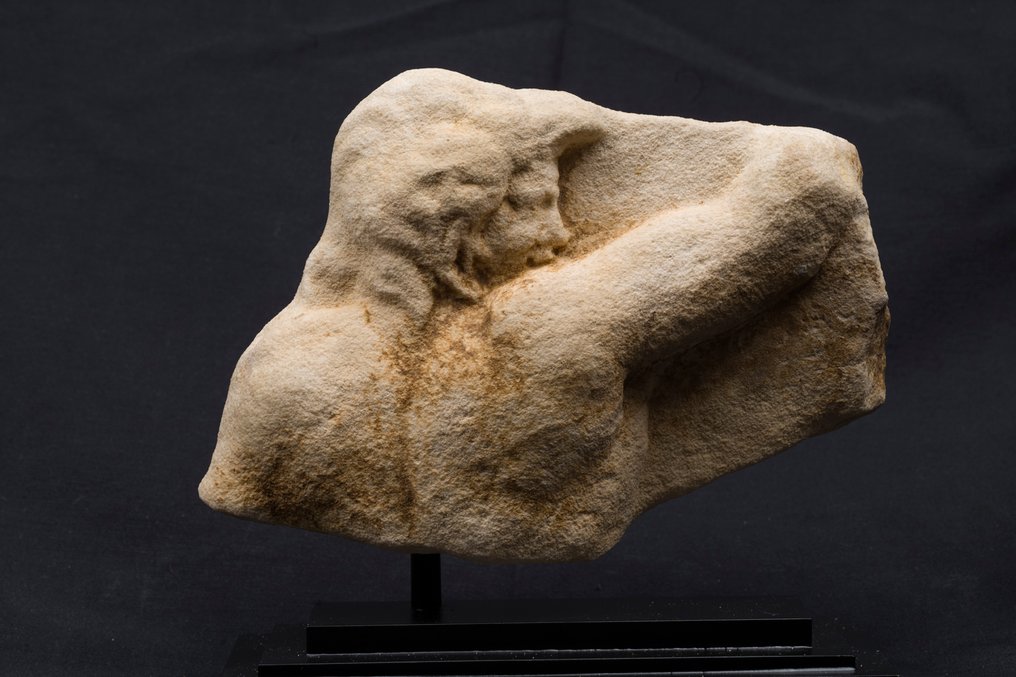
Ancient Roman Marble Relief with a Satyr. 1st century AD. 24 cm length.


12
days
18
hours
55
minutes
25
seconds
Current bid
€ 1,200
Reserve price not met

Expert
Selected by Ruth Garrido Vila
Directed the Ifergan Collection Museum, specialising in Phoenician and Mediterranean archaeology.
Estimate € 8,300 - € 9,200
11 other people are watching this object
 Bidder 9163 Bidder 9163 | €1,200 | |
|---|---|---|
 Bidder 6492 Bidder 6492 | €1,100 | |
| Bidder 9163 | €1,000 |
Catawiki Buyer Protection
Your payment’s safe with us until you receive your object.View details
Trustpilot 4.4 | 122053 reviews
Rated Excellent on Trustpilot.
Ancient Roman marble relief fragment depicting the upper torso and head of a satyr, dating to the 1st century AD, about 24 cm long (16.5 cm high, 6.5 cm deep), in good condition with superficial wear and no restorations.
AI-assisted summary
Description from the seller
Relief with a Satyr.
Ancient Roman, 1st century AD.
Marble.
24 cm length, 16.5 cm height and 6.5 cm depth.
Condition: Good condition. Without restorations. It has superficial wear on the marble.
Provenance:
- Private collection, Switzerland, acquired in the years 1980 - 1990.
- Private collection, London, 1990.
Description:
Fragment carved in marble in a remarkably high relief, probably from the decoration of a sarcophagus. It represents the upper torso and head of a young satyr or faun, with a powerful anatomy, standing with his back to the viewer, raising his right arm and turning his head in the same direction, so that he is in strict profile. The sculptor's mastery is reflected in the fine modelling of volumes and details, as well as in the successful use of schiacciato, a technique that allows the volumes to be enhanced and creates an effective three-dimensional illusion through minimal variations in the depth of the carved relief. Thus, the arm is worked practically in rounded relief, while the muscular back also stands out notably, while the face is carved in much lesser relief.
Despite its fragmentary nature, the relief still retains a dynamic expressiveness, not only in the way the muscles of the back are tensed and extended, reflecting the sculptor's careful study of nature, but also in the representation of the face, with a slight frown and a half-smile. Despite the absence of obvious iconographic elements identifying the figure, we can infer that it is a satyr from the tousled hair, typical of a wild creature, and especially from the face, with its rounded, thick nose, very different from the idealised representations of divine and heroic characters, and characteristic of the image of the satyr since Greek art (fig. 1). From the expansive and dynamic posture, with the body turned backwards, the face turned and the right arm extended, we can deduce that this fragment belongs to the representation of a dancing satyr in the context of a Dionysian scene with multiple characters. It would be part of a scenographic and moving composition, which would contrast characters from the front and from the back in order to bring naturalism and rhythm to the composition (fig. 2).
In Greece, satyrs were mythological beings usually depicted with an animal-like appearance, with goat's or horse's legs and ears, horns and tails, and often ithyphallic. Occasionally, however, these beings were depicted as beautiful young men, as in Praxiteles' Satyr in Repose. Together with the maenads, the satyrs form the retinue that accompanies the god Dionysos, although they may also be associated with the god Pan. Some traditions consider Silenus to be the father of the satyr tribe. The three eldest of these, called Maron, Leneus and Astreo, were the same as their father, and were therefore also known as Silenus. According to some versions of the myth, they were the fathers of the satyrs, who were therefore the grandsons of Silenus. The three Silenus were part of Dionysus' retinue when he travelled to India and, in fact, Astreo was the driver of his chariot.
In Rome the equivalent of the satyr were the fauns, woodland creatures with horns and goat's hooves. They were the sons of Faunus, identified with the Greek Pan, the god of the fields and forests and protector of the flocks, which he made more fertile and defended from vermin attacks. In another aspect, Faunus was considered a prophetic god who revealed the future by means of voices heard in the forests or through dreams; he was sometimes considered to be responsible for nightmares. He was depicted as having a lecherous nature, constantly pursuing the nymphs of the woods. It was thought that he could sometimes cast spells on peasants, who rubbed their bodies with certain herbs as a form of protection.
The appearance of Bacchic themes in the Roman funerary context is frequent, since Dionysus unites in his own person the human and the divine, mortality and immortality. He is the only Olympian with a human mother, and he experienced death when he was dismembered by the Titans, although his immortal nature prevailed. In his personality, life and death are in tension, and it is he who provides his followers with lysis, the relaxation and dissolution of the psyche that liberates the soul and functions symbolically as a liberation of the spirit after the death of the body. This is why the themes linked to his figure and his cult were particularly appropriate for a liminal space, halfway between the world of the living and the world of the dead, such as the funerary monument (fig. 3).
Bibliography:
- ELVIRA BARBA, M.A. Arte y Mito. Manual de iconografía clásica. Sílex. 2008.
- DE GRUMMON, E. “Bacchic Imagery and Cult Practice in Roman Italy”, en The Villa of the Mysteries in Pompeii: Ancient Ritual, Modern Muse. Kelsey Museum of Archaeology and the University of Michigan Museum of Art. 2000. Pp. 73-83.
- KERÉNYI, C. Dionysos: Archetypal Image of Indestructible Life. Princeton University Press. 1976.
- PAILLER, J. M. “Le monde de Bacchus". Anabases, n. 4. 2006.
- SEAFORD, R. Dionysos. Routledge. 2006.
Parallels:
Fig. 1 Fragment of sarcophagus with satyr mask. Roman Empire, ca. 220-235 AD. Proconnesian marble, 28 x 24 cm. Glieniche Palace, Berlin-Wansee, inv. SPSG, Skulpt.slg. 4388.
Fig. 2 Borghese Crater. Athens, Greek work for the Roman market, ca. 40-30 BC. Pentelic marble, 172 cm high. Musée du Louvre, Paris, inv. MR 985, N 274, Ma 86.
Fig. 3 Sarcophagus front with the triumph of Dionysus in India. Roman Empire, late 2nd century AD. Marble, 87.6 x 217.8 cm. The Museum of Fine Arts, Houston, inv. 2003.53.1.
Notes:
- The piece includes authenticity certificate.
- The piece includes Spanish Export License (Passport for European Union) - If the piece is destined outside the European Union a substitution of the export permit should be requested, can take between 1-2 weeks maximum.
- The seller guarantees that he acquired this piece according to all national and international laws related to the ownership of cultural property. Provenance statement seen by Catawiki.
#CollectorsFair25
Seller's Story
Gallery of Ancient Art - Archeology based in Barcelona with more than fifteen years of experience. Specialized in classical art, Egyptian art, Asian art and pre-Columbian art. It guarantees the authenticity of all its pieces. It participates in the most important art fairs in Spain, such as Feriarte, as well as in fairs abroad, BRAFA, Parcours des Mondes, Cultures Brussels.
All the pieces are sent with an Export Permit issued by the Spanish Ministry of Culture.
We are quick to ship via DHL Express or Direct Art Transport.
Translated by Google TranslateRelief with a Satyr.
Ancient Roman, 1st century AD.
Marble.
24 cm length, 16.5 cm height and 6.5 cm depth.
Condition: Good condition. Without restorations. It has superficial wear on the marble.
Provenance:
- Private collection, Switzerland, acquired in the years 1980 - 1990.
- Private collection, London, 1990.
Description:
Fragment carved in marble in a remarkably high relief, probably from the decoration of a sarcophagus. It represents the upper torso and head of a young satyr or faun, with a powerful anatomy, standing with his back to the viewer, raising his right arm and turning his head in the same direction, so that he is in strict profile. The sculptor's mastery is reflected in the fine modelling of volumes and details, as well as in the successful use of schiacciato, a technique that allows the volumes to be enhanced and creates an effective three-dimensional illusion through minimal variations in the depth of the carved relief. Thus, the arm is worked practically in rounded relief, while the muscular back also stands out notably, while the face is carved in much lesser relief.
Despite its fragmentary nature, the relief still retains a dynamic expressiveness, not only in the way the muscles of the back are tensed and extended, reflecting the sculptor's careful study of nature, but also in the representation of the face, with a slight frown and a half-smile. Despite the absence of obvious iconographic elements identifying the figure, we can infer that it is a satyr from the tousled hair, typical of a wild creature, and especially from the face, with its rounded, thick nose, very different from the idealised representations of divine and heroic characters, and characteristic of the image of the satyr since Greek art (fig. 1). From the expansive and dynamic posture, with the body turned backwards, the face turned and the right arm extended, we can deduce that this fragment belongs to the representation of a dancing satyr in the context of a Dionysian scene with multiple characters. It would be part of a scenographic and moving composition, which would contrast characters from the front and from the back in order to bring naturalism and rhythm to the composition (fig. 2).
In Greece, satyrs were mythological beings usually depicted with an animal-like appearance, with goat's or horse's legs and ears, horns and tails, and often ithyphallic. Occasionally, however, these beings were depicted as beautiful young men, as in Praxiteles' Satyr in Repose. Together with the maenads, the satyrs form the retinue that accompanies the god Dionysos, although they may also be associated with the god Pan. Some traditions consider Silenus to be the father of the satyr tribe. The three eldest of these, called Maron, Leneus and Astreo, were the same as their father, and were therefore also known as Silenus. According to some versions of the myth, they were the fathers of the satyrs, who were therefore the grandsons of Silenus. The three Silenus were part of Dionysus' retinue when he travelled to India and, in fact, Astreo was the driver of his chariot.
In Rome the equivalent of the satyr were the fauns, woodland creatures with horns and goat's hooves. They were the sons of Faunus, identified with the Greek Pan, the god of the fields and forests and protector of the flocks, which he made more fertile and defended from vermin attacks. In another aspect, Faunus was considered a prophetic god who revealed the future by means of voices heard in the forests or through dreams; he was sometimes considered to be responsible for nightmares. He was depicted as having a lecherous nature, constantly pursuing the nymphs of the woods. It was thought that he could sometimes cast spells on peasants, who rubbed their bodies with certain herbs as a form of protection.
The appearance of Bacchic themes in the Roman funerary context is frequent, since Dionysus unites in his own person the human and the divine, mortality and immortality. He is the only Olympian with a human mother, and he experienced death when he was dismembered by the Titans, although his immortal nature prevailed. In his personality, life and death are in tension, and it is he who provides his followers with lysis, the relaxation and dissolution of the psyche that liberates the soul and functions symbolically as a liberation of the spirit after the death of the body. This is why the themes linked to his figure and his cult were particularly appropriate for a liminal space, halfway between the world of the living and the world of the dead, such as the funerary monument (fig. 3).
Bibliography:
- ELVIRA BARBA, M.A. Arte y Mito. Manual de iconografía clásica. Sílex. 2008.
- DE GRUMMON, E. “Bacchic Imagery and Cult Practice in Roman Italy”, en The Villa of the Mysteries in Pompeii: Ancient Ritual, Modern Muse. Kelsey Museum of Archaeology and the University of Michigan Museum of Art. 2000. Pp. 73-83.
- KERÉNYI, C. Dionysos: Archetypal Image of Indestructible Life. Princeton University Press. 1976.
- PAILLER, J. M. “Le monde de Bacchus". Anabases, n. 4. 2006.
- SEAFORD, R. Dionysos. Routledge. 2006.
Parallels:
Fig. 1 Fragment of sarcophagus with satyr mask. Roman Empire, ca. 220-235 AD. Proconnesian marble, 28 x 24 cm. Glieniche Palace, Berlin-Wansee, inv. SPSG, Skulpt.slg. 4388.
Fig. 2 Borghese Crater. Athens, Greek work for the Roman market, ca. 40-30 BC. Pentelic marble, 172 cm high. Musée du Louvre, Paris, inv. MR 985, N 274, Ma 86.
Fig. 3 Sarcophagus front with the triumph of Dionysus in India. Roman Empire, late 2nd century AD. Marble, 87.6 x 217.8 cm. The Museum of Fine Arts, Houston, inv. 2003.53.1.
Notes:
- The piece includes authenticity certificate.
- The piece includes Spanish Export License (Passport for European Union) - If the piece is destined outside the European Union a substitution of the export permit should be requested, can take between 1-2 weeks maximum.
- The seller guarantees that he acquired this piece according to all national and international laws related to the ownership of cultural property. Provenance statement seen by Catawiki.
#CollectorsFair25
Seller's Story
Gallery of Ancient Art - Archeology based in Barcelona with more than fifteen years of experience. Specialized in classical art, Egyptian art, Asian art and pre-Columbian art. It guarantees the authenticity of all its pieces. It participates in the most important art fairs in Spain, such as Feriarte, as well as in fairs abroad, BRAFA, Parcours des Mondes, Cultures Brussels.
All the pieces are sent with an Export Permit issued by the Spanish Ministry of Culture.
We are quick to ship via DHL Express or Direct Art Transport.
Translated by Google TranslateDetails
Culture
Ancient Roman
Century/ Timeframe
1st century AD.
Name of object
Relief with a Satyr. 1st century AD. 24 cm length.
Acquired from
Private collection
Material
Marble
Condition
Good
Disclaimer
The seller was informed by Catawiki about documentation requirements and guarantees the following: - the object was legally obtained, - the seller has the right to sell and/or export the object, as relevant, - the seller will provide the necessary provenance information and arrange required documentation and permits/licenses, as applicable and as per local laws, - the seller will notify the buyer of any delays in obtaining permits/licenses. By bidding, you acknowledge that import documentation may be required depending on your country of residence and that obtaining permits/licenses may cause delays in the delivery of your object.
The seller was informed by Catawiki about documentation requirements and guarantees the following: - the object was legally obtained, - the seller has the right to sell and/or export the object, as relevant, - the seller will provide the necessary provenance information and arrange required documentation and permits/licenses, as applicable and as per local laws, - the seller will notify the buyer of any delays in obtaining permits/licenses. By bidding, you acknowledge that import documentation may be required depending on your country of residence and that obtaining permits/licenses may cause delays in the delivery of your object.
