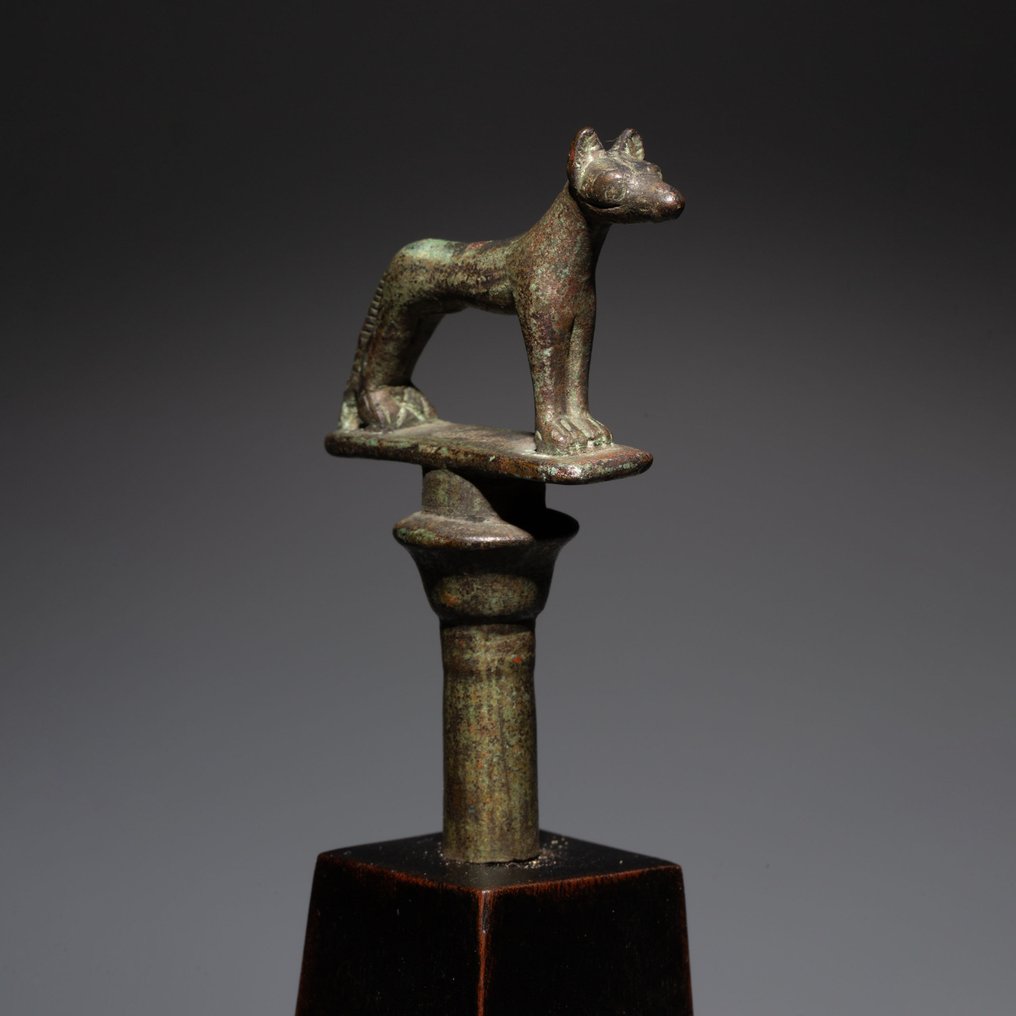
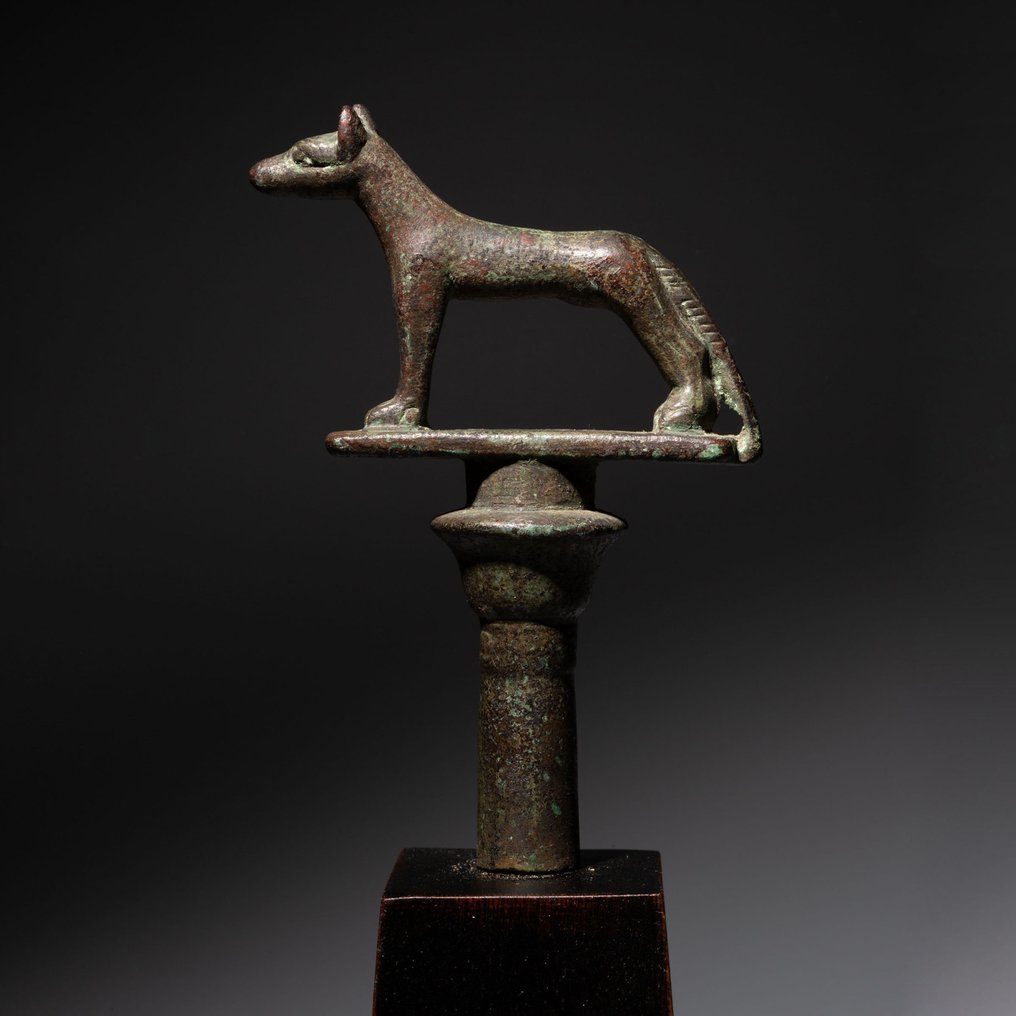
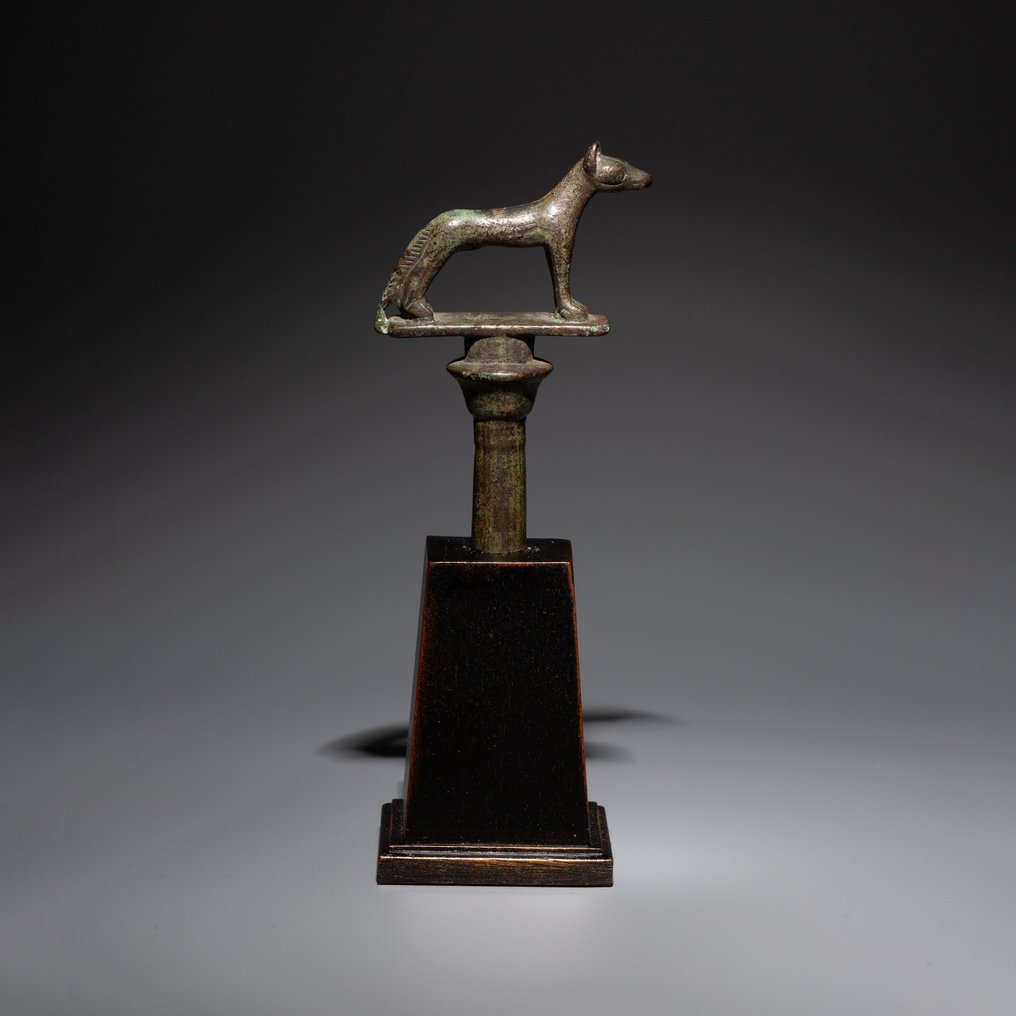
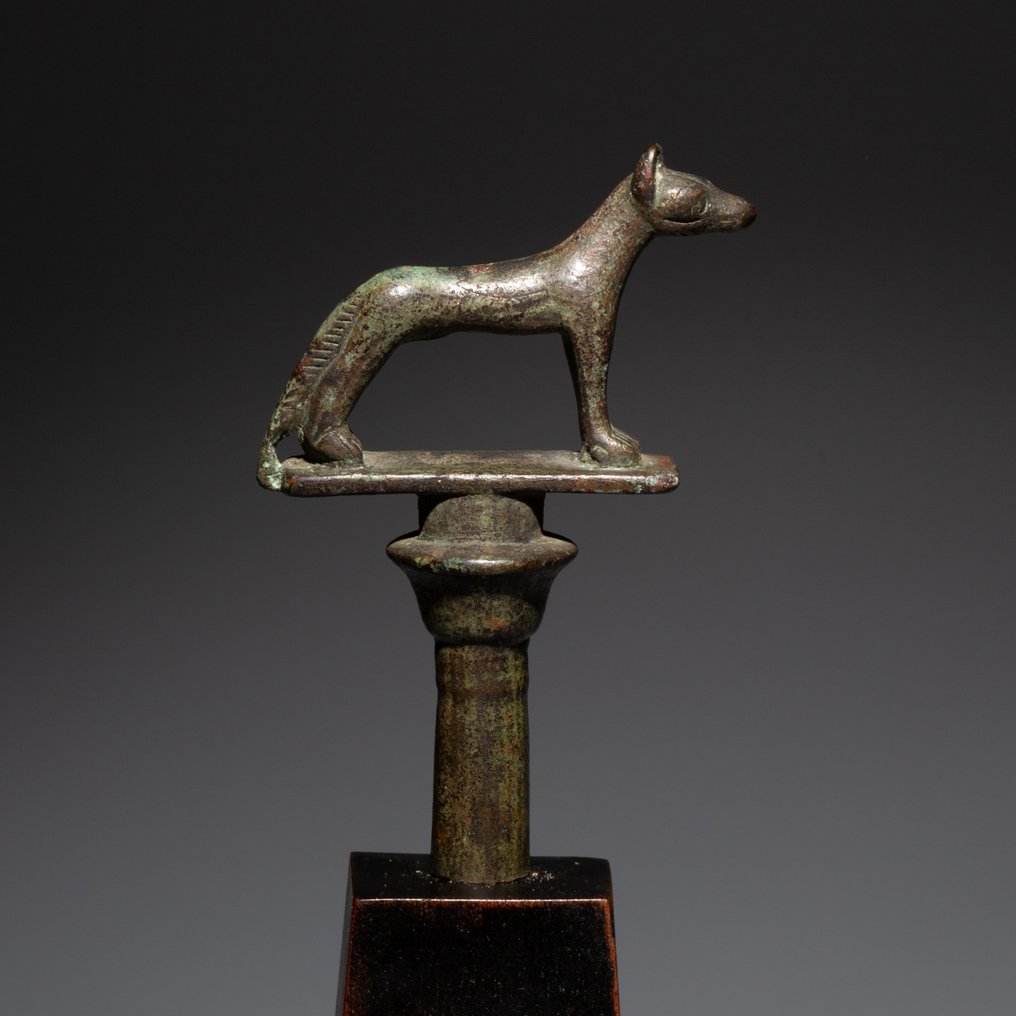
Ancient Egyptian Bronze God Wepwawet - Upuaut scepter terminal. Late Period, 626 - 323 BC. 17,5 cm H.

14
days
16
hours
17
minutes
10
seconds
Starting bid
€ 1
Reserve price not met

Expert
Selected by Ruth Garrido Vila
Directed the Ifergan Collection Museum, specialising in Phoenician and Mediterranean archaeology.
Estimate € 13,000 - € 15,000
No bids placed
Catawiki Buyer Protection
Your payment’s safe with us until you receive your object.View details
Trustpilot 4.4 | 121980 reviews
Rated Excellent on Trustpilot.
Ancient Egyptian bronze terminal of a baton or scepter depicting the jackal god Wepwawet, Late Period (626–323 BC), 17.5 cm high, intact, with authenticity certificate and Spanish export license.
AI-assisted summary
Description from the seller
God Wepwawet - Upuaut scepter terminal
CULTURE: Ancient Egypt
PERIOD: Late Period, 626 - 323 BC
MATERIAL: Solid Bronze
DIMENSIONS: Height 17,5 cm . Height 9,5 cm without stand.
PROVENANCE: Collection of Guy Delbès (1928 - 2019), Paris. Private collection, Barcelona.
CONDITION: Intact.
DESCRIPTION:
Terminal of the upper area of a baton or scepter with the effigy of a canid. The piece has a simple finish, with geometric shapes, inspired by columns, especially a typology characteristic of ancient Egypt such as lotiform columns, influenced by the shapes of the lotus flower. On the small capital with a camping structure, a circular podium raises the flat rectangular base where rests in a slender and elegant form, a dog or jackal in a standing position, is the image of the god Wepwawet.
Wepwawet "the one who opens the roads", deity of the Duat (Beyond), funerary god and of the war in the Egyptian mythology. Wepwawet was represented in the form of a black dog or jackal with a white head, on an ensign, with one or two uraeus emerging from the sides of the paws. His warrior attributes were a mace and a bow. The Greeks interpreted him as a wolf, from which comes the name of Lycopolis, his city.
It is likely that Wepwawet was originally a symbol of the pharaoh, attempting to associate himself with lupine attributes, later deifying himself as a mascot to accompany the pharaoh. Likewise, Wepwawet was said to accompany the pharaoh on hunts, in which capacity it was titled "(one with a) sharp arrow more powerful than the gods alone."
In time, the connection with war, and thus with death, led Wepwawet to be seen as the one who opened the gates through and across the Duat to the spirits of the dead. With this and the similarity of the jackal to the wolf, Wepwawet became associated with Anubis, a deity who was worshipped in Asiut, eventually considering himself his son. Viscous as a jackal, he was also said to be the son of Set. Therefore, Wepwawet is often confused with Anubis. This deity appears in the temple of Seti I at Abydos.
PARALLELS:
Fig. 1 God Upuaut. Ancient Egypt, Lower Epoch, 664 - 323 B.C., bronze. Norwich Castle, Norfolk, inv. 1894.76.725.
Fig. 2 God Upuaut. Ancient Egypt, Late Antiquity, 664 - 323 BC, bronze. Christie's London, Antiquities, April 26, 2012, lot 47.
Notes:
- The piece includes authenticity certificate.
- The piece includes Spanish Export License.
- The seller guarantees that he acquired this piece according to all national and international laws related to the ownership of cultural property. Provenance statement seen by Catawiki.
Seller's Story
Gallery of Ancient Art - Archeology based in Barcelona with more than fifteen years of experience. Specialized in classical art, Egyptian art, Asian art and pre-Columbian art. It guarantees the authenticity of all its pieces. It participates in the most important art fairs in Spain, such as Feriarte, as well as in fairs abroad, BRAFA, Parcours des Mondes, Cultures Brussels.
All the pieces are sent with an Export Permit issued by the Spanish Ministry of Culture.
We are quick to ship via DHL Express or Direct Art Transport.
Translated by Google TranslateGod Wepwawet - Upuaut scepter terminal
CULTURE: Ancient Egypt
PERIOD: Late Period, 626 - 323 BC
MATERIAL: Solid Bronze
DIMENSIONS: Height 17,5 cm . Height 9,5 cm without stand.
PROVENANCE: Collection of Guy Delbès (1928 - 2019), Paris. Private collection, Barcelona.
CONDITION: Intact.
DESCRIPTION:
Terminal of the upper area of a baton or scepter with the effigy of a canid. The piece has a simple finish, with geometric shapes, inspired by columns, especially a typology characteristic of ancient Egypt such as lotiform columns, influenced by the shapes of the lotus flower. On the small capital with a camping structure, a circular podium raises the flat rectangular base where rests in a slender and elegant form, a dog or jackal in a standing position, is the image of the god Wepwawet.
Wepwawet "the one who opens the roads", deity of the Duat (Beyond), funerary god and of the war in the Egyptian mythology. Wepwawet was represented in the form of a black dog or jackal with a white head, on an ensign, with one or two uraeus emerging from the sides of the paws. His warrior attributes were a mace and a bow. The Greeks interpreted him as a wolf, from which comes the name of Lycopolis, his city.
It is likely that Wepwawet was originally a symbol of the pharaoh, attempting to associate himself with lupine attributes, later deifying himself as a mascot to accompany the pharaoh. Likewise, Wepwawet was said to accompany the pharaoh on hunts, in which capacity it was titled "(one with a) sharp arrow more powerful than the gods alone."
In time, the connection with war, and thus with death, led Wepwawet to be seen as the one who opened the gates through and across the Duat to the spirits of the dead. With this and the similarity of the jackal to the wolf, Wepwawet became associated with Anubis, a deity who was worshipped in Asiut, eventually considering himself his son. Viscous as a jackal, he was also said to be the son of Set. Therefore, Wepwawet is often confused with Anubis. This deity appears in the temple of Seti I at Abydos.
PARALLELS:
Fig. 1 God Upuaut. Ancient Egypt, Lower Epoch, 664 - 323 B.C., bronze. Norwich Castle, Norfolk, inv. 1894.76.725.
Fig. 2 God Upuaut. Ancient Egypt, Late Antiquity, 664 - 323 BC, bronze. Christie's London, Antiquities, April 26, 2012, lot 47.
Notes:
- The piece includes authenticity certificate.
- The piece includes Spanish Export License.
- The seller guarantees that he acquired this piece according to all national and international laws related to the ownership of cultural property. Provenance statement seen by Catawiki.
Seller's Story
Gallery of Ancient Art - Archeology based in Barcelona with more than fifteen years of experience. Specialized in classical art, Egyptian art, Asian art and pre-Columbian art. It guarantees the authenticity of all its pieces. It participates in the most important art fairs in Spain, such as Feriarte, as well as in fairs abroad, BRAFA, Parcours des Mondes, Cultures Brussels.
All the pieces are sent with an Export Permit issued by the Spanish Ministry of Culture.
We are quick to ship via DHL Express or Direct Art Transport.
Translated by Google TranslateDetails
Culture
Ancient Egyptian
Century/ Timeframe
Late Period, 626 - 323 BC
Name of object
God Wepwawet - Upuaut scepter terminal. Late Period, 626 - 323 BC. 17,5 cm H.
Acquired from
Private collection
Material
Bronze
Condition
Very good
Disclaimer
The seller was informed by Catawiki about documentation requirements and guarantees the following: - the object was legally obtained, - the seller has the right to sell and/or export the object, as relevant, - the seller will provide the necessary provenance information and arrange required documentation and permits/licenses, as applicable and as per local laws, - the seller will notify the buyer of any delays in obtaining permits/licenses. By bidding, you acknowledge that import documentation may be required depending on your country of residence and that obtaining permits/licenses may cause delays in the delivery of your object.
The seller was informed by Catawiki about documentation requirements and guarantees the following: - the object was legally obtained, - the seller has the right to sell and/or export the object, as relevant, - the seller will provide the necessary provenance information and arrange required documentation and permits/licenses, as applicable and as per local laws, - the seller will notify the buyer of any delays in obtaining permits/licenses. By bidding, you acknowledge that import documentation may be required depending on your country of residence and that obtaining permits/licenses may cause delays in the delivery of your object.
