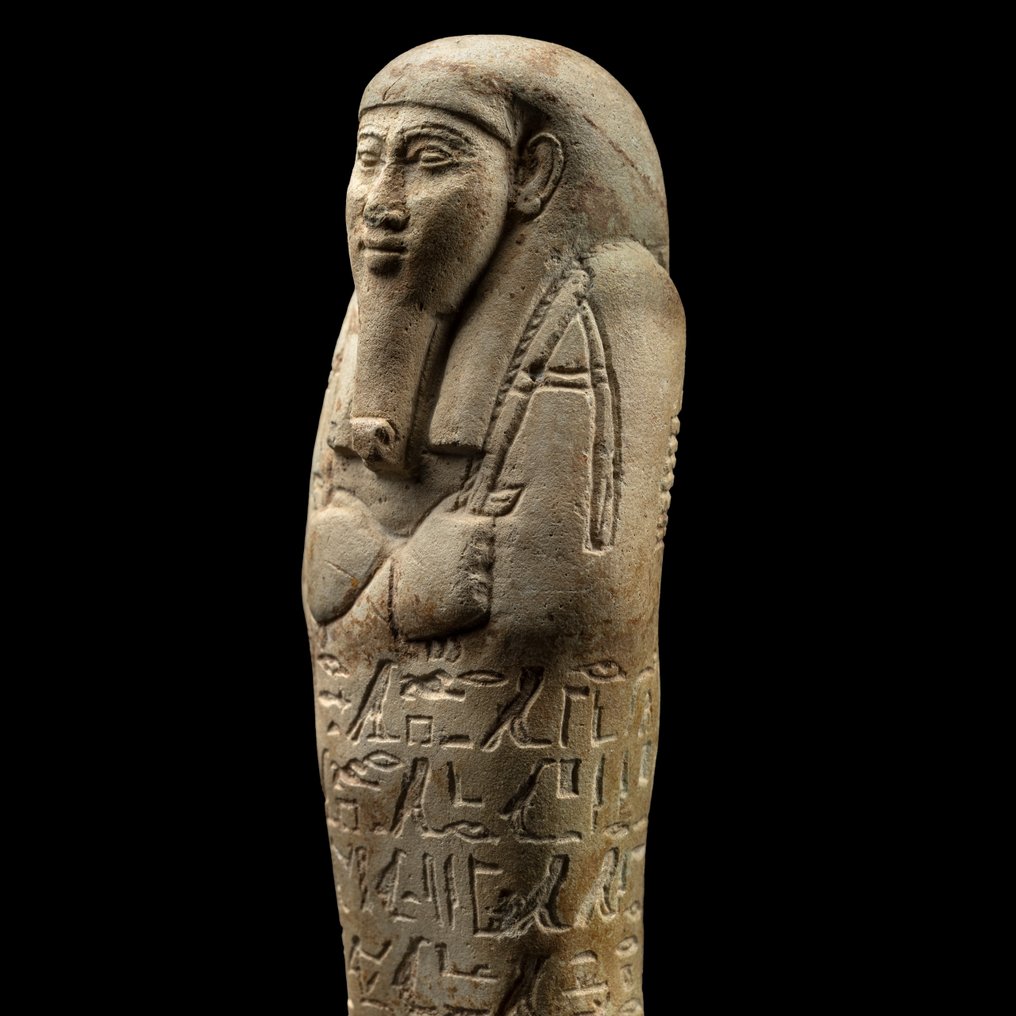
Ancient Egyptian Faience Ushabti for Horiraa. Dynasty XXVI, Reign of Necao II, 610-595 BC. 17.5 cm height.



04
days
01
hour
58
minutes
59
seconds
Current bid
€ 5,000
Reserve price not met

Expert
Selected by Ruth Garrido Vila
Directed the Ifergan Collection Museum, specialising in Phoenician and Mediterranean archaeology.
Estimate € 20,000 - € 22,000
12 other people are watching this object
 Bidder 8505 Bidder 8505 | €5,000 |
|---|
Catawiki Buyer Protection
Your payment’s safe with us until you receive your object.View details
Trustpilot 4.4 | 122028 reviews
Rated Excellent on Trustpilot.
Ushabti for Horiraa, Dynasty XXVI, Reign of Necao II (610–595 BC), in faience, 17.5 cm high, in good condition, acquired from a private collection; includes an authenticity certificate and a Spanish export license.
AI-assisted summary
Description from the seller
Ushabti for Horiraa.
Ancient Egypt, Dynasty XXVI, Reign of Necao II, 610-595 BC.
Faience.
17.5 cm height.
Condition: Good condition. It only has a dent at the end of the beard and a small restoration in the back right area of the base, the rest intact.
Provenance: Private collection from the South of France. From the collection of an Archeology expert, formed between the 60s and 90s.
Description: Ushebti for Horiraa, an eminent figure in the royal court who distinguished himself as tutor to the sons of (Nekau, Neku) Necao II, and was thus tutor to the next pharaoh, Psametic II. As a reward for services rendered to the royal family, he obtained during the reign of Apries (successor of Psametic II) the possibility of being buried with a quantity of grave goods befitting a king. His tomb was found in the Memphis necropolis at Saqqara (LS23) and consists of two chambers accessible through a shaft.
Ushebtis are small statuettes that were placed in tombs as part of the grave goods of the deceased. The oldest surviving examples come from the Middle Kingdom, although references to them can be found in texts from the end of the Early Empire. Throughout the ages they always maintained the same function in the religious sphere but, while during the Middle Empire they were conceived as representing their owner before Osiris in the tasks of tilling the kingdom of the shadows, replicas of the deceased, from the New Empire onwards they came to be seen as servants or slaves of the deceased, and were produced in large quantities.
Bibliography: - SCHNEIDER, p. III, 5.3.1. 179/181, 1977.
Parallels: - Ushabti by Hor-ir-aa, Museum of Liverpool, inv. M13876.
Notes:
- The piece includes authenticity certificate.
- The piece includes Spanish Export License (Passport for European Union) - If the piece is destined outside the European Union a substitution of the export permit should be requested, can take between 1-2 weeks maximum.
- The seller guarantees that he acquired this piece according to all national and international laws related to the ownership of cultural property. Provenance statement seen by Catawiki.
Seller's Story
Gallery of Ancient Art - Archeology based in Barcelona with more than fifteen years of experience. Specialized in classical art, Egyptian art, Asian art and pre-Columbian art. It guarantees the authenticity of all its pieces. It participates in the most important art fairs in Spain, such as Feriarte, as well as in fairs abroad, BRAFA, Parcours des Mondes, Cultures Brussels.
All the pieces are sent with an Export Permit issued by the Spanish Ministry of Culture.
We are quick to ship via DHL Express or Direct Art Transport.
Translated by Google TranslateUshabti for Horiraa.
Ancient Egypt, Dynasty XXVI, Reign of Necao II, 610-595 BC.
Faience.
17.5 cm height.
Condition: Good condition. It only has a dent at the end of the beard and a small restoration in the back right area of the base, the rest intact.
Provenance: Private collection from the South of France. From the collection of an Archeology expert, formed between the 60s and 90s.
Description: Ushebti for Horiraa, an eminent figure in the royal court who distinguished himself as tutor to the sons of (Nekau, Neku) Necao II, and was thus tutor to the next pharaoh, Psametic II. As a reward for services rendered to the royal family, he obtained during the reign of Apries (successor of Psametic II) the possibility of being buried with a quantity of grave goods befitting a king. His tomb was found in the Memphis necropolis at Saqqara (LS23) and consists of two chambers accessible through a shaft.
Ushebtis are small statuettes that were placed in tombs as part of the grave goods of the deceased. The oldest surviving examples come from the Middle Kingdom, although references to them can be found in texts from the end of the Early Empire. Throughout the ages they always maintained the same function in the religious sphere but, while during the Middle Empire they were conceived as representing their owner before Osiris in the tasks of tilling the kingdom of the shadows, replicas of the deceased, from the New Empire onwards they came to be seen as servants or slaves of the deceased, and were produced in large quantities.
Bibliography: - SCHNEIDER, p. III, 5.3.1. 179/181, 1977.
Parallels: - Ushabti by Hor-ir-aa, Museum of Liverpool, inv. M13876.
Notes:
- The piece includes authenticity certificate.
- The piece includes Spanish Export License (Passport for European Union) - If the piece is destined outside the European Union a substitution of the export permit should be requested, can take between 1-2 weeks maximum.
- The seller guarantees that he acquired this piece according to all national and international laws related to the ownership of cultural property. Provenance statement seen by Catawiki.
Seller's Story
Gallery of Ancient Art - Archeology based in Barcelona with more than fifteen years of experience. Specialized in classical art, Egyptian art, Asian art and pre-Columbian art. It guarantees the authenticity of all its pieces. It participates in the most important art fairs in Spain, such as Feriarte, as well as in fairs abroad, BRAFA, Parcours des Mondes, Cultures Brussels.
All the pieces are sent with an Export Permit issued by the Spanish Ministry of Culture.
We are quick to ship via DHL Express or Direct Art Transport.
Translated by Google TranslateDetails
Culture
Ancient Egyptian
Century/ Timeframe
Dynasty XXVI, Reign of Necao II, 610-595 BC.
Name of object
Ushabti for Horiraa. Dynasty XXVI, Reign of Necao II, 610-595 BC. 17.5 cm height.
Acquired from
Private collection
Material
Faience
Condition
Good
Disclaimer
The seller was informed by Catawiki about documentation requirements and guarantees the following: - the object was legally obtained, - the seller has the right to sell and/or export the object, as relevant, - the seller will provide the necessary provenance information and arrange required documentation and permits/licenses, as applicable and as per local laws, - the seller will notify the buyer of any delays in obtaining permits/licenses. By bidding, you acknowledge that import documentation may be required depending on your country of residence and that obtaining permits/licenses may cause delays in the delivery of your object.
The seller was informed by Catawiki about documentation requirements and guarantees the following: - the object was legally obtained, - the seller has the right to sell and/or export the object, as relevant, - the seller will provide the necessary provenance information and arrange required documentation and permits/licenses, as applicable and as per local laws, - the seller will notify the buyer of any delays in obtaining permits/licenses. By bidding, you acknowledge that import documentation may be required depending on your country of residence and that obtaining permits/licenses may cause delays in the delivery of your object.
