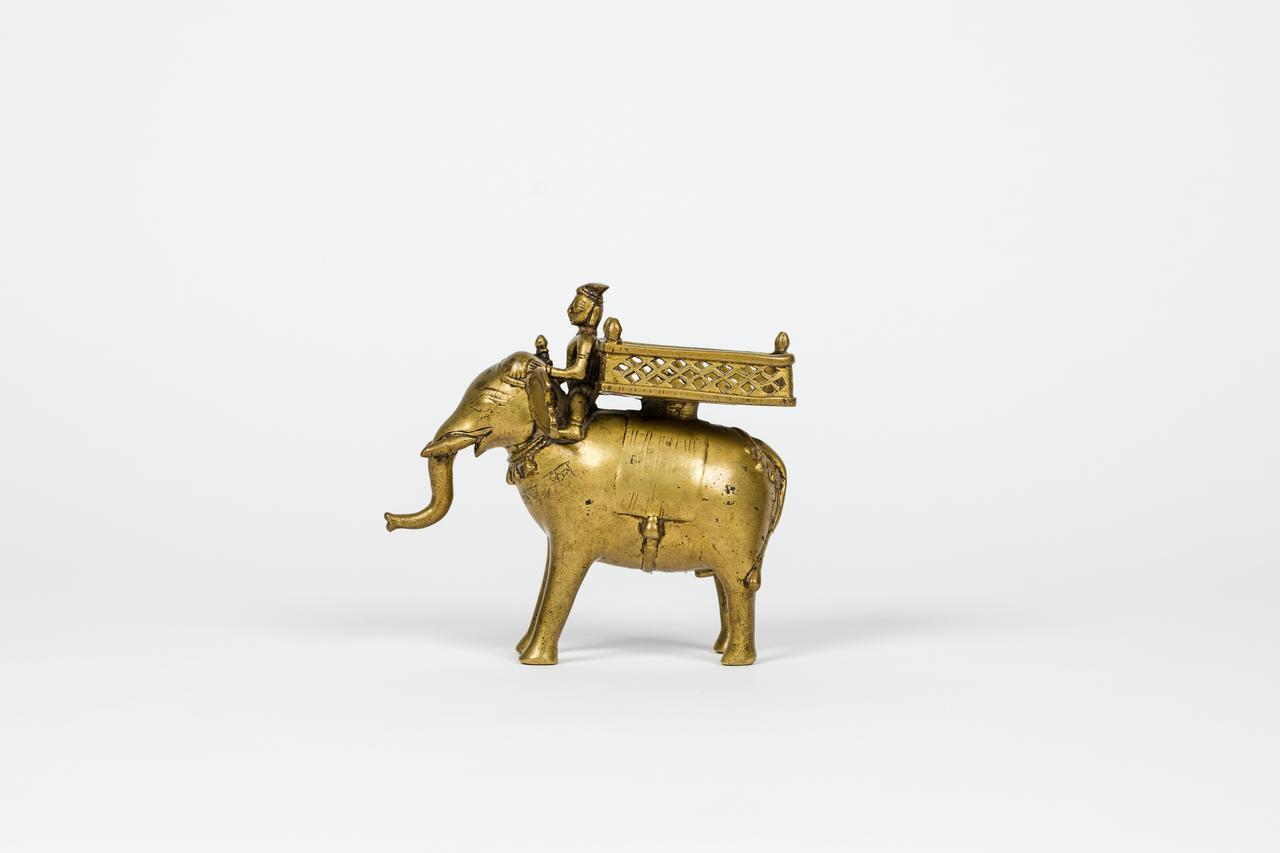
Religious objects - Mahīśāsuramardinī, Durgā who kills the buffalo demon, bronze, India, 18th century. - 1700-1750 Maratha Empire (1674-1818)


01
day
20
hours
53
minutes
40
seconds
Current bid
€ 50
Reserve price not met

Expert
Selected by Surya Rutten
Has over 25 years' experience in Asian art and owned an art gallery.
Estimate € 1,100 - € 1,500
23 other people are watching this object
 Bidder 6091 Bidder 6091 | €50 | |
|---|---|---|
| Bidder 6091 | €45 | |
| Bidder 6091 | €40 | |
Catawiki Buyer Protection
Your payment’s safe with us until you receive your object.View details
Trustpilot 4.4 | 122115 reviews
Rated Excellent on Trustpilot.
Bronze sculpture from India dating to ca. 1700–1750 in the Maratha Empire period, titled Mahīśāsuramardinī (Durgā who defeats the buffalo demon Mahīśa), with dimensions 12.5 × 8 × 6 cm and good used condition.
AI-assisted summary
Description from the seller
The bronze depicts the goddess Mahīśāsuramardinī, a warrior form of Durgā, captured in the culminating act of her battle against the buffalo-demon Mahīśa. The figure, modeled using the lost-wax casting technique typical of southern India, presents a highly dynamic pose: the goddess's body, erect with momentum, leans forward as the spear sinks into the demonic creature's body. Around her, a perforated architectural aura (prabhāmaṇḍala) frames the scene, emphasizing the divine nature of the action and amplifying the dramatic tension of the whole.
The goddess is depicted with multiple arms, each wielding a weapon or symbolic attribute: among these are the trident, the ritual sword, the bow, and the offering bowl, elements that recall her ability to simultaneously embody the powers of the various gods. The conical helmet, the ears adorned with large pendants, and the robe tied at the waist are part of the popular iconographic tradition of South India, in which the figure of Durgā takes on an energetic and earthly quality, devoid of superfluous idealizations, yet rich in ritual expressiveness.
Of particular note is the spatial construction of the base, where the divine lion, to the left of the goddess intent on trampling the buffalo's severed head, is rendered with vibrant, muscular forms while the buffalo's body is powerfully crushed by Durgā's right leg. The goddess thus stands between the two creatures as the cosmic axis of dharma's victory over chaos. The surfaces show traces of red pigment and light green oxidation deposits, indicative of an ancient devotional history and its customary display in domestic contexts or small shrines. Natural wear and the warm, uneven patina confirm the piece's authenticity and long ritual life.
The sculpture perfectly preserves the narrative and symbolic force of the Puranic episode: the goddess, immobile in her decisive gesture, crystallizes the moment when the demon's violence is definitively subdued by divine power. The compact composition and the balance between movement and frontality make this artifact a remarkable example of South Indian religious sculpture, ideal for collectors of ancient Asian art and Saivite-Sakhatian bronzes.
N.B.
For administrative reasons, Italian buyers are required to provide their tax code, which is essential for the proper issuance of the electronic invoice.
For administrative reasons related to current Italian regulations, foreign customers are kindly requested to provide their place and date of birth via email message using the appropriate Catawiki form at the time of purchase.
Seller's Story
Ethnologica was born from the love and passion for the ancient culture of Oriental, Islamic and Indian art. Refined works of art make up a constantly evolving collection capable of satisfying the needs of admirers, enthusiasts and collectors.
Ethnologica has also contributed as a lender to sector cultural exhibitions alongside prestigious public and private cultural associations and foundations.
Translated by Google TranslateThe bronze depicts the goddess Mahīśāsuramardinī, a warrior form of Durgā, captured in the culminating act of her battle against the buffalo-demon Mahīśa. The figure, modeled using the lost-wax casting technique typical of southern India, presents a highly dynamic pose: the goddess's body, erect with momentum, leans forward as the spear sinks into the demonic creature's body. Around her, a perforated architectural aura (prabhāmaṇḍala) frames the scene, emphasizing the divine nature of the action and amplifying the dramatic tension of the whole.
The goddess is depicted with multiple arms, each wielding a weapon or symbolic attribute: among these are the trident, the ritual sword, the bow, and the offering bowl, elements that recall her ability to simultaneously embody the powers of the various gods. The conical helmet, the ears adorned with large pendants, and the robe tied at the waist are part of the popular iconographic tradition of South India, in which the figure of Durgā takes on an energetic and earthly quality, devoid of superfluous idealizations, yet rich in ritual expressiveness.
Of particular note is the spatial construction of the base, where the divine lion, to the left of the goddess intent on trampling the buffalo's severed head, is rendered with vibrant, muscular forms while the buffalo's body is powerfully crushed by Durgā's right leg. The goddess thus stands between the two creatures as the cosmic axis of dharma's victory over chaos. The surfaces show traces of red pigment and light green oxidation deposits, indicative of an ancient devotional history and its customary display in domestic contexts or small shrines. Natural wear and the warm, uneven patina confirm the piece's authenticity and long ritual life.
The sculpture perfectly preserves the narrative and symbolic force of the Puranic episode: the goddess, immobile in her decisive gesture, crystallizes the moment when the demon's violence is definitively subdued by divine power. The compact composition and the balance between movement and frontality make this artifact a remarkable example of South Indian religious sculpture, ideal for collectors of ancient Asian art and Saivite-Sakhatian bronzes.
N.B.
For administrative reasons, Italian buyers are required to provide their tax code, which is essential for the proper issuance of the electronic invoice.
For administrative reasons related to current Italian regulations, foreign customers are kindly requested to provide their place and date of birth via email message using the appropriate Catawiki form at the time of purchase.
Seller's Story
Ethnologica was born from the love and passion for the ancient culture of Oriental, Islamic and Indian art. Refined works of art make up a constantly evolving collection capable of satisfying the needs of admirers, enthusiasts and collectors.
Ethnologica has also contributed as a lender to sector cultural exhibitions alongside prestigious public and private cultural associations and foundations.
Translated by Google TranslateDetails
Era
1400-1900
Specific region of origin
India meridionale
No. of items
1
Material
Mahīśāsuramardinī, Durgā who kills the buffalo demon, bronze, India, 18th century.
Country of Origin
India
Height
12.5 cm
Dynastic Style/Period
Maratha Empire (1674-1818)
Width
8 cm
Depth
6 cm
Condition
Good condition - used with small signs of aging & blemishes
Attribution
Original
Sold with stand
No
Estimated period
1700-1750
Sold by