Domenico Morelli (1823-1901), Follower of - Mater Purissima


03
days
13
hours
59
minutes
40
seconds
Starting bid
€ 1
Reserve price not met

Expert
Selected by Caroline Bokobza
Graduated as French auctioneer and worked in Sotheby’s Paris valuation department.
Estimate € 300 - € 400
No bids placed
Catawiki Buyer Protection
Your payment’s safe with us until you receive your object.View details
Trustpilot 4.4 | 121980 reviews
Rated Excellent on Trustpilot.
Description from the seller
Description
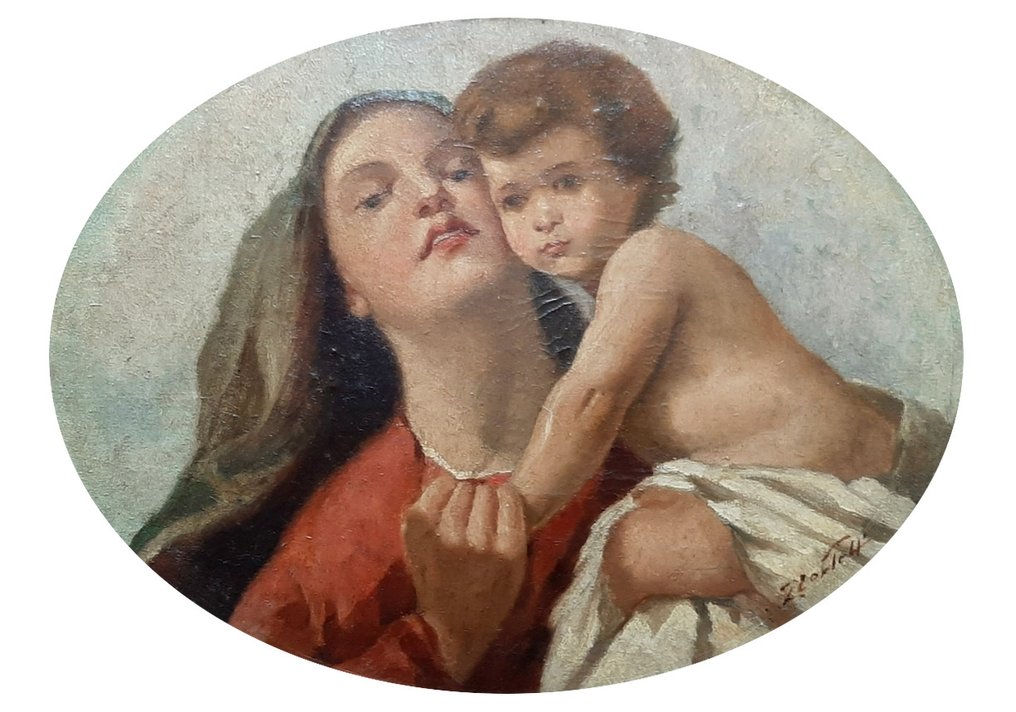
"Mater Purissima", oil on panel, 70*55cm with frame, 57*43cm the panel alone, unidentified signature lower right, datable to the end of the 19th century.
The painting is based on the celebrated work "Mater Purissima," created around 1880 by the renowned Neapolitan artist Domenico Morelli (1823-1901). The painting was a huge success as soon as it was completed, immediately spawning copies produced by numerous artists, and becoming the protagonist and subject of postcards, lithographs, and other objects intended for the private worship of the lower classes. In this case, Morelli's unidentified follower—though practically contemporary—reproduces the detail of the faces of Mary and the Baby Jesus, translating it into an oval format. In the reference painting, however, the Madonna appears full-figure, holding Christ in her arms.
Mary is depicted with her head slightly tilted back, shot with a slight foreshortening from below. Although Mary is a sacred figure here, as in the original, Mary displays the profane face of a woman, somewhat sensual. A blue veil covers her head, paired with her characteristic red dress, on which her hand firmly clasped around her son's stands out, almost as if to demonstrate the strength of the maternal bond. Jesus rests his head on his mother's and gazes at the viewer with a tender and innocent gaze. A beautifully crafted painting, in which the brushstrokes reveal a neo-Romantic influence, updated and influenced by the experience of the Italian Macchiaioli.
REFERENCE SCHOOL
Domenico Morelli (Naples, 1823 – Naples, 1901) was one of the most celebrated Italian painters of the 19th century. Trained at the Academy of Fine Arts in Naples, he began with religious and historical themes, quickly establishing himself as an interpreter of Romanticism and pictorial Verism. His art is characterized by a strong realism, combined with a narrative sensibility that allowed him to approach religious, literary, and popular subjects with great emotional intensity. He was close to the most modern cultural movements of his time, maintaining relationships with writers and intellectuals and opening Neapolitan painting to European influences.
Over the years, he achieved international fame, exhibiting in Italy and abroad, and became a key figure in the Neapolitan artistic scene, eventually serving as director of the Academy of Fine Arts in Naples. Among his best-known works are sacred canvases such as Mater Purissima and extensive historical and literary compositions. Considered an innovator for his ability to blend emotion, realism, and chromatic exploration, Morelli left a lasting mark on 19th-century Italian painting.
Condition Report
Good overall condition, the work is intact throughout, with vivid, legible colors. Craquelure consistent with the piece's age. The frame is complimentary.
Tracked and insured shipment with adequate packaging.
Description
"Mater Purissima", oil on panel, 70*55cm with frame, 57*43cm the panel alone, unidentified signature lower right, datable to the end of the 19th century.
The painting is based on the celebrated work "Mater Purissima," created around 1880 by the renowned Neapolitan artist Domenico Morelli (1823-1901). The painting was a huge success as soon as it was completed, immediately spawning copies produced by numerous artists, and becoming the protagonist and subject of postcards, lithographs, and other objects intended for the private worship of the lower classes. In this case, Morelli's unidentified follower—though practically contemporary—reproduces the detail of the faces of Mary and the Baby Jesus, translating it into an oval format. In the reference painting, however, the Madonna appears full-figure, holding Christ in her arms.
Mary is depicted with her head slightly tilted back, shot with a slight foreshortening from below. Although Mary is a sacred figure here, as in the original, Mary displays the profane face of a woman, somewhat sensual. A blue veil covers her head, paired with her characteristic red dress, on which her hand firmly clasped around her son's stands out, almost as if to demonstrate the strength of the maternal bond. Jesus rests his head on his mother's and gazes at the viewer with a tender and innocent gaze. A beautifully crafted painting, in which the brushstrokes reveal a neo-Romantic influence, updated and influenced by the experience of the Italian Macchiaioli.
REFERENCE SCHOOL
Domenico Morelli (Naples, 1823 – Naples, 1901) was one of the most celebrated Italian painters of the 19th century. Trained at the Academy of Fine Arts in Naples, he began with religious and historical themes, quickly establishing himself as an interpreter of Romanticism and pictorial Verism. His art is characterized by a strong realism, combined with a narrative sensibility that allowed him to approach religious, literary, and popular subjects with great emotional intensity. He was close to the most modern cultural movements of his time, maintaining relationships with writers and intellectuals and opening Neapolitan painting to European influences.
Over the years, he achieved international fame, exhibiting in Italy and abroad, and became a key figure in the Neapolitan artistic scene, eventually serving as director of the Academy of Fine Arts in Naples. Among his best-known works are sacred canvases such as Mater Purissima and extensive historical and literary compositions. Considered an innovator for his ability to blend emotion, realism, and chromatic exploration, Morelli left a lasting mark on 19th-century Italian painting.
Condition Report
Good overall condition, the work is intact throughout, with vivid, legible colors. Craquelure consistent with the piece's age. The frame is complimentary.
Tracked and insured shipment with adequate packaging.
Details
Artist
Domenico Morelli (1823-1901)
Sold with frame
Yes
Attribution
Follower of
Title of artwork
Mater Purissima
Technique
Oil painting
Signature
Hand signed
Country of Origin
Italy
Condition
Good condition
Height
70 cm
Width
53 cm
Style
Classical
Period
19th century
Sold by
