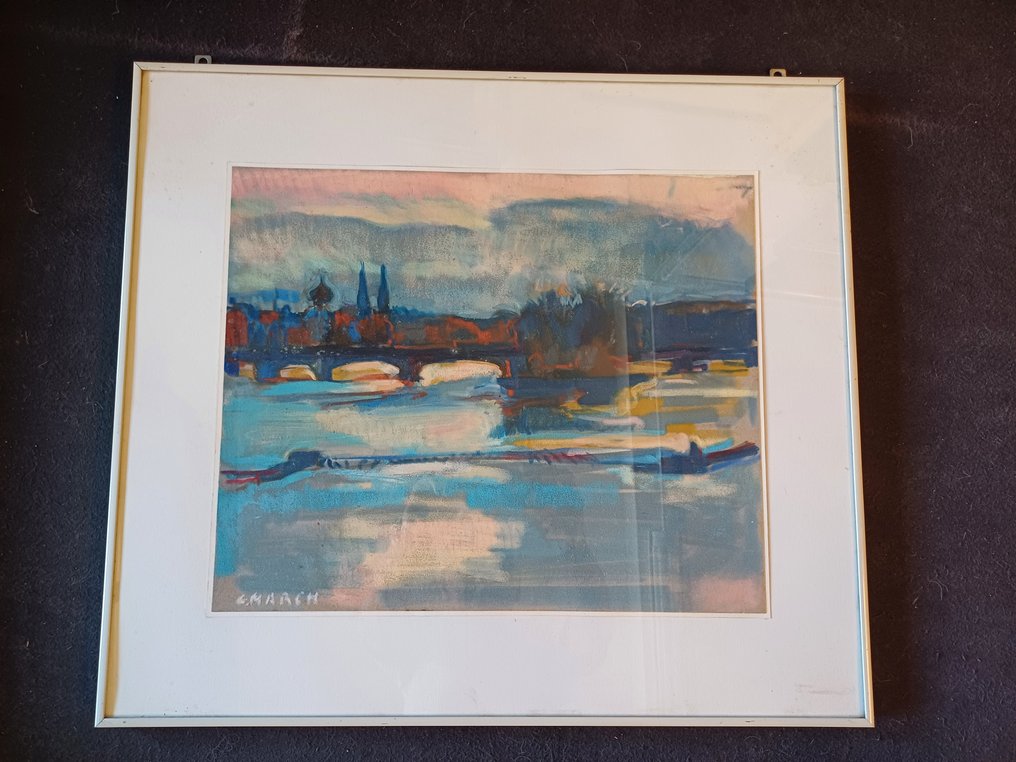
Giovanni March (1894-1974) - Veduta di città con fiume



01
day
11
hours
25
minutes
44
seconds
Current bid
€ 100
Reserve price not met

13 other people are watching this object
 Bidder 7405 Bidder 7405 | €100 | |
|---|---|---|
| Bidder 7405 | €2 | |
| Bidder 7405 | €1 |
Catawiki Buyer Protection
Your payment’s safe with us until you receive your object.View details
Trustpilot 4.4 | 121980 reviews
Rated Excellent on Trustpilot.
Veduta di città con fiume, 1940–1950, mixed media on paper, Italy, sold with frame.
AI-assisted summary
Description from the seller
Beautiful work by the painter Giovanni March (Tunis, February 2, 1894 – Livorno, October 30, 1974) painted with mixed media on paper in good condition.
The frame is not coeval with the work.
The work measures 37.5x46 cm.
Giovanni March (Tunis 1894 – Livorno 1974). Born in Tunis to Livornese parents, but in 1908, after his father's death, he moved to Livorno. March was a self-taught painter, encouraged to pursue this path by the post-Macchiaioli painter Angiolo Tommasi, whom he met in Castiglioncello. In the twenties, his works were inspired by the painting of Mario Puccini, a Livorno-born artist who died in 1920; in his honor, the Group Labronico was founded in that very year, and March was among its founders. Already in the 1920s, he participated in important exhibitions in Italy and received praise from painters like Carlo Carrà, which led to invitations to foreign exhibitions. Between 1920 and 1930, he lived in Paris, and in 1929, he exhibited at the L’Artistique Gallery in Nice and at the 35th Salon of the Society of Fine Arts in Nice; in 1930, he exhibited at the Bernheim Jeune Gallery in Paris. This experience inspired, in the same year, an exhibition at Bottega d’Arte in Livorno, where he was introduced by Ettore Petrolini. In 1938, he became an assistant at the Academy of Fine Arts in Florence, where he remained for twenty years. In the 1940s, his palette became lighter, with longer brushstrokes. In 1951, he returned to Paris for the second time. In the 1960s, his painting changed; the brushwork is hardly visible anymore, the atmosphere is still, the image frozen in time, and this would become his stylistic signature, making him more famous. He painted seascapes of the Tuscan coast, especially Livorno, but also countryside and still lifes. He continued to exhibit even in the seventies.
Origin of the collection from a private Italian collection.
Fast shipping with secure packaging
Seller's Story
Art dealer specializing in old master paintings and 19th century works
In collaboration with ART & INVESTIGATION historical and artistic investigations on works of art
Translated by Google TranslateBeautiful work by the painter Giovanni March (Tunis, February 2, 1894 – Livorno, October 30, 1974) painted with mixed media on paper in good condition.
The frame is not coeval with the work.
The work measures 37.5x46 cm.
Giovanni March (Tunis 1894 – Livorno 1974). Born in Tunis to Livornese parents, but in 1908, after his father's death, he moved to Livorno. March was a self-taught painter, encouraged to pursue this path by the post-Macchiaioli painter Angiolo Tommasi, whom he met in Castiglioncello. In the twenties, his works were inspired by the painting of Mario Puccini, a Livorno-born artist who died in 1920; in his honor, the Group Labronico was founded in that very year, and March was among its founders. Already in the 1920s, he participated in important exhibitions in Italy and received praise from painters like Carlo Carrà, which led to invitations to foreign exhibitions. Between 1920 and 1930, he lived in Paris, and in 1929, he exhibited at the L’Artistique Gallery in Nice and at the 35th Salon of the Society of Fine Arts in Nice; in 1930, he exhibited at the Bernheim Jeune Gallery in Paris. This experience inspired, in the same year, an exhibition at Bottega d’Arte in Livorno, where he was introduced by Ettore Petrolini. In 1938, he became an assistant at the Academy of Fine Arts in Florence, where he remained for twenty years. In the 1940s, his palette became lighter, with longer brushstrokes. In 1951, he returned to Paris for the second time. In the 1960s, his painting changed; the brushwork is hardly visible anymore, the atmosphere is still, the image frozen in time, and this would become his stylistic signature, making him more famous. He painted seascapes of the Tuscan coast, especially Livorno, but also countryside and still lifes. He continued to exhibit even in the seventies.
Origin of the collection from a private Italian collection.
Fast shipping with secure packaging
Seller's Story
Art dealer specializing in old master paintings and 19th century works
In collaboration with ART & INVESTIGATION historical and artistic investigations on works of art
Translated by Google TranslateDetails
Artist
Giovanni March (1894-1974)
Sold with frame
Yes
Sold by
Gallery
Title of artwork
Veduta di città con fiume
Technique
Mixed media
Signature
Hand signed
Country of Origin
Italy
Condition
Good condition
Height
56 cm
Width
64 cm
Period
1940-1950
Sold by
