Ancient Chinese, Tang Dynasty Pottery Statuette of a Fat Lady with Thermoluminescence test (TL) and Spanish Export License. - 29.6 cm


14
days
13
hours
30
minutes
36
seconds
Starting bid
€ 1
Reserve price not met

Expert
Selected by Ruth Garrido Vila
Directed the Ifergan Collection Museum, specialising in Phoenician and Mediterranean archaeology.
Estimate € 2,500 - € 3,000
No bids placed
Catawiki Buyer Protection
Your payment’s safe with us until you receive your object.View details
Trustpilot 4.4 | 121980 reviews
Rated Excellent on Trustpilot.
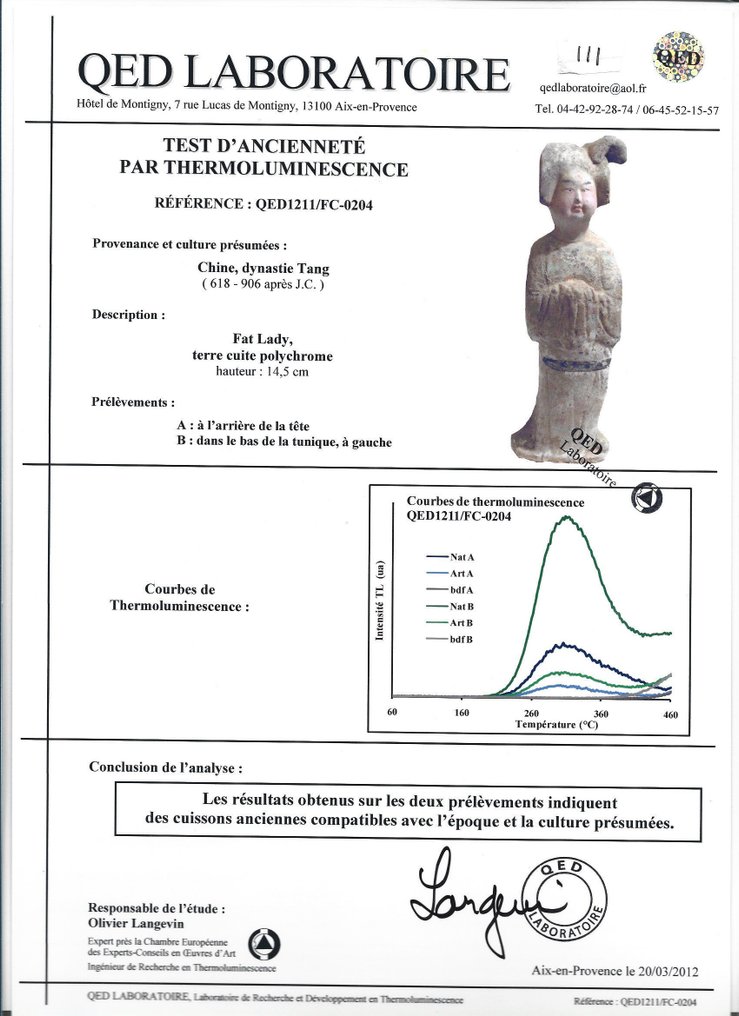
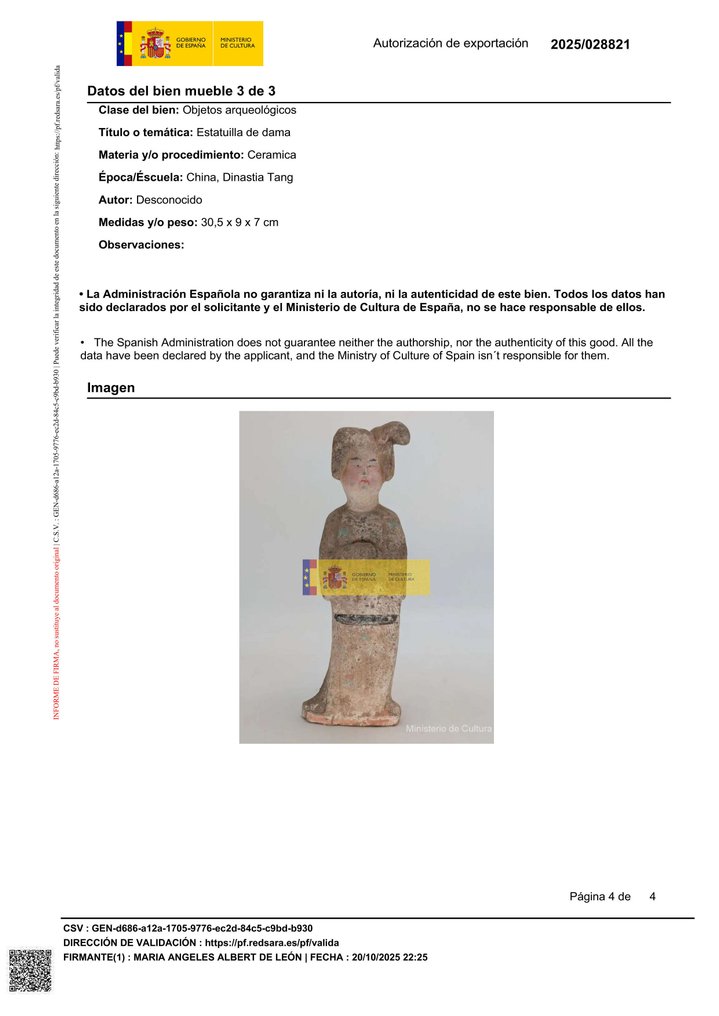
Statuette of a Fat Lady, an Ancient Chinese Tang Dynasty pottery figure (618–907 A.D.), 303 mm × 110 mm × 83 mm, in good condition, with Thermoluminescence test by QED Laboratory and a Spanish export license.
AI-assisted summary
Description from the seller
ITEM: Statuette of a Fat Lady
MATERIAL: Pottery
CULTURE: Chinese, Tang Dynasty
PERIOD: 618 - 907 A.D
DIMENSIONS: 303 mm x 110 mm x 83 mm
CONDITION: Good condition. Includes Thermoluminescence test by QED Laboratory (Reference: QED1211/FC-0204)
PROVENANCE: Ex French private collection, from Toulouse, acquired in the 1980s
PARALLEL: National Palace Museum, Taipei, Taiwan (R.O.C), Object number 000550N000000000. National Palace Museum, Taipei, Taiwan (R.O.C), Object number 000434N000000000
Comes with Certificate of Authenticity, Export license, Thermoluminescence test by QED Laboratory (Reference: QED1211/FC-0204)
If you bid outside the European Union and win the item, we will have to apply for an export licence for your country and shipping will take 3 to 5 weeks.
During the Tang dynasty (618–907 CE), China experienced a period of extraordinary cultural prosperity, artistic refinement, and cosmopolitan openness. The ceramic figures known today as Fat Ladies—portrayals of court women with full, rounded faces and voluptuous bodies—reflect both the ideals of beauty of the time and the sophistication of Tang funerary art. These sculptures, often found in elite tombs, were created as mingqi (spirit objects) intended to accompany the deceased in the afterlife, ensuring comfort, elegance, and the continuation of social status beyond death.
The figures typically depict court attendants dressed in long flowing robes with layered garments, high-waisted skirts, and elaborate coiffures arranged in large chignons or wing-shaped buns. Their serene expressions, gently tilted heads, and subtle hand gestures convey grace and dignity. The robust physiques—so different from the slender forms admired in other periods—reflect the Tang aesthetic that associated fullness with beauty, wealth, and good fortune. This ideal was famously linked to the influence of the imperial concubine Yang Guifei, whose celebrated plumpness epitomized sensuality and refinement at the Tang court.
Technically, these sculptures were made of earthenware and often decorated with pigments or sancai (three-colored) lead glazes in amber, green, and cream tones. The use of such vivid glazes, combined with delicate modeling, created figures of striking realism and charm. Many examples show traces of painted cosmetics, such as red lips and rouged cheeks, further emphasizing their fashionable appearance and status as embodiments of worldly elegance.
Together, the Tang Fat Lady figures offer a vivid glimpse into the tastes, values, and daily life of the Tang elite. They reveal how notions of beauty were intertwined with social and moral ideals—expressing not only physical opulence but also the grandeur and confidence of a flourishing empire at the height of its artistic achievement.
Seller's Story
Your Antiquarian offers ancient art and ancient coins. Our main objective is to offer the highest quality at the best price respecting and strictly complying with the laws of heritage protection and UNESCO heritage norms. Therefore, all the pieces that are published come from private collections in which the provenance can be checked or international auctions. All our antiquities and coins are accompanied by their Certificate of Authenticity. We have a no quibble 90 day return policy. At Your Antiquarian we are committed to helping disadvantaged groups and for this reason a portion of each purchase is donated to charities to help people in need.
Translated by Google TranslateITEM: Statuette of a Fat Lady
MATERIAL: Pottery
CULTURE: Chinese, Tang Dynasty
PERIOD: 618 - 907 A.D
DIMENSIONS: 303 mm x 110 mm x 83 mm
CONDITION: Good condition. Includes Thermoluminescence test by QED Laboratory (Reference: QED1211/FC-0204)
PROVENANCE: Ex French private collection, from Toulouse, acquired in the 1980s
PARALLEL: National Palace Museum, Taipei, Taiwan (R.O.C), Object number 000550N000000000. National Palace Museum, Taipei, Taiwan (R.O.C), Object number 000434N000000000
Comes with Certificate of Authenticity, Export license, Thermoluminescence test by QED Laboratory (Reference: QED1211/FC-0204)
If you bid outside the European Union and win the item, we will have to apply for an export licence for your country and shipping will take 3 to 5 weeks.
During the Tang dynasty (618–907 CE), China experienced a period of extraordinary cultural prosperity, artistic refinement, and cosmopolitan openness. The ceramic figures known today as Fat Ladies—portrayals of court women with full, rounded faces and voluptuous bodies—reflect both the ideals of beauty of the time and the sophistication of Tang funerary art. These sculptures, often found in elite tombs, were created as mingqi (spirit objects) intended to accompany the deceased in the afterlife, ensuring comfort, elegance, and the continuation of social status beyond death.
The figures typically depict court attendants dressed in long flowing robes with layered garments, high-waisted skirts, and elaborate coiffures arranged in large chignons or wing-shaped buns. Their serene expressions, gently tilted heads, and subtle hand gestures convey grace and dignity. The robust physiques—so different from the slender forms admired in other periods—reflect the Tang aesthetic that associated fullness with beauty, wealth, and good fortune. This ideal was famously linked to the influence of the imperial concubine Yang Guifei, whose celebrated plumpness epitomized sensuality and refinement at the Tang court.
Technically, these sculptures were made of earthenware and often decorated with pigments or sancai (three-colored) lead glazes in amber, green, and cream tones. The use of such vivid glazes, combined with delicate modeling, created figures of striking realism and charm. Many examples show traces of painted cosmetics, such as red lips and rouged cheeks, further emphasizing their fashionable appearance and status as embodiments of worldly elegance.
Together, the Tang Fat Lady figures offer a vivid glimpse into the tastes, values, and daily life of the Tang elite. They reveal how notions of beauty were intertwined with social and moral ideals—expressing not only physical opulence but also the grandeur and confidence of a flourishing empire at the height of its artistic achievement.
Seller's Story
Your Antiquarian offers ancient art and ancient coins. Our main objective is to offer the highest quality at the best price respecting and strictly complying with the laws of heritage protection and UNESCO heritage norms. Therefore, all the pieces that are published come from private collections in which the provenance can be checked or international auctions. All our antiquities and coins are accompanied by their Certificate of Authenticity. We have a no quibble 90 day return policy. At Your Antiquarian we are committed to helping disadvantaged groups and for this reason a portion of each purchase is donated to charities to help people in need.
Translated by Google TranslateDetails
Culture
Ancient Chinese, Tang Dynasty
Century/ Timeframe
618 - 907 A.D
Name of object
Statuette of a Fat Lady with Thermoluminescence test (TL) and Spanish Export License.
Acquired from
Private collection
Year acquired
2025
Material
Pottery
Country acquired from
France
Condition
Good
Previous owner acquired from
Antique market
Height
29.6 cm
Previous owner - year acquired
1980
Width
33 cm
Previous owner - country acquired from
France
Depth
20.3 cm
I verify that I have obtained this object legally and that I am allowed to sell it
Yes
Sold by
Disclaimer
The seller was informed by Catawiki about documentation requirements and guarantees the following: - the object was legally obtained, - the seller has the right to sell and/or export the object, as relevant, - the seller will provide the necessary provenance information and arrange required documentation and permits/licenses, as applicable and as per local laws, - the seller will notify the buyer of any delays in obtaining permits/licenses. By bidding, you acknowledge that import documentation may be required depending on your country of residence and that obtaining permits/licenses may cause delays in the delivery of your object.
The seller was informed by Catawiki about documentation requirements and guarantees the following: - the object was legally obtained, - the seller has the right to sell and/or export the object, as relevant, - the seller will provide the necessary provenance information and arrange required documentation and permits/licenses, as applicable and as per local laws, - the seller will notify the buyer of any delays in obtaining permits/licenses. By bidding, you acknowledge that import documentation may be required depending on your country of residence and that obtaining permits/licenses may cause delays in the delivery of your object.
