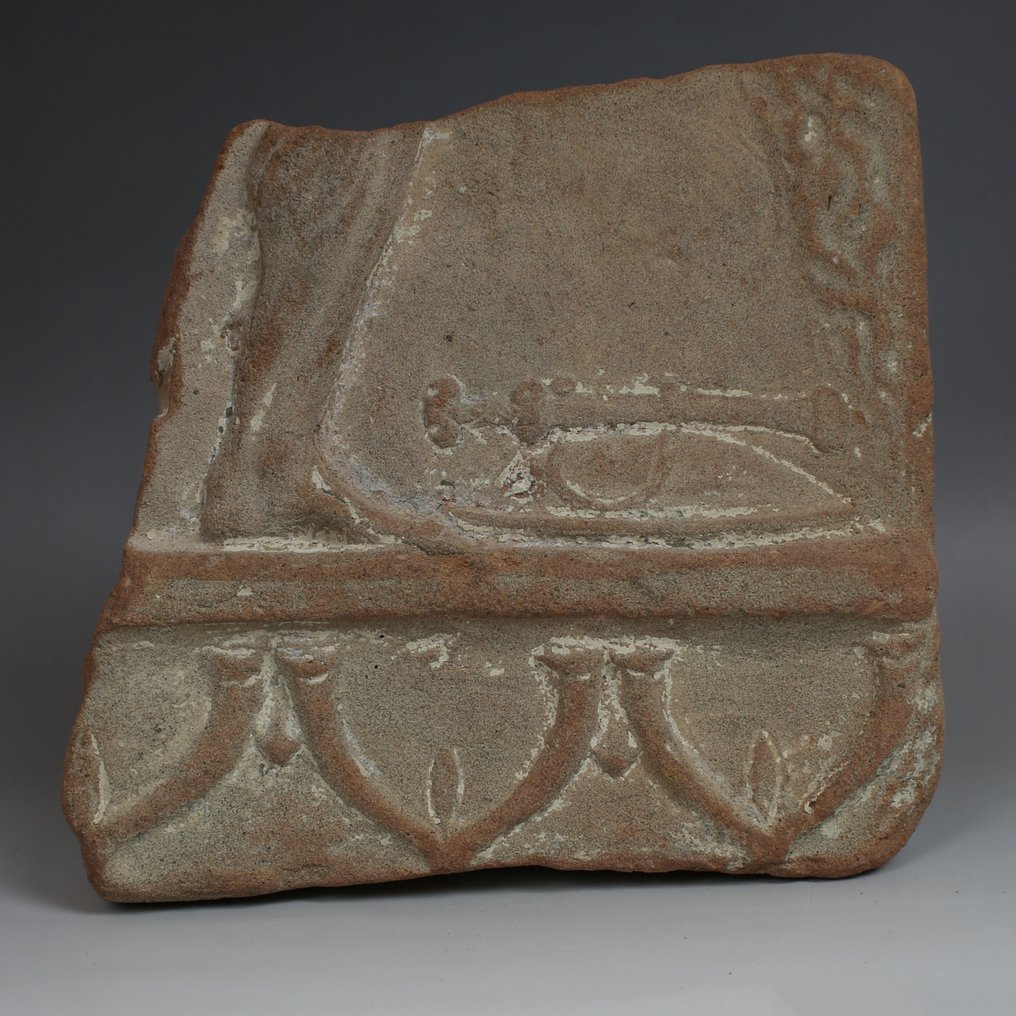
Ancient Roman Pottery Campana relief depicting mythological hero Theseus, lifting a huge rock, Aithra stands behind him



Opens 11:00
Starting bid
€ 1
Add to your favourites to get an alert when the auction starts.

Expert
Selected by Ruth Garrido Vila
Directed the Ifergan Collection Museum, specialising in Phoenician and Mediterranean archaeology.
Estimate € 1,300 - € 1,600
Catawiki Buyer Protection
Your payment’s safe with us until you receive your object.View details
Trustpilot 4.4 | 121980 reviews
Rated Excellent on Trustpilot.
Description from the seller
ITEM: Campana relief depicting mythological hero Theseus, shown lifting a huge rock under which his father Aigeus, King of Athens had hidden the sword and sandals Theseus would need for his perilous journeys. Theseus mother Aithra stands behind him, indicating the hiding spot.
MATERIAL: Pottery
CULTURE: Roman
PERIOD: 1st Century A.D
DIMENSIONS: Overall 630 mm x 410 mm, Separate pieces 345 mm x 340 mm x 50 mm, 230 mm x 230 mm x 50 mm, 132 mm x 190 mm x 25 mm
CONDITION: Good condition, fragmentary
PROVENANCE: Ex European private collection, Ex Lakythos S.A.R.L (1987), Ex Galerie Hydra, Geneva, Switzerland (1984)
PARALLEL: BRITISH MUSEUM Collection Online, Museum number 1893,0628.5
Comes with Certificate of Authenticity and European Union export license
If you bid outside European Union and win the item, we must request a new export license to your country and the shipment will delay between 3 - 5 weeks.
Roman terracotta busts of boys are a fascinating category of minor art that provides unique insights into childhood and commemoration in the ancient world. While large-scale imperial portraits were typically carved in expensive marble or bronze, terracotta—baked clay—offered an affordable and accessible medium for private individuals. These busts were often mass-produced using molds, though unique finishing touches would be added by hand. The typical representation features the boy with plump, soft, and realistic childlike features, such as full cheeks, a rounded face, and sometimes a serious, distant gaze that lent an air of gravitas (dignity) to the young subject, aligning with the Roman tradition of honoring ancestors. The hairstyle, often short and carefully combed, helps modern scholars date the piece by correlating it with prevailing imperial fashions of the time, such as the Julio-Claudian or Hadrianic periods.
The primary context for these terracotta portraits was funerary or commemorative. In a society with high infant mortality, the loss of a child was a common tragedy. These busts were frequently placed in tombs, either as a portrait of the deceased or as a stand-in for the expensive imago (wax death mask) or marble bust that only elite families could afford. Their use in tombs underscores the deep importance of the family unit (familia) in Roman life and the desire to preserve the memory and identity of even the youngest members. The terracotta material, despite its fragility, allowed for a wider dissemination of the portrait tradition, bringing the practice of individualized commemoration to a broader social class, including freedmen and middle-class families.
Stylistically, the terracotta busts of children demonstrate the Roman interest in realistic portraiture, a trend that often contrasted with the more idealized figures of Greek art. The artists were adept at capturing the vulnerability and particular features of youth, making the busts more personal and emotionally resonant than standardized adult figures. While some terracotta sculptures were plain, others show evidence of polychromy—being painted with vibrant colors—to enhance their lifelike appearance, though this paint rarely survives today. The survival of these delicate clay portraits, though often fragmentary, attests to their cultural significance and their role in a crucial Roman social function: creating a lasting visual record of a person's life for their family's lineage and remembrance.
Seller's Story
Your Antiquarian offers ancient art and ancient coins. Our main objective is to offer the highest quality at the best price respecting and strictly complying with the laws of heritage protection and UNESCO heritage norms. Therefore, all the pieces that are published come from private collections in which the provenance can be checked or international auctions. All our antiquities and coins are accompanied by their Certificate of Authenticity. We have a no quibble 90 day return policy. At Your Antiquarian we are committed to helping disadvantaged groups and for this reason a portion of each purchase is donated to charities to help people in need.
Translated by Google TranslateITEM: Campana relief depicting mythological hero Theseus, shown lifting a huge rock under which his father Aigeus, King of Athens had hidden the sword and sandals Theseus would need for his perilous journeys. Theseus mother Aithra stands behind him, indicating the hiding spot.
MATERIAL: Pottery
CULTURE: Roman
PERIOD: 1st Century A.D
DIMENSIONS: Overall 630 mm x 410 mm, Separate pieces 345 mm x 340 mm x 50 mm, 230 mm x 230 mm x 50 mm, 132 mm x 190 mm x 25 mm
CONDITION: Good condition, fragmentary
PROVENANCE: Ex European private collection, Ex Lakythos S.A.R.L (1987), Ex Galerie Hydra, Geneva, Switzerland (1984)
PARALLEL: BRITISH MUSEUM Collection Online, Museum number 1893,0628.5
Comes with Certificate of Authenticity and European Union export license
If you bid outside European Union and win the item, we must request a new export license to your country and the shipment will delay between 3 - 5 weeks.
Roman terracotta busts of boys are a fascinating category of minor art that provides unique insights into childhood and commemoration in the ancient world. While large-scale imperial portraits were typically carved in expensive marble or bronze, terracotta—baked clay—offered an affordable and accessible medium for private individuals. These busts were often mass-produced using molds, though unique finishing touches would be added by hand. The typical representation features the boy with plump, soft, and realistic childlike features, such as full cheeks, a rounded face, and sometimes a serious, distant gaze that lent an air of gravitas (dignity) to the young subject, aligning with the Roman tradition of honoring ancestors. The hairstyle, often short and carefully combed, helps modern scholars date the piece by correlating it with prevailing imperial fashions of the time, such as the Julio-Claudian or Hadrianic periods.
The primary context for these terracotta portraits was funerary or commemorative. In a society with high infant mortality, the loss of a child was a common tragedy. These busts were frequently placed in tombs, either as a portrait of the deceased or as a stand-in for the expensive imago (wax death mask) or marble bust that only elite families could afford. Their use in tombs underscores the deep importance of the family unit (familia) in Roman life and the desire to preserve the memory and identity of even the youngest members. The terracotta material, despite its fragility, allowed for a wider dissemination of the portrait tradition, bringing the practice of individualized commemoration to a broader social class, including freedmen and middle-class families.
Stylistically, the terracotta busts of children demonstrate the Roman interest in realistic portraiture, a trend that often contrasted with the more idealized figures of Greek art. The artists were adept at capturing the vulnerability and particular features of youth, making the busts more personal and emotionally resonant than standardized adult figures. While some terracotta sculptures were plain, others show evidence of polychromy—being painted with vibrant colors—to enhance their lifelike appearance, though this paint rarely survives today. The survival of these delicate clay portraits, though often fragmentary, attests to their cultural significance and their role in a crucial Roman social function: creating a lasting visual record of a person's life for their family's lineage and remembrance.
Seller's Story
Your Antiquarian offers ancient art and ancient coins. Our main objective is to offer the highest quality at the best price respecting and strictly complying with the laws of heritage protection and UNESCO heritage norms. Therefore, all the pieces that are published come from private collections in which the provenance can be checked or international auctions. All our antiquities and coins are accompanied by their Certificate of Authenticity. We have a no quibble 90 day return policy. At Your Antiquarian we are committed to helping disadvantaged groups and for this reason a portion of each purchase is donated to charities to help people in need.
Translated by Google TranslateDetails
Culture
Ancient Roman
Century/ Timeframe
1st Century A.D
Name of object
Campana relief depicting mythological hero Theseus, lifting a huge rock, Aithra stands behind him
Acquired from
Private collection
Year acquired
2025
Material
Pottery
Country acquired from
Netherlands
Condition
Good
Previous owner acquired from
Antique market
Previous owner - year acquired
1984
Previous owner - country acquired from
Netherlands
I verify that I have obtained this object legally and that I am allowed to sell it
Yes
Sold by
Disclaimer
The seller was informed by Catawiki about documentation requirements and guarantees the following: - the object was legally obtained, - the seller has the right to sell and/or export the object, as relevant, - the seller will provide the necessary provenance information and arrange required documentation and permits/licenses, as applicable and as per local laws, - the seller will notify the buyer of any delays in obtaining permits/licenses. By bidding, you acknowledge that import documentation may be required depending on your country of residence and that obtaining permits/licenses may cause delays in the delivery of your object.
The seller was informed by Catawiki about documentation requirements and guarantees the following: - the object was legally obtained, - the seller has the right to sell and/or export the object, as relevant, - the seller will provide the necessary provenance information and arrange required documentation and permits/licenses, as applicable and as per local laws, - the seller will notify the buyer of any delays in obtaining permits/licenses. By bidding, you acknowledge that import documentation may be required depending on your country of residence and that obtaining permits/licenses may cause delays in the delivery of your object.
