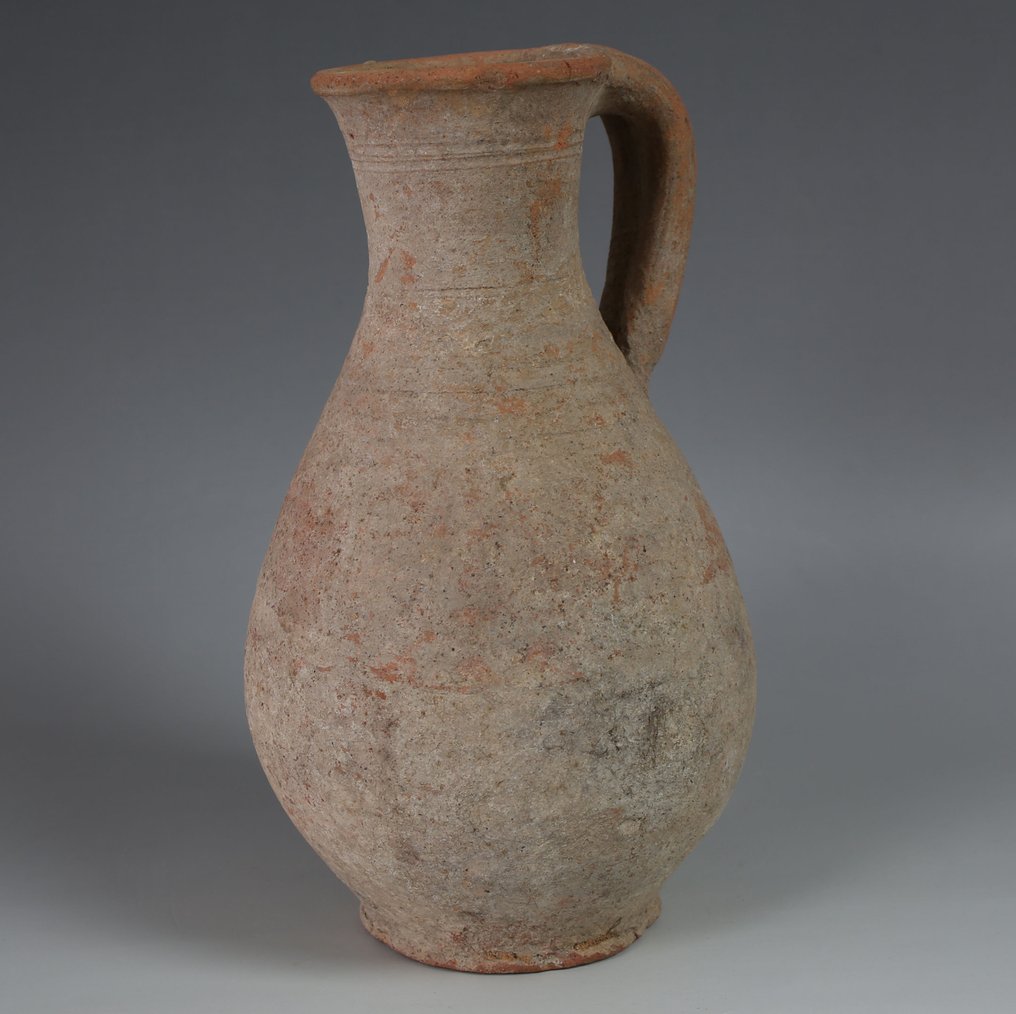
Ancient Roman Pottery Jug (No Reserve Price)


14
days
18
hours
56
minutes
03
seconds
Current bid
€ 1
No reserve price

Expert
Selected by Ruth Garrido Vila
Directed the Ifergan Collection Museum, specialising in Phoenician and Mediterranean archaeology.
Estimate € 330 - € 400
11 other people are watching this object
 Bidder 2345 Bidder 2345 | €1 |
|---|
Catawiki Buyer Protection
Your payment’s safe with us until you receive your object.View details
Trustpilot 4.4 | 121980 reviews
Rated Excellent on Trustpilot.
Ancient Roman pottery jug dating to the 2nd–3rd century A.D., 200 mm x 105 mm, in good condition, acquired in 2025 from a French private collection, with a Certificate of Authenticity and export licence.
AI-assisted summary
Description from the seller
ITEM: Jug
MATERIAL: Pottery
CULTURE: Roman
PERIOD: 2nd - 3rd Century A.D
DIMENSIONS: 200 mm x 105 mm
CONDITION: Good condition
PROVENANCE: Ex French private collection, acquired between 1970 - 1990
Comes with Certificate of Authenticity and Export license.
If you bid outside the European Union and win the item, we will have to apply for an export licence for your country and shipping will take 3 to 5 weeks.
Roman jugs, often referred to by their Latin names such as oinochoe, lagynos, or ampulla, were ubiquitous vessels in the Roman world, designed primarily for holding, serving, and pouring wine, water, or other beverages. Made from diverse materials including pottery (terra sigillata), bronze, and glass, jugs varied in size and refinement according to their intended use, ranging from simple, utilitarian terracotta pitchers used in the kitchen to elaborately decorated bronze vessels employed during formal banquets (convivia). The bronze jugs, in particular, often featured intricate handles molded with mythological figures, masks, or animal heads, showcasing the Roman mastery of metalworking and reflecting the high status of the owner.
The evolution of Roman jugs was influenced by both Etruscan and Greek traditions, but the vessels were adapted to the distinctly Roman custom of communal dining and drinking. Clay jugs, especially those produced in mass quantities throughout the empire, were essential for local commerce and military provisioning. The Roman emphasis on hygiene and the widespread availability of blown glass from the 1st century CE onwards led to a proliferation of glass jugs. These were prized for their non-porous nature and clarity, allowing the contents to be seen. Glass jugs, often found in domestic and funerary contexts, typically featured a single handle, a wide belly, and a slightly flared or pinched rim designed for easy pouring and minimal spillage.
Beyond their practical use in the tavern or dining room, Roman jugs held ritual and symbolic significance. In religious rites, they were used to pour libations to the gods, making them common finds near altars and temples. In funerary contexts, jugs were often included as grave goods—sometimes even intentionally broken—symbolizing the consumption of beverages in the afterlife or providing sustenance for the deceased's journey. Regardless of their material, Roman jugs stand as testament to the advanced manufacturing and widespread trade networks of the Imperial era, reflecting the daily habits, religious beliefs, and social stratification of the people who used them.
Seller's Story
Your Antiquarian offers ancient art and ancient coins. Our main objective is to offer the highest quality at the best price respecting and strictly complying with the laws of heritage protection and UNESCO heritage norms. Therefore, all the pieces that are published come from private collections in which the provenance can be checked or international auctions. All our antiquities and coins are accompanied by their Certificate of Authenticity. We have a no quibble 90 day return policy. At Your Antiquarian we are committed to helping disadvantaged groups and for this reason a portion of each purchase is donated to charities to help people in need.
Translated by Google TranslateITEM: Jug
MATERIAL: Pottery
CULTURE: Roman
PERIOD: 2nd - 3rd Century A.D
DIMENSIONS: 200 mm x 105 mm
CONDITION: Good condition
PROVENANCE: Ex French private collection, acquired between 1970 - 1990
Comes with Certificate of Authenticity and Export license.
If you bid outside the European Union and win the item, we will have to apply for an export licence for your country and shipping will take 3 to 5 weeks.
Roman jugs, often referred to by their Latin names such as oinochoe, lagynos, or ampulla, were ubiquitous vessels in the Roman world, designed primarily for holding, serving, and pouring wine, water, or other beverages. Made from diverse materials including pottery (terra sigillata), bronze, and glass, jugs varied in size and refinement according to their intended use, ranging from simple, utilitarian terracotta pitchers used in the kitchen to elaborately decorated bronze vessels employed during formal banquets (convivia). The bronze jugs, in particular, often featured intricate handles molded with mythological figures, masks, or animal heads, showcasing the Roman mastery of metalworking and reflecting the high status of the owner.
The evolution of Roman jugs was influenced by both Etruscan and Greek traditions, but the vessels were adapted to the distinctly Roman custom of communal dining and drinking. Clay jugs, especially those produced in mass quantities throughout the empire, were essential for local commerce and military provisioning. The Roman emphasis on hygiene and the widespread availability of blown glass from the 1st century CE onwards led to a proliferation of glass jugs. These were prized for their non-porous nature and clarity, allowing the contents to be seen. Glass jugs, often found in domestic and funerary contexts, typically featured a single handle, a wide belly, and a slightly flared or pinched rim designed for easy pouring and minimal spillage.
Beyond their practical use in the tavern or dining room, Roman jugs held ritual and symbolic significance. In religious rites, they were used to pour libations to the gods, making them common finds near altars and temples. In funerary contexts, jugs were often included as grave goods—sometimes even intentionally broken—symbolizing the consumption of beverages in the afterlife or providing sustenance for the deceased's journey. Regardless of their material, Roman jugs stand as testament to the advanced manufacturing and widespread trade networks of the Imperial era, reflecting the daily habits, religious beliefs, and social stratification of the people who used them.
Seller's Story
Your Antiquarian offers ancient art and ancient coins. Our main objective is to offer the highest quality at the best price respecting and strictly complying with the laws of heritage protection and UNESCO heritage norms. Therefore, all the pieces that are published come from private collections in which the provenance can be checked or international auctions. All our antiquities and coins are accompanied by their Certificate of Authenticity. We have a no quibble 90 day return policy. At Your Antiquarian we are committed to helping disadvantaged groups and for this reason a portion of each purchase is donated to charities to help people in need.
Translated by Google TranslateDetails
Culture
Ancient Roman
Century/ Timeframe
2nd - 3rd Century A.D
Name of object
Jug
Acquired from
Private collection
Year acquired
2025
Material
Pottery
Country acquired from
France
Condition
Good
Previous owner acquired from
Antique market
Previous owner - year acquired
1970
Previous owner - country acquired from
United States
I verify that I have obtained this object legally and that I am allowed to sell it
Yes
Sold by
Disclaimer
The seller was informed by Catawiki about documentation requirements and guarantees the following: - the object was legally obtained, - the seller has the right to sell and/or export the object, as relevant, - the seller will provide the necessary provenance information and arrange required documentation and permits/licenses, as applicable and as per local laws, - the seller will notify the buyer of any delays in obtaining permits/licenses. By bidding, you acknowledge that import documentation may be required depending on your country of residence and that obtaining permits/licenses may cause delays in the delivery of your object.
The seller was informed by Catawiki about documentation requirements and guarantees the following: - the object was legally obtained, - the seller has the right to sell and/or export the object, as relevant, - the seller will provide the necessary provenance information and arrange required documentation and permits/licenses, as applicable and as per local laws, - the seller will notify the buyer of any delays in obtaining permits/licenses. By bidding, you acknowledge that import documentation may be required depending on your country of residence and that obtaining permits/licenses may cause delays in the delivery of your object.
