Louis De Caullery (c.1580-c.1621) - XVII Vlaamse Navolger - Le Golgotha - NO RESERVE




09
days
16
hours
21
minutes
00
seconds
Current bid
€ 1,025
No reserve price

Expert
Selected by Caroline Bokobza
Graduated as French auctioneer and worked in Sotheby’s Paris valuation department.
Estimate € 8,000 - € 9,600
57 other people are watching this object
 Bidder 2632 Bidder 2632 | €1,025 | |
|---|---|---|
| Bidder 3938 | €975 | |
 Bidder 7791 Bidder 7791 | €925 | |
Catawiki Buyer Protection
Your payment’s safe with us until you receive your object.View details
Trustpilot 4.4 | 121980 reviews
Rated Excellent on Trustpilot.
Le Golgotha - NO RESERVE, a 17th-century oil painting from Belgium, by a Flemish follower of Louis de Caullery, sold with frame.
AI-assisted summary
Description from the seller
17th-century Flemish follower of Louis de Caullery (ca. 1580–ca. 1621)
The Golgotha
Oil paint on panel, 49.5 × 36.5 cm
With list 64.5 × 49.5 cm
Undesignated
Flemish Baroque
Condition: old panel with a horizontal crack, glued and stabilized; slight bulging; retouchings visible under UV; surface cleaned and coated with very thin dammar matte varnish; framed in a 19th–20th-century carved frame with bronze-colored accents.
Introduction
This 17th-century Flemish panel belongs to the tradition of Louis de Caullery, an artist active in Antwerp, who is especially known for his detailed, richly populated compositions. His style was widely adopted in the Southern Netherlands, with workshops favoring meticulous finishing, compact figuration, and clear narration. This depiction of Golgotha closely aligns with that tradition and showcases the visual language that developed strongly in early Flemish baroque.
description of the work
Central is the depiction of the cross of Christ, flanked by the two criminals. The scene is composed around a wide variety of characters: soldiers, riders, high-ranking military officials, bystanders, and the mourning group around Mary and John. The artist has rendered these figures with remarkable attention to detail, visible in helmets, chainmail, spear points, horse equipment, and garments.
The composition is richly populated but still clear, with a distinct grouping into foreground, middle zone, and background. The small figures in the distance enhance the sense of depth and give the scene a lively, almost processional character that is typical of followers of De Caullery.
technique and use of color
The painting is executed in oil paint on a crafted wooden panel, in which the texture of the individual parts remains recognizable. The paint application is fine, precise, and linear, with clearly defined forms. The palette consists of warm red and ochre tones, complemented by green and earth colors in the landscape zone. Accents in white bring light and rhythm to the composition, especially in armor, garments, and attributes. The recently applied thin dammar matte varnish provides an even satin gloss and emphasizes the depth of color.
composition
The vertical axis of the cross forms the structural center of the composition. Around it, the scene is divided into three clearly readable zones. The foreground contains the mourners and a prominent rider figure; the middle zone is dominated by the gathered soldiers and onlookers; the background shows troops spreading further across the landscape. The orderly arrangement and layering fit within the early Baroque tradition of Flemish history paintings, in which the dramatic event was embedded within a clear, readable structure.
art historical context and style
Louis de Caullery worked in Antwerp during the transition from late Mannerist elegance to early Baroque clarity. His work is characterized by refinement, precise detailing, and a strong interest in scenes with numerous figures. The followers who worked in his style, including the maker of this panel, continued this tradition by developing compact, richly filled history paintings.
Within Flemish painting, the work aligns with contemporaries such as Frans Francken II and Hendrick van Balen; internationally, stylistic departures can be seen in artists like Paul Bril and Jacopo Tintoretto.
the artist (successor of)
Louis de Caullery, born in Cambrai and active in Antwerp, was admitted as a master in the Sint-Lucasgilde in 1602. His body of work includes cityscapes, interiors, and figurative scenes with particular attention to detail and decoration. The influence of his style was significant, as evidenced by the broad following that emerged in the 17th century. This panel was created by an anonymous Flemish follower who clearly remains within this stylistic continuity.
condition
The panel shows an old horizontal crack that has been professionally glued and reinforced at the back. A slight bulging of the wood is present but stable. Under UV light, retouchings become visible along the crack line and in some small areas of the painted surface. The paint layer exhibits a fine craquelure pattern and is in a stable condition. Surface cleaning and a very thin dammar matte varnish ensure a clear and well-maintained presentation. The 19th–20th century robust frame provides a suitable surround.
This panel is a representative example of the 17th-century Flemish imitation of Louis de Caullery. The detailed figures, compact and orderly composition, and narrative strength clearly place the work within the early Baroque tradition of the Southern Netherlands. The painting combines devotional content with technical craftsmanship and reflects the enduring appeal of De Caullery’s style.
The work 'Le Golgotha' is a 19th/20th-century wooden Robbellist frame with a bronze gold-gilded finish.
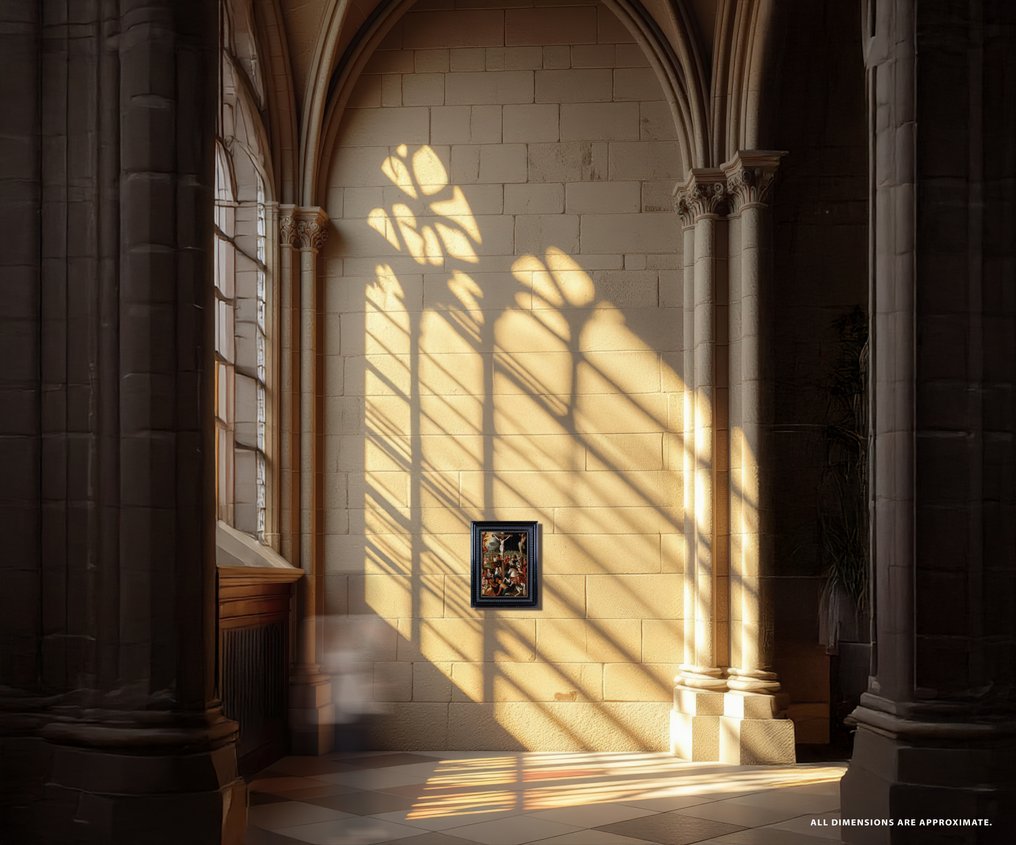
Total dimensions: 64.5x49.5cm
Canvas dimensions: 49.5x36.5cm
All shipments are sent in professional packaging via FedEx, DPD, or PostNL.
For all shipments, a surcharge for packaging material applies, which is already included in the stated shipping price.
Shipping artworks always carries certain risks. While shipping is possible, we recommend collecting the artwork in person when this option is available. If shipping is chosen, this is entirely at the buyer's risk. Collection ensures that the artwork will be received undamaged and in perfect condition. After purchase, you can easily schedule an appointment to collect the artwork from our workshop and studio, where it will be safely and carefully prepared for you.
Transport quotation request via our website (Service-transport) or via Catawiki support.
When purchasing this artwork, you have the option to have it delivered with or without a frame. The frame, richly decorated and matching the artwork, is offered free of charge so you can hang the painting immediately. Although we take utmost care in professional packaging and shipping, there is a small risk of damage to the frame or glass during transport. Any damage to the frame or glass that does not affect the artwork itself will not be accepted as a valid reason for a claim or cancellation. We recommend collecting the artwork in person or arranging your own transportation, as damage to the frame, especially the plaster ornaments, will not be covered.
We aim to deliver your artwork to you safely and in optimal condition, paying careful attention to packaging and the shipping process. If you have any questions or special requests, you can always contact Catawiki customer service.
The customer is responsible for any customs duties and additional costs that may apply upon delivery abroad.
Seller's Story
Welcome to Vandenberg Fine Art BV on Catawiki. We specialize in paintings from the 15th to the 19th century, with particular attention to Dutch, Belgian, and Italian masters. Our carefully curated collection consists of high-quality artworks that stand out for their artistic quality, authenticity, and historical relevance.
Our offer includes works by prominent artists from the Dutch and Flemish schools, as well as important representatives of the Italian Renaissance and Baroque. Each artwork is selected with expertise, paying special attention to condition, provenance, and art historical significance.
At Vandenberg Fine Art, reliability and transparency are central. We provide detailed descriptions, high-quality images, and carefully conducted provenance research. Our goal is to support both experienced collectors and novice art lovers in making informed choices.
Discover our exclusive collection and experience the rich history and lasting beauty of classical painting.
Translated by Google Translate17th-century Flemish follower of Louis de Caullery (ca. 1580–ca. 1621)
The Golgotha
Oil paint on panel, 49.5 × 36.5 cm
With list 64.5 × 49.5 cm
Undesignated
Flemish Baroque
Condition: old panel with a horizontal crack, glued and stabilized; slight bulging; retouchings visible under UV; surface cleaned and coated with very thin dammar matte varnish; framed in a 19th–20th-century carved frame with bronze-colored accents.
Introduction
This 17th-century Flemish panel belongs to the tradition of Louis de Caullery, an artist active in Antwerp, who is especially known for his detailed, richly populated compositions. His style was widely adopted in the Southern Netherlands, with workshops favoring meticulous finishing, compact figuration, and clear narration. This depiction of Golgotha closely aligns with that tradition and showcases the visual language that developed strongly in early Flemish baroque.
description of the work
Central is the depiction of the cross of Christ, flanked by the two criminals. The scene is composed around a wide variety of characters: soldiers, riders, high-ranking military officials, bystanders, and the mourning group around Mary and John. The artist has rendered these figures with remarkable attention to detail, visible in helmets, chainmail, spear points, horse equipment, and garments.
The composition is richly populated but still clear, with a distinct grouping into foreground, middle zone, and background. The small figures in the distance enhance the sense of depth and give the scene a lively, almost processional character that is typical of followers of De Caullery.
technique and use of color
The painting is executed in oil paint on a crafted wooden panel, in which the texture of the individual parts remains recognizable. The paint application is fine, precise, and linear, with clearly defined forms. The palette consists of warm red and ochre tones, complemented by green and earth colors in the landscape zone. Accents in white bring light and rhythm to the composition, especially in armor, garments, and attributes. The recently applied thin dammar matte varnish provides an even satin gloss and emphasizes the depth of color.
composition
The vertical axis of the cross forms the structural center of the composition. Around it, the scene is divided into three clearly readable zones. The foreground contains the mourners and a prominent rider figure; the middle zone is dominated by the gathered soldiers and onlookers; the background shows troops spreading further across the landscape. The orderly arrangement and layering fit within the early Baroque tradition of Flemish history paintings, in which the dramatic event was embedded within a clear, readable structure.
art historical context and style
Louis de Caullery worked in Antwerp during the transition from late Mannerist elegance to early Baroque clarity. His work is characterized by refinement, precise detailing, and a strong interest in scenes with numerous figures. The followers who worked in his style, including the maker of this panel, continued this tradition by developing compact, richly filled history paintings.
Within Flemish painting, the work aligns with contemporaries such as Frans Francken II and Hendrick van Balen; internationally, stylistic departures can be seen in artists like Paul Bril and Jacopo Tintoretto.
the artist (successor of)
Louis de Caullery, born in Cambrai and active in Antwerp, was admitted as a master in the Sint-Lucasgilde in 1602. His body of work includes cityscapes, interiors, and figurative scenes with particular attention to detail and decoration. The influence of his style was significant, as evidenced by the broad following that emerged in the 17th century. This panel was created by an anonymous Flemish follower who clearly remains within this stylistic continuity.
condition
The panel shows an old horizontal crack that has been professionally glued and reinforced at the back. A slight bulging of the wood is present but stable. Under UV light, retouchings become visible along the crack line and in some small areas of the painted surface. The paint layer exhibits a fine craquelure pattern and is in a stable condition. Surface cleaning and a very thin dammar matte varnish ensure a clear and well-maintained presentation. The 19th–20th century robust frame provides a suitable surround.
This panel is a representative example of the 17th-century Flemish imitation of Louis de Caullery. The detailed figures, compact and orderly composition, and narrative strength clearly place the work within the early Baroque tradition of the Southern Netherlands. The painting combines devotional content with technical craftsmanship and reflects the enduring appeal of De Caullery’s style.
The work 'Le Golgotha' is a 19th/20th-century wooden Robbellist frame with a bronze gold-gilded finish.
Total dimensions: 64.5x49.5cm
Canvas dimensions: 49.5x36.5cm
All shipments are sent in professional packaging via FedEx, DPD, or PostNL.
For all shipments, a surcharge for packaging material applies, which is already included in the stated shipping price.
Shipping artworks always carries certain risks. While shipping is possible, we recommend collecting the artwork in person when this option is available. If shipping is chosen, this is entirely at the buyer's risk. Collection ensures that the artwork will be received undamaged and in perfect condition. After purchase, you can easily schedule an appointment to collect the artwork from our workshop and studio, where it will be safely and carefully prepared for you.
Transport quotation request via our website (Service-transport) or via Catawiki support.
When purchasing this artwork, you have the option to have it delivered with or without a frame. The frame, richly decorated and matching the artwork, is offered free of charge so you can hang the painting immediately. Although we take utmost care in professional packaging and shipping, there is a small risk of damage to the frame or glass during transport. Any damage to the frame or glass that does not affect the artwork itself will not be accepted as a valid reason for a claim or cancellation. We recommend collecting the artwork in person or arranging your own transportation, as damage to the frame, especially the plaster ornaments, will not be covered.
We aim to deliver your artwork to you safely and in optimal condition, paying careful attention to packaging and the shipping process. If you have any questions or special requests, you can always contact Catawiki customer service.
The customer is responsible for any customs duties and additional costs that may apply upon delivery abroad.
Seller's Story
Welcome to Vandenberg Fine Art BV on Catawiki. We specialize in paintings from the 15th to the 19th century, with particular attention to Dutch, Belgian, and Italian masters. Our carefully curated collection consists of high-quality artworks that stand out for their artistic quality, authenticity, and historical relevance.
Our offer includes works by prominent artists from the Dutch and Flemish schools, as well as important representatives of the Italian Renaissance and Baroque. Each artwork is selected with expertise, paying special attention to condition, provenance, and art historical significance.
At Vandenberg Fine Art, reliability and transparency are central. We provide detailed descriptions, high-quality images, and carefully conducted provenance research. Our goal is to support both experienced collectors and novice art lovers in making informed choices.
Discover our exclusive collection and experience the rich history and lasting beauty of classical painting.
Translated by Google TranslateDetails
Artist
Louis De Caullery (c.1580-c.1621) - XVII Vlaamse Navolger
Sold with frame
Yes
Title of artwork
Le Golgotha - NO RESERVE
Technique
Oil painting
Signature
Not signed
Country of Origin
Belgium
Condition
Good condition
Height
64.5 cm
Width
49.5 cm
Weight
5 kg
Depiction/Theme
Religion
Style
Baroque
Period
17th century
Sold by
