Marco Liberi (1640-1725), Attrib. - Susanna e i vecchioni - NO RESERVE



13
days
08
hours
44
minutes
41
seconds
Current bid
€ 400
No reserve price

Expert
Selected by Caterina Maffeis
Master in early Renaissance Italian painting with internship at Sotheby’s and 15 years' experience.
Estimate € 9,000 - € 12,000
84 other people are watching this object
 Bidder 3418 Bidder 3418 | €400 | |
|---|---|---|
| Bidder 1821 | €380 | |
| Bidder 3418 | €340 | |
Catawiki Buyer Protection
Your payment’s safe with us until you receive your object.View details
Trustpilot 4.4 | 122053 reviews
Rated Excellent on Trustpilot.
Susanna e i vecchioni - NO RESERVE, 17th century, oil painting, Italy, sold with frame.
AI-assisted summary
Description from the seller
Marco Liberi (1640–1725), attributed – Susanna and the Elders
Oil painting on canvas, 55.5 × 63.5 cm (frame: 66 × 74 cm) – Baroque – unsigned – professionally restored (double-layered; retouches visible under UV). No Reserve.
Introduction
The theme of Susanna and the elders belongs to the most charged and psychologically compelling subjects in seventeenth-century painting. The dramatic scene, originating from chapter 13 of the biblical book of Daniel, was particularly popular during the Baroque period due to the moral tension between innocence and abuse of power, the opportunity for expressive body postures, and the contrast between light and dark. This painting closely aligns with the oeuvre of Marco Liberi through its brushwork, thematic intensity, and Venetian-like color palette, as he was known for his skill in depicting refined female figures and emotionally charged mythological and biblical scenes.
Description of the work
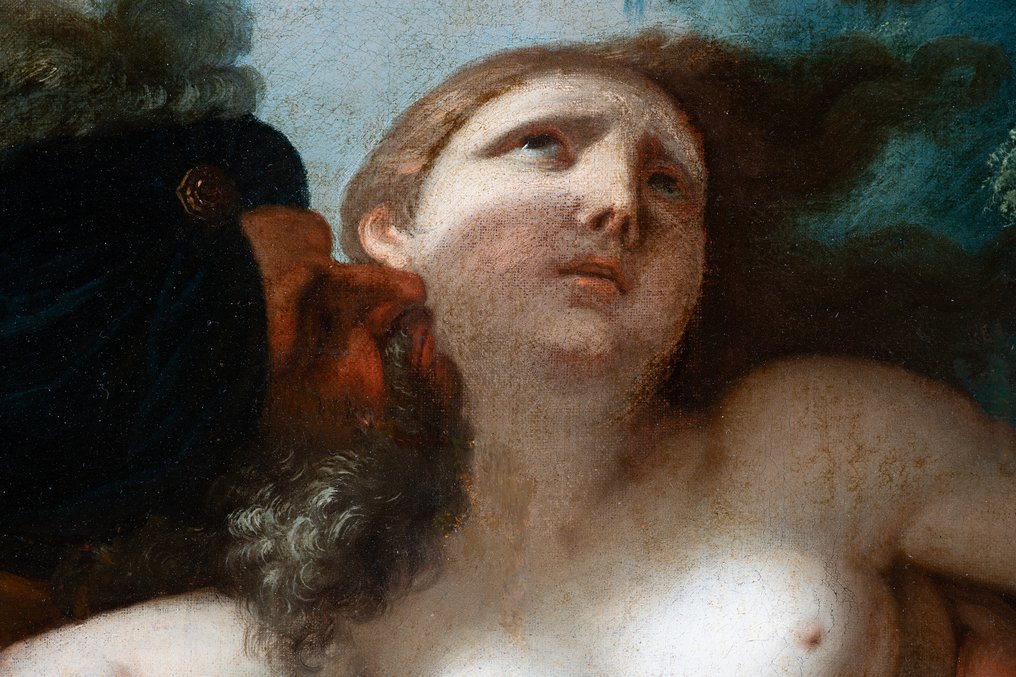
The canvas depicts a poignant moment at the peak of the drama: Susanna, caught in her intimacy, is forced and assaulted by two elders. Her body is half-turned, vulnerable and centrally lit, making her the visual and narrative focal point. Her facial expression, with upward-gazing eyes and a tense mouth, shows fear and inner resistance. The painter paid great attention to the soft, porcelain-like texture of Susanna's skin; subtle shades of pink, cream tones, and cool half-tones give her a lively and naturalistic presence.
The elders are placed close to her body, almost in a choreography of embracing. The man on the left, dressed in warm red robes and a dark turban, pushes forward, his face shadowed and strongly contrasted with Susanna's illuminated skin. The man on the right, wearing a red and white headscarf, holds her arm with tense hand, while his other hand tries to pull the white cloth around her waist away. The interaction of the figures is carefully composed and captivates the viewer's gaze: the three bodies form a closed, dramatic unity, reinforced by the diagonal lines of arms and shoulders.
The background shows a landscape with a dense canopy of leaves, an atmosphere that is typically Venetian in its color palette and suggestive light. The upper edge of the bright blue sky with light pink cloud reflections contrasts with the dark forest zones, giving the scene a theatrical depth effect.
Technique and use of color
The painter used thin glaze layers that give the skin tones a soft, almost transparent glow. The modeling is characteristically classical baroque: smooth transitions, saturated shadows, and convincing anatomical shaping. The colors are carefully balanced. Warm earth tones — seen in the clothing of the elders and in the shadows — alternate with cool, serene hues in the sky and the surrounding greenery. The white cloth that surrounds Susanna is painted with special attention: the folds demonstrate both technical mastery and a deliberate play with light reflections, essential in the baroque depiction of texture and material.
The paint layer shows a nuanced craquelure under natural lighting that matches the age of the work. Under UV light (see the provided images), retouches become visible, mainly along the background areas and some accents in clothing and contours. These retouches are carefully applied for aesthetic reasons and support the conclusion that the work has been professionally conserved in the past.
Composition and art historical context
The composition follows an expressed baroque conception: a close clustering of figures, a dynamic diagonal structure, and a strong focus on the interplay between light and dark. By illuminating Susanna’s body centrally and rendering the elders in more subdued tones, the painter creates a morally charged hierarchy: light signifies innocence, darkness signifies threat.
The theme was developed in a similar way in the 17th century by artists who aimed to elevate the psychological tension of the moment into a dramatic tableau. The Venetian tradition — rooted in Marco Liberi — is characterized by an emphasis on colorito, building with color rather than with line. This is clearly evident here: contours are soft, forms flow into each other, and the emotional impact is carried by tonality and light.
The work fits within the broader European Baroque, where expression, movement, and pathos were central. The technical and stylistic kinship with Venetian and North Italian ateliers from the late 17th century is convincingly visible. Stylistic peers working within the same thematic and expressive tradition include, among others, (national) Bernardo Strozzi and Palma il Giovane, and (internationally) Artemisia Gentileschi and Guido Reni.
The artist
Marco Liberi (Treviso, 1640 – Venice, 1725) was the son and pupil of Liberale da Verona. His oeuvre mainly includes mythological and sensually dramatic representations in which female protagonists play an important role. He primarily worked in Venice, where the influence of colorito and the theatrical baroque style defined his signature. Although Liberi left behind a limited body of documented works, he is known for refined figure modeling and pronounced narrative intensity — both elements present in the work offered here.
Condition
The painting has been professionally double-mounted, a conservation intervention appropriate for works from this period. The recent restoration by Atelier Simonis in the Netherlands included superficial cleaning, consolidation of the paint layer, and careful retouching, which are only visible under UV light. The overall condition is stable; craquelure is appropriate and evenly distributed. The restoration is technically sound and carried out according to current museum standards.
Final remarks
This painting exemplifies a classic Baroque history painting tradition. The powerful interplay of emotion, color, light, and composition gives the scene a vivid intensity and a timeless contemporary relevance. The attribution to Marco Liberi is supported by the Venetian stylistic features, the delicate rendering of the female figure, and the thematic preference for dramatic and moral stories. It is a work that has a strong presence both art historically and decoratively, and it constitutes a valuable addition to a collection centered on Baroque painting and seventeenth-century Italian masters.
The work 'Susanna en de ouderlingen' is housed in a matte black wooden frame with a brass-plated silver finish.
Total dimensions: 66x74cm
Canvas dimensions: 55.5x63.5cm
All shipments are sent in professional packaging via FedEx, DPD, or PostNL.
For all shipments, a surcharge for packaging material applies, which is already included in the stated shipping price.
We aim to deliver your artwork to you safely and in optimal condition, paying careful attention to packaging and the shipping process. If you have any questions or special requests, you can always contact Catawiki customer service.
The customer is responsible for any customs duties and additional costs that may apply upon delivery abroad.
Seller's Story
Welcome to Vandenberg Fine Art BV on Catawiki. We specialize in paintings from the 15th to the 19th century, with particular attention to Dutch, Belgian, and Italian masters. Our carefully curated collection consists of high-quality artworks that stand out for their artistic quality, authenticity, and historical relevance.
Our offer includes works by prominent artists from the Dutch and Flemish schools, as well as important representatives of the Italian Renaissance and Baroque. Each artwork is selected with expertise, paying special attention to condition, provenance, and art historical significance.
At Vandenberg Fine Art, reliability and transparency are central. We provide detailed descriptions, high-quality images, and carefully conducted provenance research. Our goal is to support both experienced collectors and novice art lovers in making informed choices.
Discover our exclusive collection and experience the rich history and lasting beauty of classical painting.
Translated by Google TranslateMarco Liberi (1640–1725), attributed – Susanna and the Elders
Oil painting on canvas, 55.5 × 63.5 cm (frame: 66 × 74 cm) – Baroque – unsigned – professionally restored (double-layered; retouches visible under UV). No Reserve.
Introduction
The theme of Susanna and the elders belongs to the most charged and psychologically compelling subjects in seventeenth-century painting. The dramatic scene, originating from chapter 13 of the biblical book of Daniel, was particularly popular during the Baroque period due to the moral tension between innocence and abuse of power, the opportunity for expressive body postures, and the contrast between light and dark. This painting closely aligns with the oeuvre of Marco Liberi through its brushwork, thematic intensity, and Venetian-like color palette, as he was known for his skill in depicting refined female figures and emotionally charged mythological and biblical scenes.
Description of the work
The canvas depicts a poignant moment at the peak of the drama: Susanna, caught in her intimacy, is forced and assaulted by two elders. Her body is half-turned, vulnerable and centrally lit, making her the visual and narrative focal point. Her facial expression, with upward-gazing eyes and a tense mouth, shows fear and inner resistance. The painter paid great attention to the soft, porcelain-like texture of Susanna's skin; subtle shades of pink, cream tones, and cool half-tones give her a lively and naturalistic presence.
The elders are placed close to her body, almost in a choreography of embracing. The man on the left, dressed in warm red robes and a dark turban, pushes forward, his face shadowed and strongly contrasted with Susanna's illuminated skin. The man on the right, wearing a red and white headscarf, holds her arm with tense hand, while his other hand tries to pull the white cloth around her waist away. The interaction of the figures is carefully composed and captivates the viewer's gaze: the three bodies form a closed, dramatic unity, reinforced by the diagonal lines of arms and shoulders.
The background shows a landscape with a dense canopy of leaves, an atmosphere that is typically Venetian in its color palette and suggestive light. The upper edge of the bright blue sky with light pink cloud reflections contrasts with the dark forest zones, giving the scene a theatrical depth effect.
Technique and use of color
The painter used thin glaze layers that give the skin tones a soft, almost transparent glow. The modeling is characteristically classical baroque: smooth transitions, saturated shadows, and convincing anatomical shaping. The colors are carefully balanced. Warm earth tones — seen in the clothing of the elders and in the shadows — alternate with cool, serene hues in the sky and the surrounding greenery. The white cloth that surrounds Susanna is painted with special attention: the folds demonstrate both technical mastery and a deliberate play with light reflections, essential in the baroque depiction of texture and material.
The paint layer shows a nuanced craquelure under natural lighting that matches the age of the work. Under UV light (see the provided images), retouches become visible, mainly along the background areas and some accents in clothing and contours. These retouches are carefully applied for aesthetic reasons and support the conclusion that the work has been professionally conserved in the past.
Composition and art historical context
The composition follows an expressed baroque conception: a close clustering of figures, a dynamic diagonal structure, and a strong focus on the interplay between light and dark. By illuminating Susanna’s body centrally and rendering the elders in more subdued tones, the painter creates a morally charged hierarchy: light signifies innocence, darkness signifies threat.
The theme was developed in a similar way in the 17th century by artists who aimed to elevate the psychological tension of the moment into a dramatic tableau. The Venetian tradition — rooted in Marco Liberi — is characterized by an emphasis on colorito, building with color rather than with line. This is clearly evident here: contours are soft, forms flow into each other, and the emotional impact is carried by tonality and light.
The work fits within the broader European Baroque, where expression, movement, and pathos were central. The technical and stylistic kinship with Venetian and North Italian ateliers from the late 17th century is convincingly visible. Stylistic peers working within the same thematic and expressive tradition include, among others, (national) Bernardo Strozzi and Palma il Giovane, and (internationally) Artemisia Gentileschi and Guido Reni.
The artist
Marco Liberi (Treviso, 1640 – Venice, 1725) was the son and pupil of Liberale da Verona. His oeuvre mainly includes mythological and sensually dramatic representations in which female protagonists play an important role. He primarily worked in Venice, where the influence of colorito and the theatrical baroque style defined his signature. Although Liberi left behind a limited body of documented works, he is known for refined figure modeling and pronounced narrative intensity — both elements present in the work offered here.
Condition
The painting has been professionally double-mounted, a conservation intervention appropriate for works from this period. The recent restoration by Atelier Simonis in the Netherlands included superficial cleaning, consolidation of the paint layer, and careful retouching, which are only visible under UV light. The overall condition is stable; craquelure is appropriate and evenly distributed. The restoration is technically sound and carried out according to current museum standards.
Final remarks
This painting exemplifies a classic Baroque history painting tradition. The powerful interplay of emotion, color, light, and composition gives the scene a vivid intensity and a timeless contemporary relevance. The attribution to Marco Liberi is supported by the Venetian stylistic features, the delicate rendering of the female figure, and the thematic preference for dramatic and moral stories. It is a work that has a strong presence both art historically and decoratively, and it constitutes a valuable addition to a collection centered on Baroque painting and seventeenth-century Italian masters.
The work 'Susanna en de ouderlingen' is housed in a matte black wooden frame with a brass-plated silver finish.
Total dimensions: 66x74cm
Canvas dimensions: 55.5x63.5cm
All shipments are sent in professional packaging via FedEx, DPD, or PostNL.
For all shipments, a surcharge for packaging material applies, which is already included in the stated shipping price.
We aim to deliver your artwork to you safely and in optimal condition, paying careful attention to packaging and the shipping process. If you have any questions or special requests, you can always contact Catawiki customer service.
The customer is responsible for any customs duties and additional costs that may apply upon delivery abroad.
Seller's Story
Welcome to Vandenberg Fine Art BV on Catawiki. We specialize in paintings from the 15th to the 19th century, with particular attention to Dutch, Belgian, and Italian masters. Our carefully curated collection consists of high-quality artworks that stand out for their artistic quality, authenticity, and historical relevance.
Our offer includes works by prominent artists from the Dutch and Flemish schools, as well as important representatives of the Italian Renaissance and Baroque. Each artwork is selected with expertise, paying special attention to condition, provenance, and art historical significance.
At Vandenberg Fine Art, reliability and transparency are central. We provide detailed descriptions, high-quality images, and carefully conducted provenance research. Our goal is to support both experienced collectors and novice art lovers in making informed choices.
Discover our exclusive collection and experience the rich history and lasting beauty of classical painting.
Translated by Google TranslateDetails
Artist
Marco Liberi (1640-1725), Attrib.
Sold with frame
Yes
Title of artwork
Susanna e i vecchioni - NO RESERVE
Technique
Oil painting
Signature
Not signed
Country of Origin
Italy
Condition
Excellent condition
Height
66 cm
Width
74 cm
Style
Baroque
Period
17th century
Sold by
