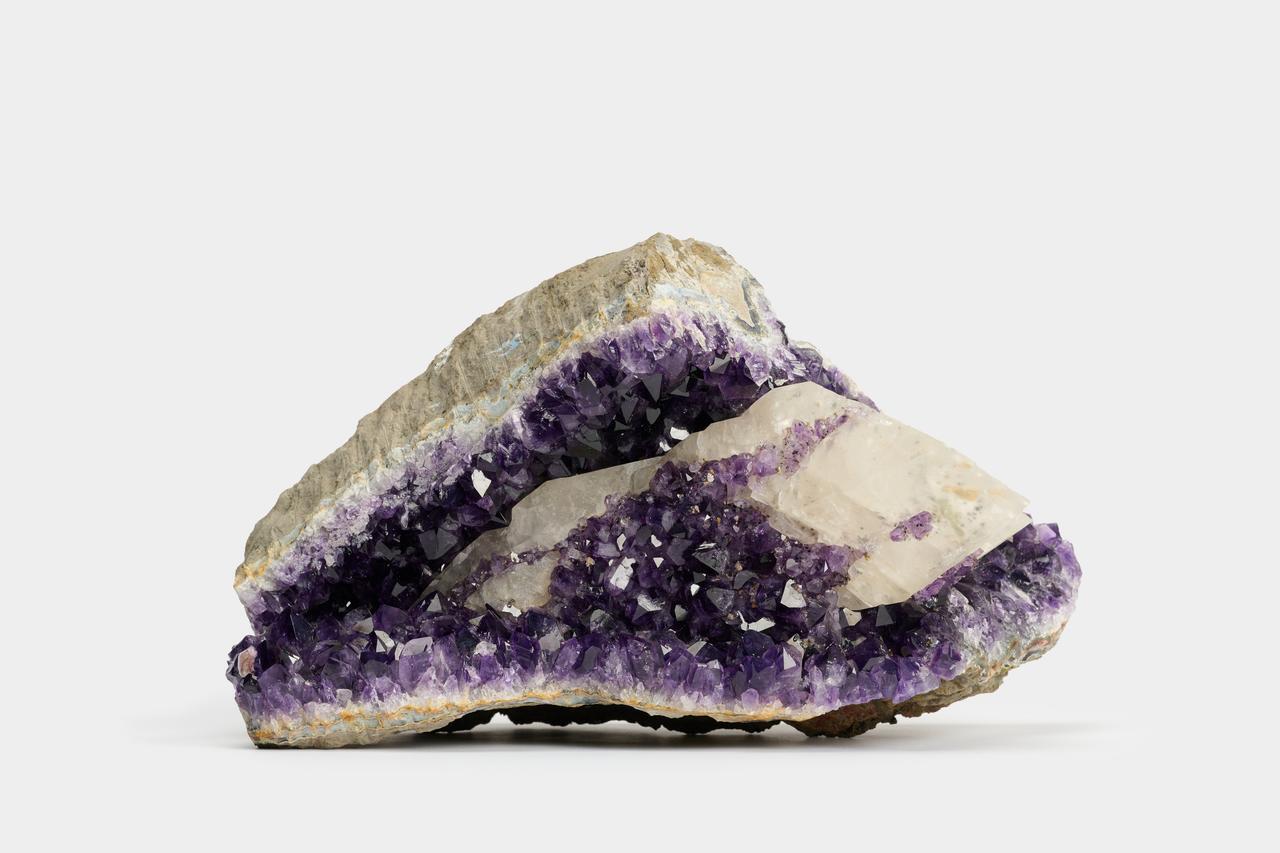
Grey Amethyst Geode – Microcrystalline Cavity with Primordial Patina - Height: 315 mm - Width: 190 mm- 5444 g


07
days
10
hours
27
minutes
47
seconds
Starting bid
€ 1
Reserve price not met

Expert
Selected by Luca Esposito
Geology graduate with 10 years' professional experience and webshop founder.
Estimate € 1,050 - € 1,200
No bids placed
Catawiki Buyer Protection
Your payment’s safe with us until you receive your object.View details
Trustpilot 4.4 | 121980 reviews
Rated Excellent on Trustpilot.
Main mineral: amethyst; Name meteorite: Meteorite; Mineral form/type: Grey Amethyst Geode with a microcrystalline cavity and primordial patina; Country of origin: Uruguay; Origin (region/city): Uruguay.
AI-assisted summary
Description from the seller
This formation comes from Uruguay, but it belongs to a particular chapter of its geology: that of the fine silica geodes, where amethyst does not manifest in its classic form of visible crystals, but as a microscopic and compact weave, a uniform veil covering the interior of the cavity like stardust. At first glance, it looks like a lunar fragment, a silica basin carved by a slow and precise event. In reality, it is the result of an initial hydrothermal phase, where silica precipitates in microcrystalline, almost amorphous form, creating a velvety, dark surface that does not reflect but absorbs light with depth. Inside the cavity, ancient signs can be seen: tension lines, small undulations, depressions where water has stagnated just a little longer, depositing a film of very fine quartz. In some areas, the silica thickens, revealing slight botryoidal concentrations, like barely hinted sprouts. It is an archaic landscape, an embryonic phase of the geode, which has never reached crystalline maturity.
Seller's Story
The Mineral Art Gallery offers minerals, fossils, shells and natural elements.
Born in Italy in 2017, today she collaborates with international galleries and collectors, she is a direct importer of large minerals and naturalistic collectible elements; deals with the processing to insert them inside the living space. A section of the gallery was dedicated to the Wunderkammer, "chamber of wonders or cabinet of curiosities" in which Mirabilia elements are presented: naturalia and italiania, a union between "the present is the past".
All lots are shipped via DHL Express and Fercam couriers, with insured parcel and tracking.
Translated by Google TranslateThis formation comes from Uruguay, but it belongs to a particular chapter of its geology: that of the fine silica geodes, where amethyst does not manifest in its classic form of visible crystals, but as a microscopic and compact weave, a uniform veil covering the interior of the cavity like stardust. At first glance, it looks like a lunar fragment, a silica basin carved by a slow and precise event. In reality, it is the result of an initial hydrothermal phase, where silica precipitates in microcrystalline, almost amorphous form, creating a velvety, dark surface that does not reflect but absorbs light with depth. Inside the cavity, ancient signs can be seen: tension lines, small undulations, depressions where water has stagnated just a little longer, depositing a film of very fine quartz. In some areas, the silica thickens, revealing slight botryoidal concentrations, like barely hinted sprouts. It is an archaic landscape, an embryonic phase of the geode, which has never reached crystalline maturity.
Seller's Story
The Mineral Art Gallery offers minerals, fossils, shells and natural elements.
Born in Italy in 2017, today she collaborates with international galleries and collectors, she is a direct importer of large minerals and naturalistic collectible elements; deals with the processing to insert them inside the living space. A section of the gallery was dedicated to the Wunderkammer, "chamber of wonders or cabinet of curiosities" in which Mirabilia elements are presented: naturalia and italiania, a union between "the present is the past".
All lots are shipped via DHL Express and Fercam couriers, with insured parcel and tracking.
Translated by Google TranslateDetails
Mineral Form
Grey Amethyst Geode – Microcrystalline Cavity with Primordial Patina
Weight
5444 g
Country of Origin
Uruguay
Height
315 mm
Width
190 mm
Depth
150 mm
Sold by