While most novelists nowadays are inseparable from their laptops, up until some decades ago the typewriter was among the author’s most treasured possessions. Many of the greatest stories have been written on the typewriter, making it one of the most genius inventions of all time. Read along to learn about the machines behind some of the most famous stories.
Mark Twain
Mark Twain (1835-1910) supposedly is the first ever author to submit a typed manuscript, although which script is not clear. In his autobiography (1904) he claimed that he was the first person in the world to apply the type-machine to literature, which he remembered to be The Adventures of Tom Sawyer (1876), using a Remington No.2. However, it is now believed that this story was published from a hand-written manuscript. Historians think it was Life on the Mississippi (1882) that is the original typed manuscript, although it was dictated by Mark Twain to a typist from a handwritten version. The same Remington No.2 was given away twice by Twain for being frustrated by it, but it returned to him both times. Before Twain owned a Remington, it is thought that he tried the Sholes & Glidden Treadle from 1874.
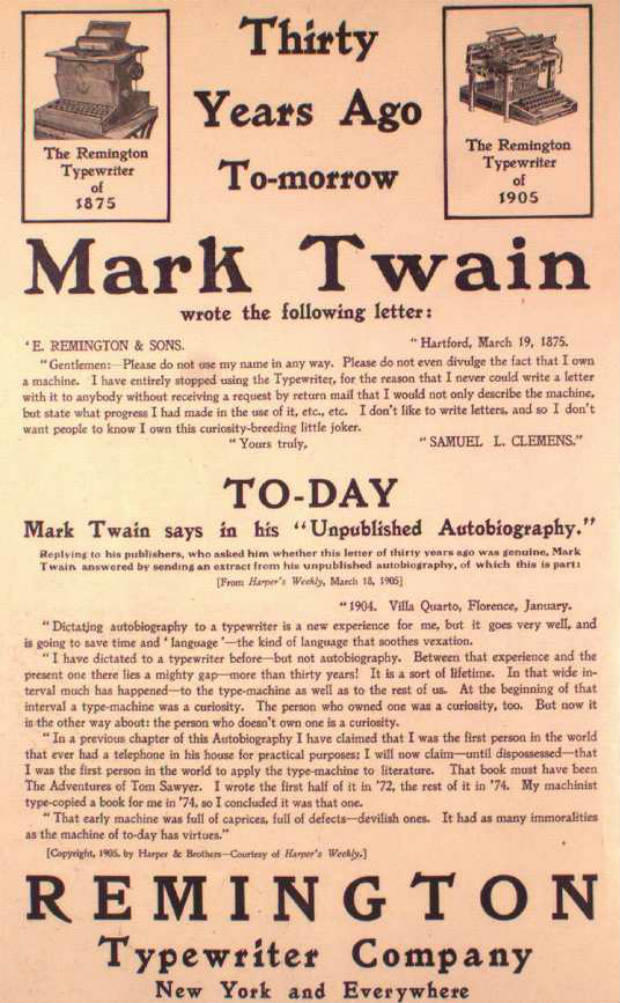
Source: images.mentalfloss.com
Ernest Hemingway
In the times of Ernest Hemingway (1899-1961) typewriters had become more manageable and were widely used by writers. Hemingway has worn out several typewriters, including the Corona No.3, No.4 and several Royal portables. Supposedly, the author of The Sun also Rises (1926), A Farewell to Arms (1929) and The Old Man and the Sea (1952) preferred to write standing up, keeping his Royal Quiet de Luxe typewriter on a bookshelf.
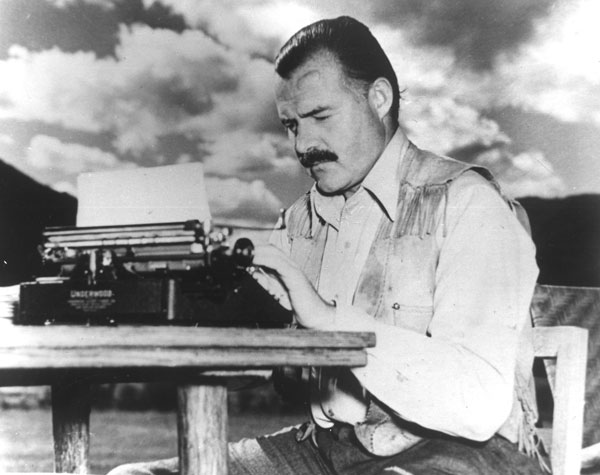
Source: beyondtheflow.files.wordpress.com
Agatha Christie
The typewriter connected to Agatha Christie’s famous for Hercule Poroit and Miss Marple detectives, is the Remington Home Portable No.2. She started off with an Empire from her sister and got to appreciate the typewriter in general when she broke her wrist. Dictating her stories to a secretary made Christie realise how much the writing and typing processes helped her choose the best words, instead of repeating comparable sentences several times. Writing on a typewriter also kept her in the writer's flow. Other typewriters Agatha Christie presumably used were a Corona portable No.3. and Remington Victor T.
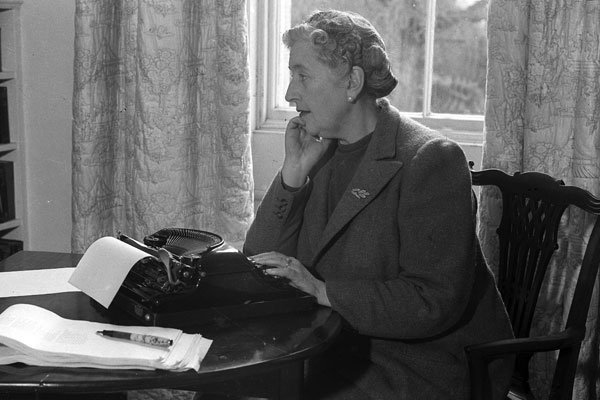
Source: pbs.twimg.com
Orson Welles
Orson Welles proves that typewriters were perfect for writing plays too. The American cultural icon, producer, screenwriter and actor is mostly famous for the movie Citizen Kane (1941) and the play War of the Worlds (1938). He used an Underwood Standard Portable typewriter, with his name and address painted on the case.

Source: pickurselfup.tumblr.com
Danielle Steel
Although most modern authors use a modern computer to write stories, Danielle Steel held on to her 1946 Olympia typewriter she calls “Ollie”. Steel claims to be “technologically challenged”, only using a computer to write emails – despite many attempts of editors and family to expand her technology skills. Steel wrote over 90 romantic novels on her typewriter, including Once in a Lifetime (1982) and Kaleidoscope (1987).

Source: thetimes.co.uk
As Danielle Steel and many more famous authors prove, it is not too late to start using a typewriter. It can provide a welcome change from staring at the screen of your computer and who knows, it might just inspire you to write a great novel. Check out our astonishing themed Typewriter Auction to get your own copy and start writing like Hemmingway.