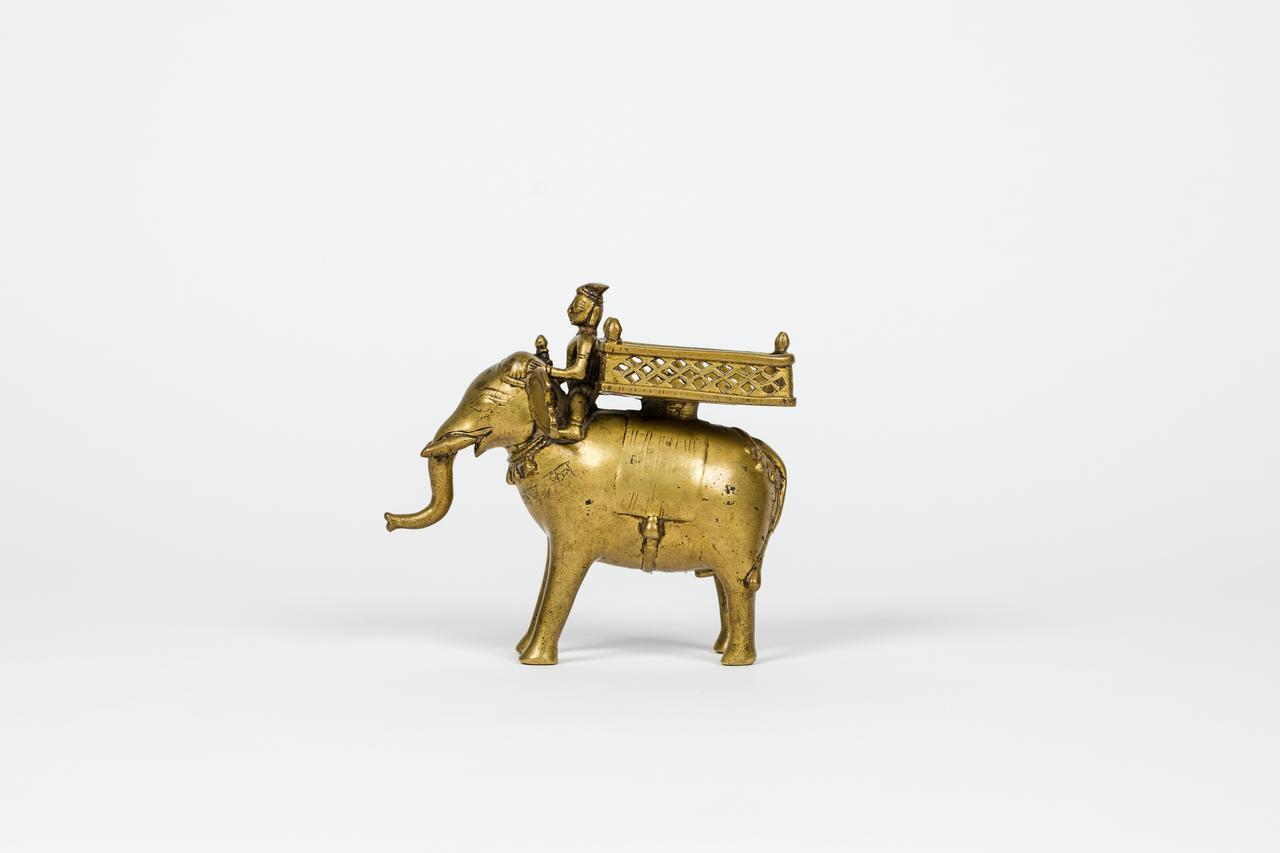
寺院の玩具 – 象と乗り手(象使い)を乗せた、車輪付きのおもちゃ - Bronze - India - 19世紀後半から20世紀初頭


02
days
12
hours
32
minutes
27
seconds

11 other people are watching this object
 | €10 | |
|---|---|---|
| €1 |
Catawiki Buyer Protection
Your payment’s safe with us until you receive your object.View details
Trustpilot 4.4 | 134906 reviews
Rated Excellent on Trustpilot.
Temple toy – Elephant with rider (Mahout) on wheels, an original bronze sculpture from India dating to the late 19th to early 20th century.
AI-assisted summary
Description from the seller
Temple toy – Elephant with rider (Mahout) on wheels – ca. 1890–1930
Detailed Description
An original and rare piece of Hindu tribal art, representing a ritual temple toy (Temple Toy) hand-cast in solid solid bronze. The figurine depicts a ceremonial elephant guided by a rider (mahout) positioned on its back. It is a collector's item specific to Colonial India from the late 19th or early 20th century.
Head and Ornaments: The animal’s forehead is richly ornamented with a granular pearl decoration (bronze beads in relief), and in the central area it presents a prominent decorative medallion in the shape of a sacred bell. The trunk is directed downwards and curved at the tip, symbolising calm strength and stability.
The rider (Mahout): The anthropomorphic figurine is modelled in a naive-tribal style, with strongly stylised facial features (large, almond-shaped eyes), traditional hairstyle and a sacred dot (Bindi/Tilak) visible in relief on the forehead.
Manufacturing technique and elements of authenticity
Dhokra (Lost Wax) casting: The object is entirely handmade. On the back (under the tail) it shows a primitive material void. This is an original casting defect from the archaic workshop (air bubble in the clay mould), a detail that guarantees historical authenticity and excludes modern industrial copies.
Riveted iron axles: A supreme indicator of the age of the piece is the rolling system. Only the axles are made of ferrous metal (hand-forged iron). The wheels are permanently fixed at the ends by coarse riveting by manual hot hammering, a completely archaic process.Technical specifications
Length: 11 cm
Height: 11 cm
Width (wheel gauge): 8 cm
Weight: 450 grams (solid metal, high density, full casting)
Conservation condition
Patina: Piece with natural, historical patina, chemically untreated. It retains the original gray-brown oxidation in the recesses and handling gloss on the prominent areas.
Details: The object is structurally stable. The two bronze tusks of the elephant are broken from old age (during its active use), the edges of the breaks being naturally blunted and covered over time by patina. Small structural wear (age porosity) on the rider's chest
Temple toy – Elephant with rider (Mahout) on wheels – ca. 1890–1930
Detailed Description
An original and rare piece of Hindu tribal art, representing a ritual temple toy (Temple Toy) hand-cast in solid solid bronze. The figurine depicts a ceremonial elephant guided by a rider (mahout) positioned on its back. It is a collector's item specific to Colonial India from the late 19th or early 20th century.
Head and Ornaments: The animal’s forehead is richly ornamented with a granular pearl decoration (bronze beads in relief), and in the central area it presents a prominent decorative medallion in the shape of a sacred bell. The trunk is directed downwards and curved at the tip, symbolising calm strength and stability.
The rider (Mahout): The anthropomorphic figurine is modelled in a naive-tribal style, with strongly stylised facial features (large, almond-shaped eyes), traditional hairstyle and a sacred dot (Bindi/Tilak) visible in relief on the forehead.
Manufacturing technique and elements of authenticity
Dhokra (Lost Wax) casting: The object is entirely handmade. On the back (under the tail) it shows a primitive material void. This is an original casting defect from the archaic workshop (air bubble in the clay mould), a detail that guarantees historical authenticity and excludes modern industrial copies.
Riveted iron axles: A supreme indicator of the age of the piece is the rolling system. Only the axles are made of ferrous metal (hand-forged iron). The wheels are permanently fixed at the ends by coarse riveting by manual hot hammering, a completely archaic process.Technical specifications
Length: 11 cm
Height: 11 cm
Width (wheel gauge): 8 cm
Weight: 450 grams (solid metal, high density, full casting)
Conservation condition
Patina: Piece with natural, historical patina, chemically untreated. It retains the original gray-brown oxidation in the recesses and handling gloss on the prominent areas.
Details: The object is structurally stable. The two bronze tusks of the elephant are broken from old age (during its active use), the edges of the breaks being naturally blunted and covered over time by patina. Small structural wear (age porosity) on the rider's chest
Details
王朝様式/時代
late 19th - early 20th century
原産国
India
帰属
Original
素材
Bronze
高さ
0 cm
幅
0 cm
作品タイトル
Temple toy – Elephant with rider (Mahout) on wheels
奥行き
0 cm
コンディション
Good condition
Authenticity
Original/official
Sold by