We carefully select Post-War & Contemporary Art and Prints submissions to maintain high-quality and authenticity standards. We only accept authentic works of art valued at €100 or more. Every submission is reviewed by our in-house experts to ensure bidders find rare, significant, and collectible objects. Our experts will support you with:
- Pricing: Aligning your object’s price with current market trends and Catawiki buyer demand. Experts may suggest adjustments to help you sell successfully.
- Authenticity: Ensuring all necessary documentation is in place to build buyer confidence.
- Curation: Assigning your object to the most relevant auctions to maximise visibility and interest.
Follow these guidelines to maximize your chances of a successful sale.
What we accept
We’re looking for authentic, high-quality artworks from 1945 to present that appeal to serious collectors. To be accepted, your object must:
- Fall within our accepted categories:
- Paintings & Mixed Media
- Prints & Multiples
- Sculptures & 3D objects
- Be authentic
- Be in good condition (acceptable wear : minor frame scruffs, light handling marks)
Include provenance and paperwork (e.g. COA, invoices) if requested
- Meet the minimum expected value of €100
No reserve price is allowed for works with an estimated value below €200
- Have shipping costs proportionate to the object's value
Note: Each artwork will be looked at by our experts and will be judged on a case-by-case basis.
📌 Examples of accepted objects:
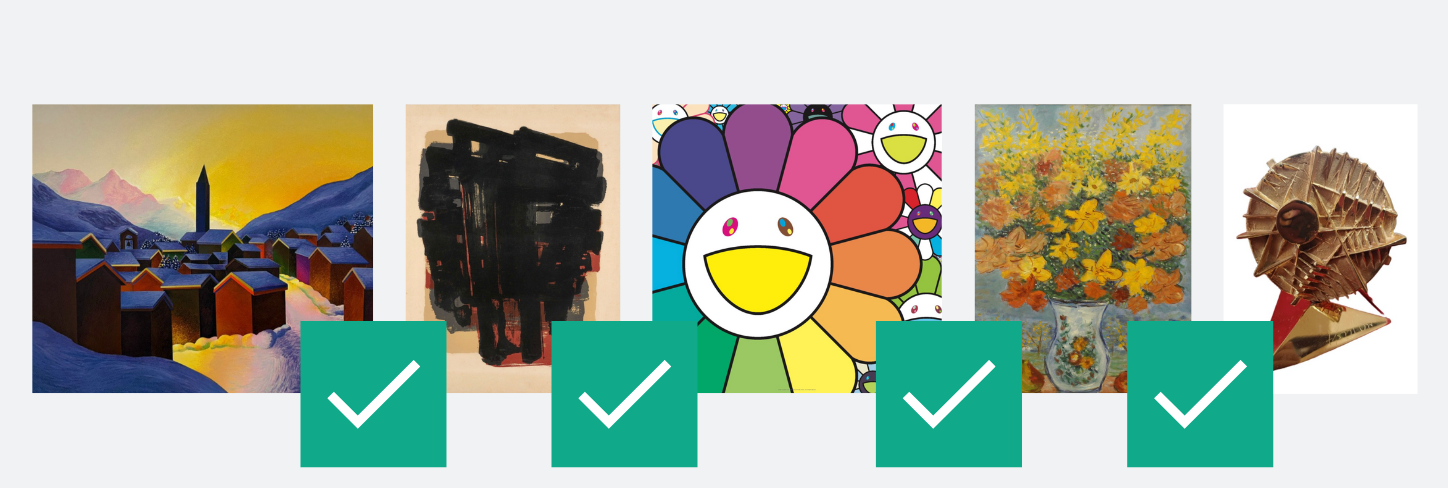
What we do not accept
To keep our auctions high-quality and trustworthy, we do not accept:
- Artworks with authenticity or provenance concernswithout supporting documentation
- Artworks in poor condition (rips, mold, major fading) or too heavily restored (large areas of overpainting, replaced canvas or paper support)
- Artworks declined for legal reasons (e.g. copyright infringement)
- Reproduction prints not clearly described as 'After'
- Editions from blacklisted publishers (see at the end of these guidelines)
- Artworks that infringe intellectual property
- Artworks that depict inappropriate content
📌 Examples of rejected objects:
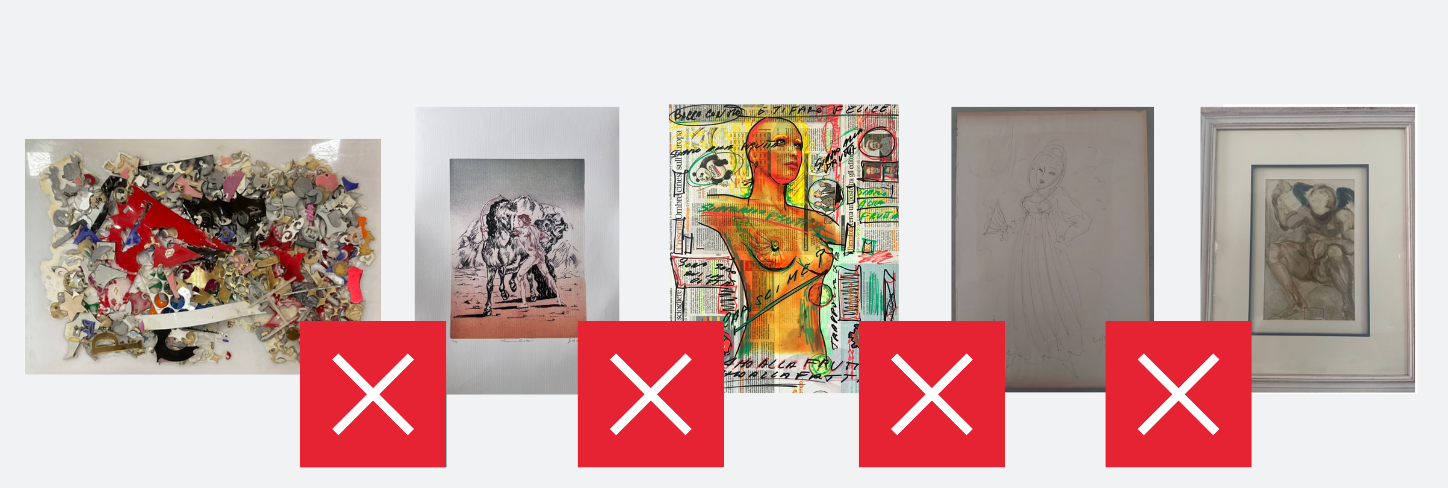
Getting your submission ready
1. Fill in all the details and write a clear description
When you submit an object, you’ll see fields to guide you in providing the right information, e.g. artist name and lifespan, title, medium/technique, dimensions (with and without frame), creation period, signature details, edition, framing, and condition. These fields ensure your listing is clear, searchable, and easy for bidders to understand.
Please also use the object description field to share:
- Background information and history of the artist
- Further details on materials and techniques
Further details on condition, possible restoration/conservation, and any flaws
- Catalogues or exhibition references
- Where the object came from/how it was obtained
- Shipping method and insurance details.
Tip: The more detail you provide, the easier it is for bidders to understand the value of your object – and the more likely it is to sell. Find here more tips on how to write a clear, accurate description.
📌 Examples of a well-written description:
“Salvador Dalí (Figueres, Girona, 1904 - 1989).
Nude study: couple, standing man and reclining woman.
Approximately 1966.
Graphite and colored airbrush, gold paint on Arches paper.
38 x 56 cm. (67 x 84 cm with frame).
PROVENANCE: Private collection, David Colombo, France.
DOCUMENTATION:
Nicolas and Olivier Descharnes have confirmed the authenticity of the piece (d6955_c1966).
A certificate of authenticity issued by Mr. Joël Barès, modern art expert, dated Paris, France, September 23, 1982, is included.
Certificate issued by Descharnes Archives, No. D6955.
Export permit issued by the Ministry of Culture, Spain.
DESCRIPTION:
Signed in the lower right corner 'Dalí', in blue biros. Manuscript by a third party on the back, upper left, in blue pen: 'Received directly from the artist / and master Salvador Dali / David Colombo'.
This work, executed by Dalí around 1966, combines sketchy, evanescent and delicate drawing with airbrush work that gives the image a celestial atmosphere, amidst soft clouds of blue and twilight violet and intense, opaque golden splashes. The naked figures, evocative of a world of sensuality, share space without relating to each other, linked only through the dreamlike space of the superimposed colour.
Salvador Dalí (Figueres, Girona, 1904-1989) moved to Madrid in 1922, where he lived in the famous Residencia de Estudiantes and entered the San Fernando Academy of Fine Arts. However, in 1926, before his final exams, he was expelled for claiming that there was no one at the Academy fit to examine him. That same year Dalí settled in Paris, where he began to establish the formal characteristics that would become the hallmark of his work, absorbing disparate influences, from the academic masters to the avant-garde. Linked to the surrealism of Montparnasse, in 1929 he collaborated with Luis Buñuel in the making of Un perro andaluz, the movement's most renowned film. His work greatly influenced the direction of Surrealism for the next two years, and he was hailed as the creator of the paranoiac-critical method, which was said to help access the subconscious by releasing creative artistic energies. In 1931 Dalí painted one of his most famous works, The Persistence of Memory, in which, according to some theories, he illustrated his rejection of time as a rigid or deterministic entity.
Dalí arrived in America in 1934 under the guidance of the art dealer Julian Levy. Following his first solo exhibition in New York, his international reputation was firmly established, and from then on he showcased his work and lectured worldwide. That same year, he was subjected to a 'Surrealist trial' which led to his expulsion from the movement, as the painter believed that Surrealism could exist in an apolitical context and refused to commit to André Breton's ideas. Dalí responded to his expulsion with his famous retort: 'I am Surrealism.' Most of his works are currently housed in the Dalí Theatre-Museum in Figueres, followed by the collection of the Salvador Dalí Museum in St. Petersburg (Florida), the MNCARS in Madrid, the Salvador Dalí Gallery in Pacific Palisades (California), the Espace Dalí in Montmartre (Paris), and the Dalí Universe in London”.
2. Dimensions: be specific
To avoid confusion about artwork sizes, please specify all measurements clearly. Ensure your photos clearly reflect the measurements stated above (for example, frame depth or border visibility).
| Field | What to include | Example |
| Image area (HxW) | The actual printed or painted area | 45 x 30 cm |
| Sheet or canvas size (H x W) | Total surface of paper , board or canvas | 60 x 45 cm |
| Framed dimensions (H x W x D) | If framed, include external size and depth | 64 x 49 x 3 cm |
| Orientation | Horizontal/vertical | Horizontal |
| 3D Objects (H x W x D) | For sculptures or other three-dimensional artworks, list the total size of the object itself, excluding any additional display elements (e.g., pedestal, base, or case — specify these separately if relevant). | 65 x 15 x 25 cm With pedestal: 75 x 15 x 25 cm |
3. Great photos matter
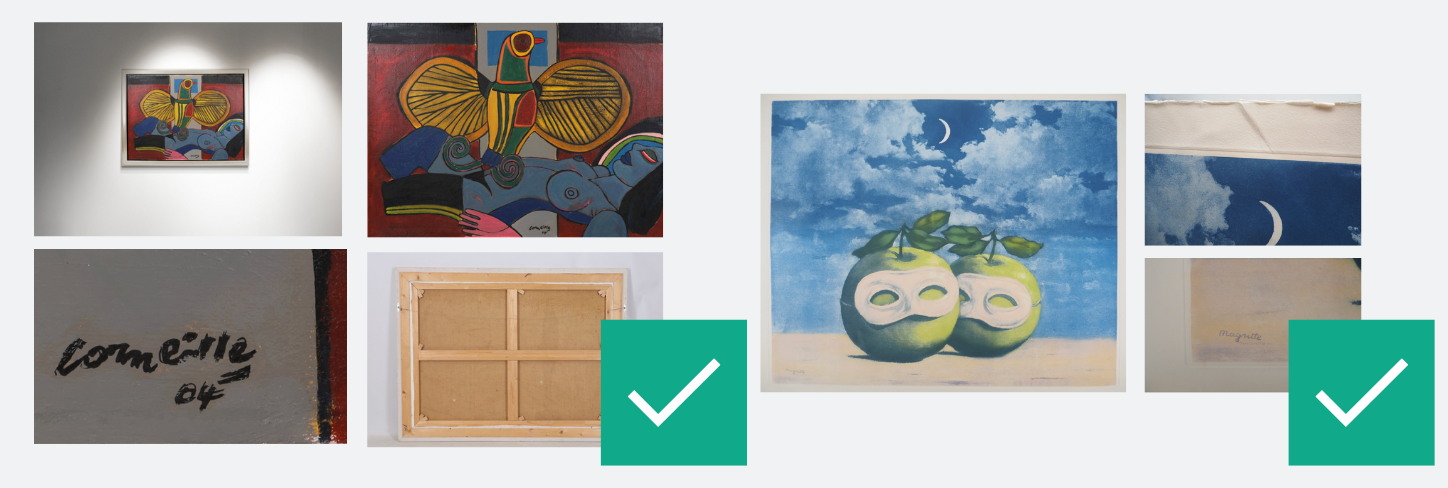
Photos are the first thing bidders see – so make them count! We recommend including at least:
5 high-quality images for paintings and sculptures
2 high-quality images for prints
These images will clearly show the condition and details of your object. Your photos should include:
For all submissions:
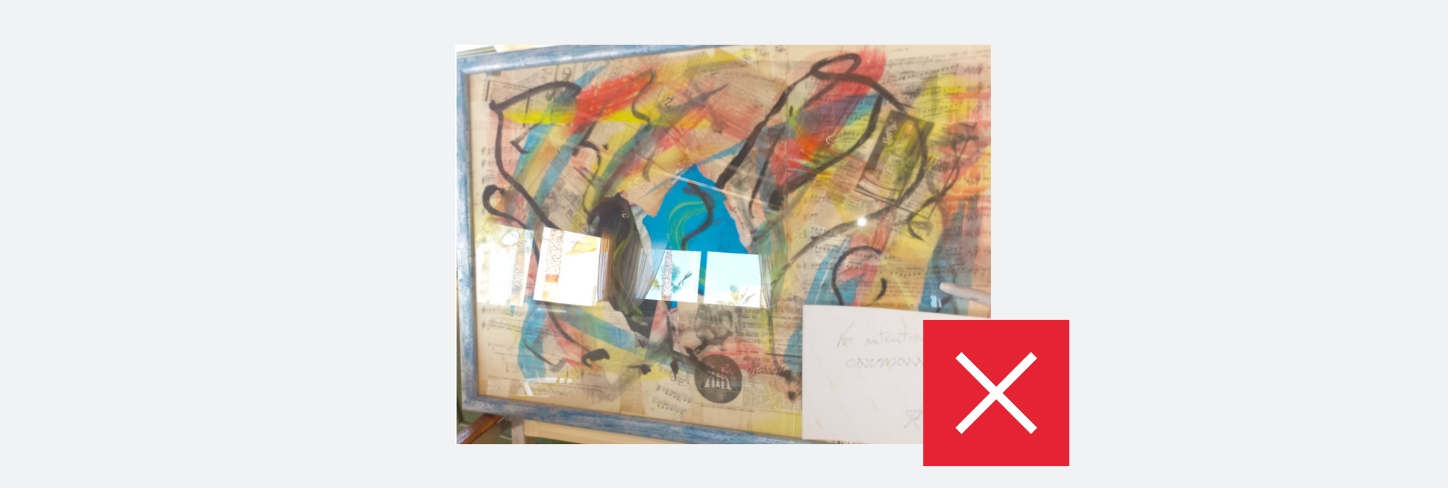
- Use of a neutral background
- Use of the highest resolution possible
- Images of the full artwork (framed and unframed)
- Image of the reverse side
- Close-ups of the signature
- Images showing condition flaws
- Images of the supporting documents
For authenticated works, you must include photos of all supporting documentation.
This includes:
- Certificate of Authenticity (COA)
- Provenance papers or invoices
- Expert statements or letters
Missing document photos may delay expert approval or result in rejection.
Tip: Use a plain light-coloured background, ensure the artwork is well-lit and in focus, and avoid flash or colour filters. Find here more tips on how to take professional photos.
📌 Examples of good vs. bad photos:
4. Additional proof of authenticity
We pay extra attention to ensure the authenticity of all works to protect bidders and maintain trust in our auctions.
You must provide verifiable proof of authenticity and provenance for each artwork, especially for high-value or attributed works.
Acceptable documentation includes:
- Certificates of Authenticity (COA) issued by a recognized gallery, expert, or artist’s foundation
- Gallery invoices or original purchase receipts
- References to catalogues raisonnés or artist archives
- Provenance documentation (previous ownership, exhibition, or sale records)
Important:
- COAs must not be self-issued, unless by the living artist themself and signed with a matching signature on the artwork.
- You must upload clear photos of all documents, including COAs, invoices, or expert letters.
- COAs or provenance that cannot be verified may result in rejection or expert re-evaluation.
📌 Examples of proof of authenticity: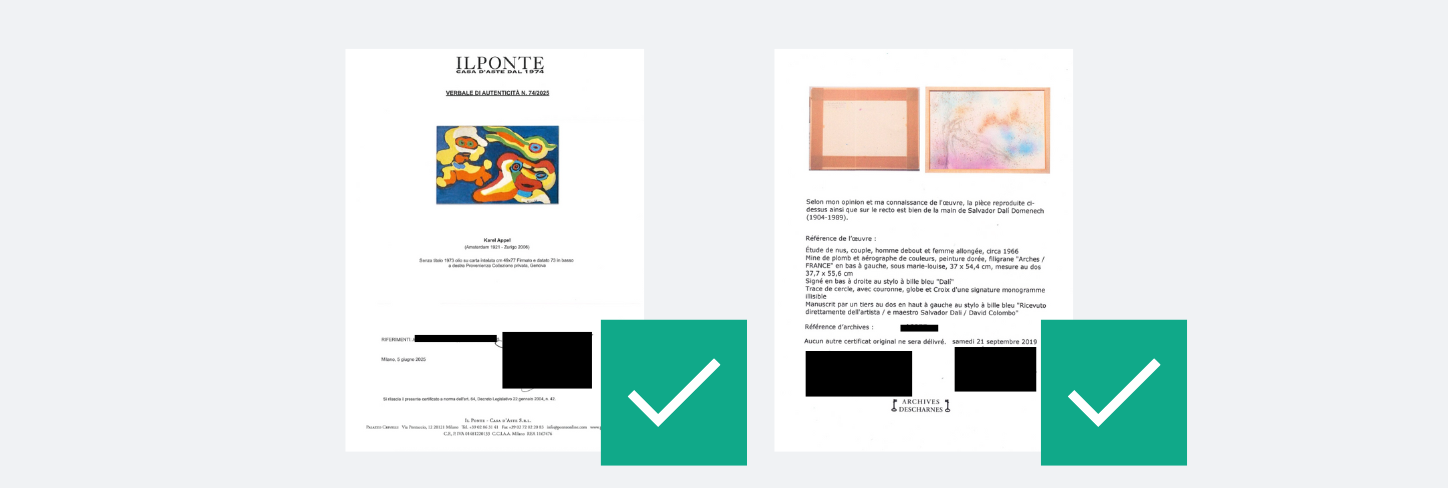
5. Condition: describe honestly and in detail
Provide an accurate description of the artwork’s current state. Mention even minor imperfections so buyers know what to expect.
Please include:
- Surface characteristics (texture, craquelure, paint strokes, or paper waviness)
- Color tone variations (e.g., due to lighting or ageing)
- Any restorations, repairs, or alterations to the original form (such as cropping or folding the canvas, or re-varnishing)
- For works on paper: Type of edges (deckled, cut, irregular)
- Signature position and medium (front/back, pencil/paint)
- For prints: whether the ink or paper shows fading, foxing, or discoloration
Ensure the description matches visible details in the photographs. If restoration, fading, or discolouration is visible, mention it explicitly to prevent post-sale disputes.
Use this checklist before submitting: mention all visible imperfections (craquelure, foxing, tears, fading, scratches, repairs, or restorations) and make sure each appears clearly in at least one photo.
Tip: Add a close-up photos of texture and of any flaw/s or mark/s you mention. This prevents post-sale condition misunderstandings.
6. Edition and authenticity: provide complete information
To ensure buyers can trust editioned and printed works, please include all relevant information about the edition and printing process.
For all limited editions or prints, specify:
- Edition size (e.g., “3/25”)
- Printing or reproduction technique (e.g., “etching,” “lithograph,” “giclée print”)
- Signature and numbering details (e.g., “signed lower right in pencil”)
- Certificate of Authenticity with issuer, date, and, if applicable, archive or catalogue reference
- Provenance or gallery invoice, if available
If the work is a reproduction, facsimile, or “After” another artist:
- Include “After [Artist]” in the title (e.g., “After Pablo Picasso – Lithograph”).
- Describe the printing process clearly (e.g., “modern giclée reproduction on fine art paper”).
- Avoid ambiguous descriptions such as “Lithograph after Picasso” without process details.
- Misleading or incomplete edition information may lead to rejection or reclassification.
Edition verification:
- For numbered editions, upload close-up photos showing both the signature and edition number.
- Our experts may verify editions against catalogues raisonnés or known print databases.
Tip: Photograph all relevant documentation and close-ups of the signature and edition number.
7. Attributed or Unsigned Works
Works listed as “Attributed to,” “In the manner of,” or “Circle of” must be supported by clear documentation or expert evaluation.
Required proof includes:
- Expert opinions or authentication reports
- Prior gallery or auction sale records
- Provenance evidence (collection label, stamp, or invoice)
Unsigned or attributed works without supporting evidence will not be accepted for auction.
Experts reserve the right to reclassify works that cannot be confidently attributed to the stated artist.
Ready to sell? List your modern and contemporary artworks today
Selling with us is free – commission is only applied if your object sells.
Follow these guidelines to maximize your chances of success.
Register as a seller and submit your artworks and prints for auction now.
List of blacklisted publishers
Below you will find a list of print editions that are not accepted on our platform. Please be aware that more editions may be added to this list in the future.
- SDNE Societe Des Nouvelles Editions
- Studio Salvador Rosa Editions
- Johnson & Johnson Editions
- La Trec Spa. Blindstamp "trec" Editions
- Atlantis Kunst Verlag Freiburg Editions
- Birkhauser Kunstverlag Basel Editions
- Suc. Salerno & Hijos Editions
- Impression art certified Editions
- Atelier Jobin Paris Dali Editions
- Editions du Rhin (EdR)
- Erica De Jong Gallery Editeur with a George Israel Blindstamp
- Leo Castelli Gallery stamp with a George Israel Blindstamp
- Il Borghetto casa d'arte, Milano
- All editions that carry a forged “S.P.A.D.E.M. Paris” Blindstamp
- All editions that carry a forged National Museum des Neunhundert Blindstamp (grammatically incorrect)
- All editions claiming to be produced by Munch Museet Oslo in 1995