We carefully select books, maps, and manuscripts to maintain high-quality standards. We only accept authentic objects valued at least at €75 or more (or €100 for old and rare books). Our experts review every submission to ensure bidders find rare and valuable objects that appeal to passionate collectors.
Follow these guidelines to increase your chances of a successful sale.
What we accept
We’re looking for authentic, high-quality books and manuscripts that appeal to passionate collectors. To be accepted, your object must:
- Be scarce and not widely available online or in physical bookshops (e.g. fewer than 20 copies on vialibri.net).
- Be authentic, of collectable value and in good condition
- Meet the minimum expected value of €75 (for Old & Rare books: €100)
(You can combine objects in one submission to meet this threshold)
Tip: While our experts are using rarebookhub.com to compare historical auction records where Catawiki results appear as well, we encourage you to use free reference platforms such as www.vialibri.net, www.boekwinkeltjes.nl or www.abebooks.com to determine scarcity and retail value.
What increases your chances of approval:
- First editions in the original language
- Limited or numbered editions
- Signed by the author or illustrator
- Include quality illustrations or engravings
- Be on high-demand subjects (e.g. art, topography, science, military, travel)
📌 Examples of accepted objects:
- Signed well-known first edition of contemporary literature
- Incunabula
- Illustrated scientific, geographical and historical old books
- Scarce contemporary art & photography books
- Historical autographs and manuscripts
What we do not accept
To keep our auctions trustworthy and attractive to buyers, we do not accept:
- Books that are common or widely available online for under €75
- Incomplete or heavily damaged objects without historical significance
- Cheap reprints, outdated encyclopaedias or lexicons
📌 Examples of rejected objects:
Modern and contemporary encyclopedias
Inconsistent bundles of books
School books
Paperbacks
Getting your submission ready
1. Fill in all the details and write a clear description
When you submit an object, you’ll see fields to guide you in providing the right information, such as: author, title, publisher, condition, number of pages, and dimensions.
Note: To determine condition, we use the following grading system:
- As new – In the same condition as when it was published.
- Fine – Approaches the condition of ‘As new’, but without being crisp. The book may have been opened and read, but there are no defects to the book, jacket or pages.
- Very good – Shows some small, insignificant signs of wear and tear on either the binding or paper.
- Good – The average used worn book that has all pages or leaves present.
- Fair – A worn book that has complete text pages (including those with maps or plates), but may lack endpapers, half-title, etc. (this must be noted). The binding, jacket (if any), etc. may also be worn.
- Poor – Sufficiently worn. Any missing maps or plates should still be noted. This copy may be soiled, scuffed, stained or spotted and may have loose joints, hinges, pages, etc.
Please also use the object description field to share:
- Unique features (e.g. signed, limited edition) or notable history of the object
- Background or provenance (e.g. bookplate, notable owner)
- If the object has any flaws (e.g. torn dust jacket, missing page noted))
Tip: The more detail you provide, the easier it is for bidders to understand the value of your object – and the more likely it is to sell. Find here more tips on how to write a clear, accurate description.
📌 Examples of a well-written description:
“Dante Con L’espositioni Di Christoforo Landino, Et D'Alessandro Vellutello, Sopra la sua Comedia dell’Inferno, del Purgatorio, et del Paradiso. Con tavole, argomenti, & allegorie, & riformato, riveduto, & ridotto alla sua vera lettura, per Francesco Sansovino fiorentino.
In Venetia, appresso Giovambattista, Marchiò Sessa, et fratelli 1578.
Well-preserved specimen of this edition, which was a great editorial success, with clearly impressed woodcuts. De Batines I, pp. 91-92. Mambelli p. 49. Mortimer, 148. Essling I, 546.
Page [28], 163, [4], 164-392. Portrait of Dante within an architectural border on the frontispiece and many illustrations in the text, 10 in the Descrittione de lo Inferno by Vellutello and others at the beginning of the cantos, headpieces, drop caps, and ornaments in the text, all woodcut. Contemporary full parchment binding with few signs of wear. Two ex libris on the first pastedown. Internal pages fresh and clear with well-inked prints. On the last page, the famous printer's coat of arms (cat) above the colophon. A collectible copy.
Printed edition in Venice in large folio by the publisher Sessa and Brothers.
Complete copy in all respects, in good condition. Colomb de Batines, Bibliografia Dantesca, I, p. 52; Koch, Cat. of the Willard Fiske Dante collection, I, p. 5; Mambelli, Annali delle edizioni dantesche, no. 13;
The illustrations are attributed to Francesco Marcolini of Forlì. "He must have absorbed the Poem, immersing himself in the eyes and heart of the Poet, and created depictions of an Inferno seen from above, where one cannot tell whether to admire the boldness of the drawing or the vivid expressiveness. The struggle of the genius's burin with the greatness of the material to express the ethereal substance of Paradise passes through different phases with varying success, until, in some of the latest depictions, the circular form adorned with stars and radiant with lines tending to infinity manages to give us a profound sense of divine and eternal things." (Morchini, The Dantean Collection Mackenzie. Genoa, 1923).
Large sixteenth-century folio illustrated with woodcut plates depicting Dante's Inferno, Purgatorio, and Paradiso.
The best Sessa edition of Sansovino.
Beautiful oval woodcut portrait of Dante with an allegorical frame on the title page, with woodcut headers and initials. Forty-seven fine woodcuts adorn the Inferno, twenty-two the Purgatorio, and twenty-eight the Paradiso, with a canonical Sessa typographic mark on the back of the last page. Famous edition 'nasone' (so called for the portrait of the Poet on the title page), a reprint of the first 1544, decorated with a rich and splendid iconographic apparatus engraved on wood.
Complete frontispiece with portrait of Dante, dedications, prose, life of Dante, Laudi alla poesia, Epistle of Marsilio Ficino, life and customs of the poet.
Work of extreme iconographic beauty and excellent layout. Edition of the Divine Comedy, to be considered among the most important overall.
Here, the two comments of Landino and Vellutello are gathered, and the comparison of the opinions of the 15th-century scholar with those of the 16th-century scholar proves to be very interesting for the student (Mambelli 40). This edition also boasts the figures of the Marcolini, considered the most expressive examples of Dantean iconography, used for the first time by the Sessa in 1544. Brunet II, 504; Gamba 390”.
2. Great photos matter
Photos are the first thing bidders see – so make them count! We recommend including at least 5 high-quality images that clearly show the condition and details of your object. This helps bidders make informed decisions and increases your chances of a successful sale.
Your photos should include:
For all submissions:
- Front and back cover and spine (with and without dust jacket, if applicable)
- Title page and colophon/verso showing printing history
- Any special illustrations, plates, or features
- Any flaws (creases, tears, repairs)
For grouped submissions:
- Photograph of all books together, showing the spines
Tip: Avoid photos with people, selfies, or screenshots. Use a neutral background (white or black), avoid low-quality or stock images, and aim for natural lighting. Find here more tips on how to take professional photos.
📌 Examples of good vs. bad photos:
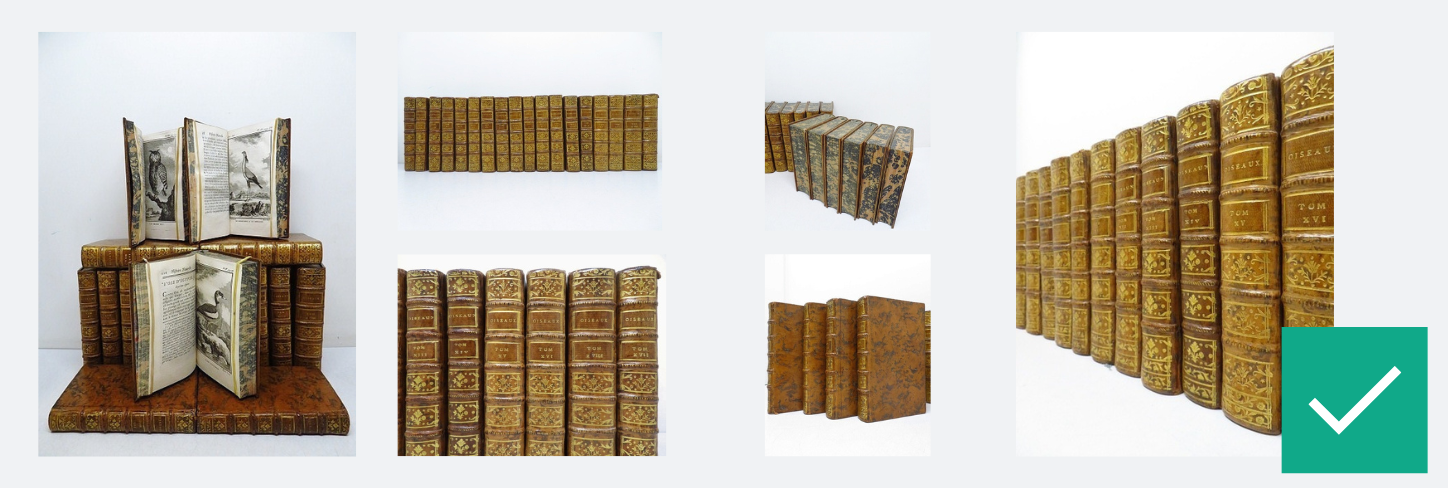
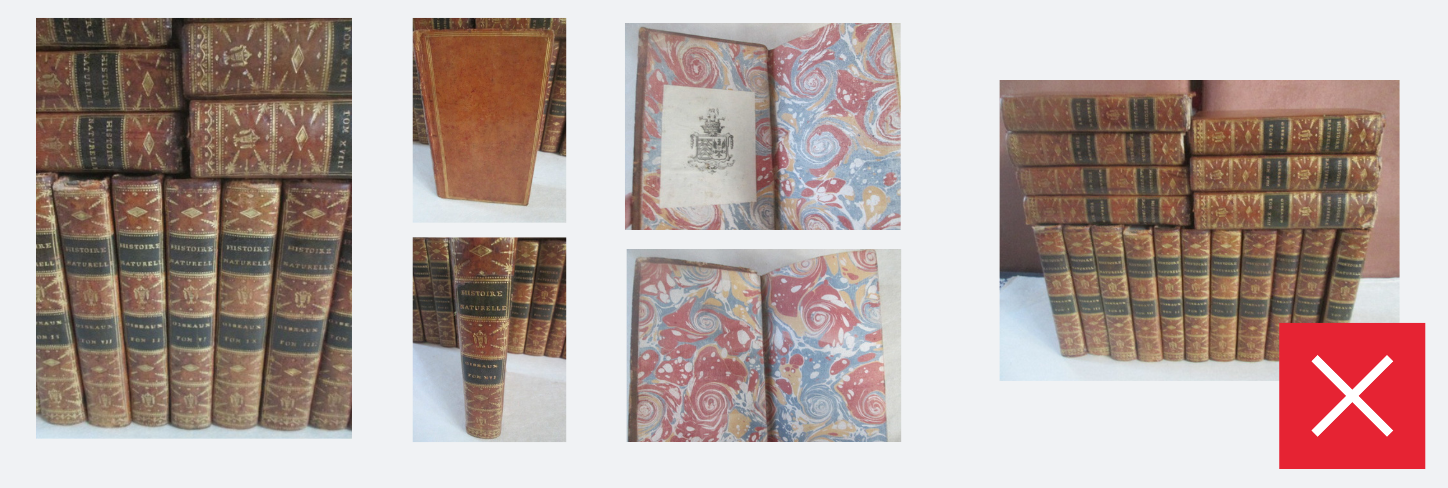
- The first example is neatly presented, showing all volumes clearly and attractively; the second is poorly lit, disorganised, and does not show the complete set.
3. Additional proof of authenticity
We pay extra attention to ensure authenticity of high-value and autographed objects to protect bidders and ensure a trustworthy marketplace.
For high-value or signed books, additional documentation may be required:
✔ Certificate from a registered and trusted company with an ID and the authenticator name/signature
✔ Provenance documents such as an auction/sale invoice from professional sellers in the field
✔ Comparison with known examples (our experts will assist)
Age Verification
Certain books may be subject to age restrictions. As the seller, you are responsible for complying with all applicable laws in both your country and the buyer’s, including any required age verification at delivery. Please check with your shipping provider to ensure that an adult signature or equivalent age check can be applied where legally required.
Ready to sell? List your books today
Selling with us is free – commission is only applied if your object sells.
Follow these guidelines to maximise your chances of success.
Register as a seller and submit your books for auction now.