At Catawiki, we curate premium auctions of coins, banknotes, and bullion — featuring the most sought-after numismatic treasures. From ancient Greek and Roman coins to modern world / euro coins, from early 19th-century banknotes to vintage gold bars, every object is carefully reviewed by our experts. Only objects valued at €50 or more are accepted, ensuring collectors discover rare, authentic, and truly valuable pieces.
Follow these guidelines to maximize your chances of a successful sale.
What we accept
We’re looking for authentic, high-quality coins, banknotes, bullion, and exonumia. Accepted categories include:
- Ancient coins: Roman, Byzantine, Greek, Celtic, early Eastern coins — minimum estimated value €50 (Ancient Coins Auctions)
- Ancient tokens: tesserae/spintriae — minimum estimated value €50 (Ancient Coins Auctions)
- Banknotes: minimum estimated value €50 (Banknotes Auctions)
- Bonds & shares: minimum estimated value of €100 (Banknotes Auctions)
- Bullion bars & coins: minimum estimated value €75 (Bullion Auctions)
- Gold: ≥1 g
- Silver: ≥100 g / 3 troy oz
- Platinum: ≥2 g
- Palladium: ≥2 g
- Rhodium: ≥0.5 g
(Exceptions may apply depending on the type of ingot or coin)
Note: Different guidelines apply to Daily Bullion Auctions. Contact us for details.
- Euro coins: minimum estimated value €50 (Euro Coins Auctions)
- World coins: minimum estimated value €50 (World Coins Auctions, country-specific & regional auctions)
- Modern world coins (post-1960): minimum estimated value €50 (Modern World Coins Auctions)
- Exonumia (e.g., tokens, medals, trays, catalogues) — minimum estimated value €50
- Medals & tokens → Medal & Token Auctions
- Other exonumia → relevant auctions
Important: Objects under €50 must be combined into a submission with a total value of at least €50.
What increases your chances of approval?
- Offering objects that meet the following criteria:
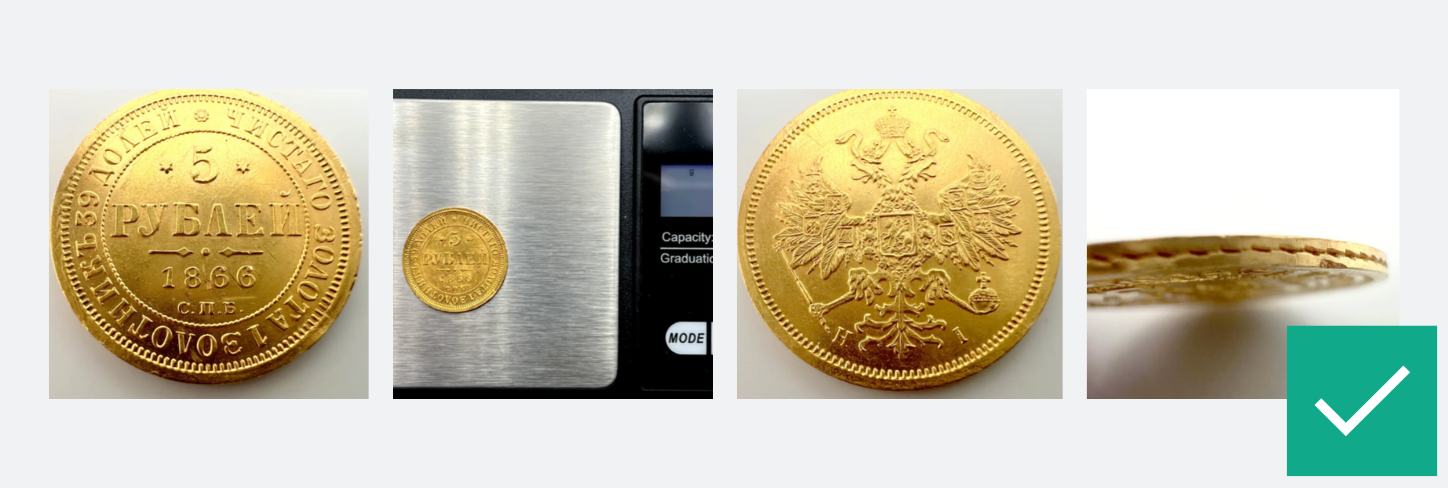
- Clear photos of obverse, reverse, and the edge (for coins)
- Accurate object specifics/description, ideally including catalogue number: we can help with attribution if needed.
- Low or free shipping costs, which have proven to positively impact final results
- Combined shipping
- Specific desirable categories:
- Ancient Coins - Greek coins: Alexander III Drachms & Tetradrachms; Athenian/Ptolemaic/Seleukid Tetradrachms; Sicilian bronzes
- Ancient Coins - Roman coins: Republican/Imperatorial Denarii (e.g., Julius Caesar); early Imperial Denarii (e.g., Augustus & Tiberius); high-grade bronzes (e.g., Dupondii & Sestertii); Roman Egyptian Tetradrachms; graded coins (we suggest NGC & PCGS); coins with long provenance
- Banknotes: graded Asian (China, Japan), Eastern European (Romania, Bulgaria), Dutch & U.S. notes; contemporary forgeries; bundles; Disney Dollars; error/specimen/replacement notes; graded banknotes (PMG/WBG/PCGS/Legacy)
- Bullion: vintage ingots; mid-20th century European silver bars
- Euro Coins: 2 Euro commemoratives; micro-states Euro coins (e.g., Monaco. 2 Euro Grace Kelly 2007 & 2 Euro ‘Forteresse’ 2015); slabbed mint error coins (e.g., mules, misaligned dies/off-center strikes, 1 & 2 Euro ‘fried egg’ errors with deformed core); new releases
- Modern World Coins: small gold coins (1/1000 oz needs to be grouped); coloured 1 oz coins; 3D/high relief coins; proof/year sets (1960s–1990s); vintage iconic silver coins (e.g., kookaburra, panda, Walking Liberty); vintage medal sets (1960s–1990s)
- World Coins: U.S. Morgan & Peace Dollars; U.S. Carson Mint issues, U.S. key-dates; U.S. 19th-early 20th century gold coins; Russian 5/10 Roubles & 18th century silver coins; Eastern European Thalers; Dutch provincial silver coins (e.g., Prinsendaalders, Philipdaalders, Leeuwendaalders) and early Kingdom (e.g., Willem I coins); Dutch key dates; Spanish & Portuguese gold coins (€250–€1000, no reserve)
- Medals: 16th-17th century jetons/tokens; Napoleonic medals (not the restrikes/aftercasts); 19th–20th century silver/gold medals; Italian Renaissance medals (e.g., Paduan medals); 17th-18th century Dutch medals; rectangular 19th-early 20th century French medals
📌Example of accepted objects:
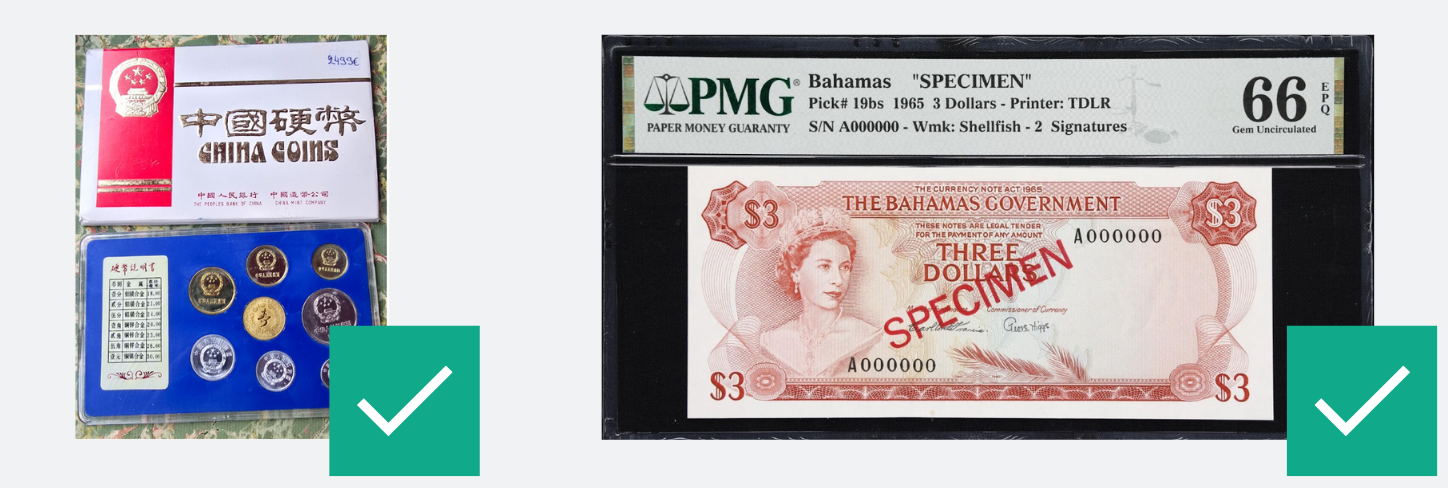
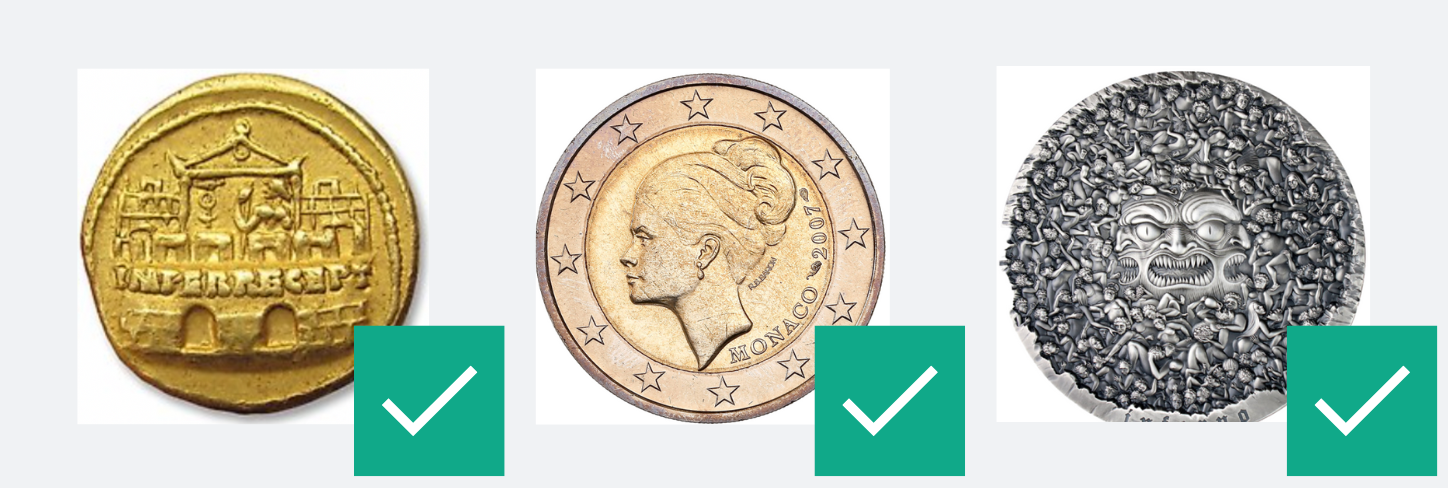
What we do not accept
To keep our auctions high-quality and trustworthy, we do not accept:
- Ancient Coins: low-grade Late Roman bronzes as single lots; commonly copied coins without provenance/certification; undocumented coins from restricted regions; modern replicas (ancient forgeries & Renaissance copies allowed if noted); undecorated Celtic ring-money; manipulated coins (tooled, smoothed, plugged) without disclosure
- Banknotes: Banknotes, manipulated to imitate error notes; manipulated notes (e.g., ironed notes) without disclosure; commonly forged banknotes (e.g., specific Chinese notes), if not graded
- Bullion: Perth Mint, PAMP Suisse, APMEX (in weekly auctions; possible in daily auctions)
- Euro Coins: 2 Euro Monaco coins with fake boxes & certificates; Croatian 2023 coincards featuring proof coins; Belgian coincards featuring Maltese 2 Euro 2023
- Modern World Coins: single 1/1000 oz gold coins; unofficial gold-plated 1 oz coins that imitate official issues
- World Coins: group submissions <4 kg of common 20th century base metal coins
- Medals: low-value 19th-20th century bronze medals (French, Portuguese, Spanish) unless ≥10; 20th century restrikes/aftercasts; manipulated medals without disclosure
📌Example of rejected objects:
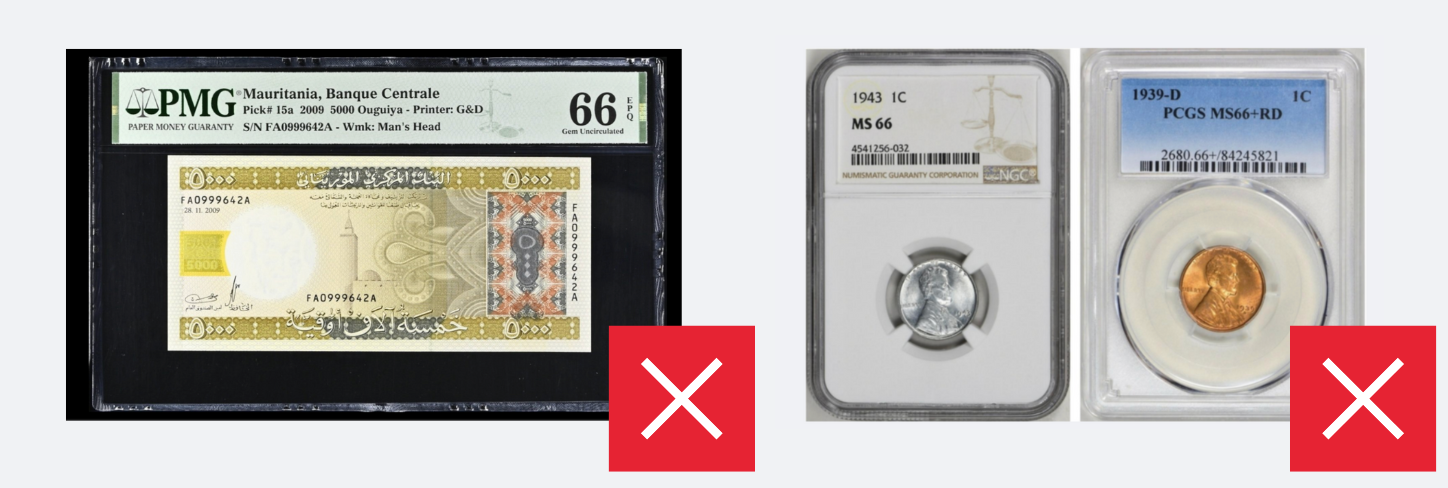
Getting your submission ready
1. Fill in all the details and write a clear description
When you submit an object, you’ll see dropdown menus that guide you in entering the correct details (e.g., type of object, country/region, ruler, condition, weight). These fields automatically generate the object title and make your listing clear, searchable, and easy for bidders to understand.
Please also use the object description field to share:
- A description of the object(s), ideally covering both obverse and reverse (for coins and banknotes). If possible, include the catalogue number
- Condition details (e.g., wear, scratches, folds)
- Weight (for coins): please make sure to include the weight, this information is essential for verifying a coin’s authenticity.
- Provenance information, if available
- What is included or excluded (e.g., coin trays, certificates of authenticity)
Tip: The more detail you provide, the easier it is for bidders to understand the value of your object – and the more likely it is to sell. Find here more tips on how to write a clear, accurate description.
📌Example of a well-written description:
“Material: Silver
Weight: 3.83 g
Diameter: 18,50 mm
Ref.: Crawford 443/1; CRI 9; BMCRR Gaul 27–30; RSC 49
Obverse: Elephant advancing right, trampling on serpent; CAESAR in exergue
Reverse: Emblems of the pontificate: simpulum, aspergillum, securis (surmounted by wolf's head), and apex”.
2. Great photos matter
Photos are the first thing bidders see – so make them count! We recommend including at least 2 high-quality images that clearly show the condition and details of your object. This helps bidders make informed decisions and increases your chances of a successful sale.
Your photos should include:
For all submissions:
- Photos of the obverse/front and reverse/back of the coin, bar or banknote.
- Clear visuals of engraver’s signatures, dates, mint marks, as well as any scratches, folds, tooling/restorations
For coins:
- For certain coins, a photo of the edge is also required
- A picture of a coin on the scale to show weight
For slabbed coins and graded banknotes:
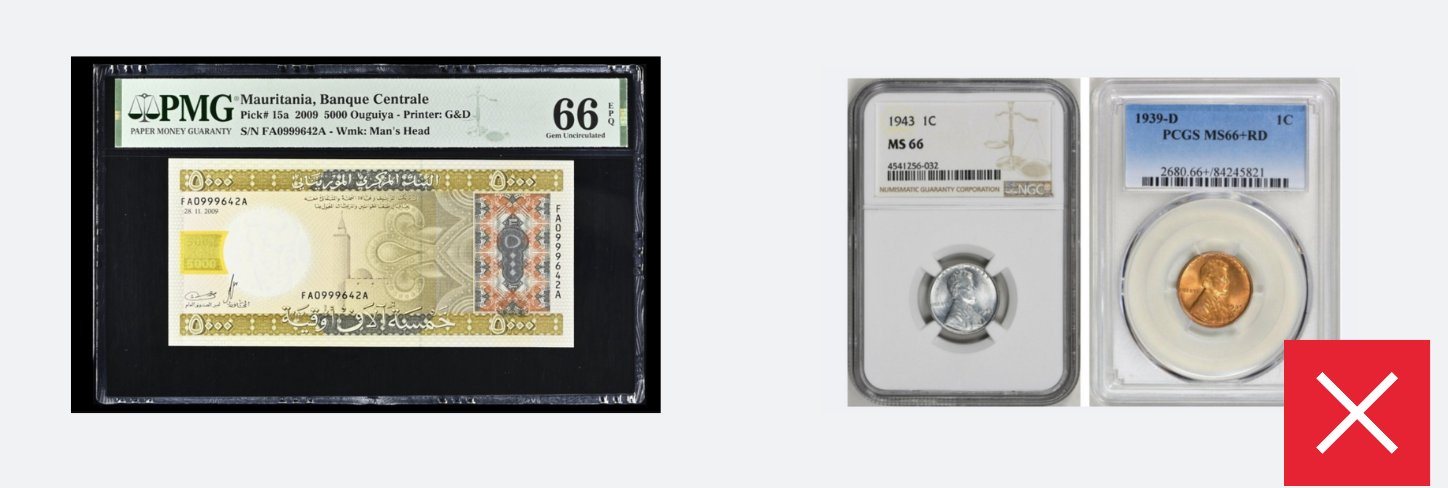
- A full image of the slab, ensuring the certification details are fully visible and legible
For grouped submissions:
- Overview image including all coins or banknotes, followed by detailed images of the most notable pieces to ensure proper evaluation
Tips:
- For single coin or banknotes, the images must be centered, with the coin or banknote preferably occupying at least 80% of the frame.
- Individual coins should be photographed outside of cardboard holders or sleeves. Exception: if the holder or sleeve dates from the early 20th century or earlier and serves as provenance, it may remain in place.
- Do not include any prices, website references, phone numbers, or store addresses in your photos.
- Ensure proper lighting: if you don’t have a professional lighting setup, place a clean white sheet of paper as a background near a window to use natural daylight.
- Use the macro function on your camera or smartphone. Make sure the coin or banknote is in focus, and take the picture with a steady hand to ensure clarity.
- Find here more tips on how to take professional photos.
📌Example of good images:
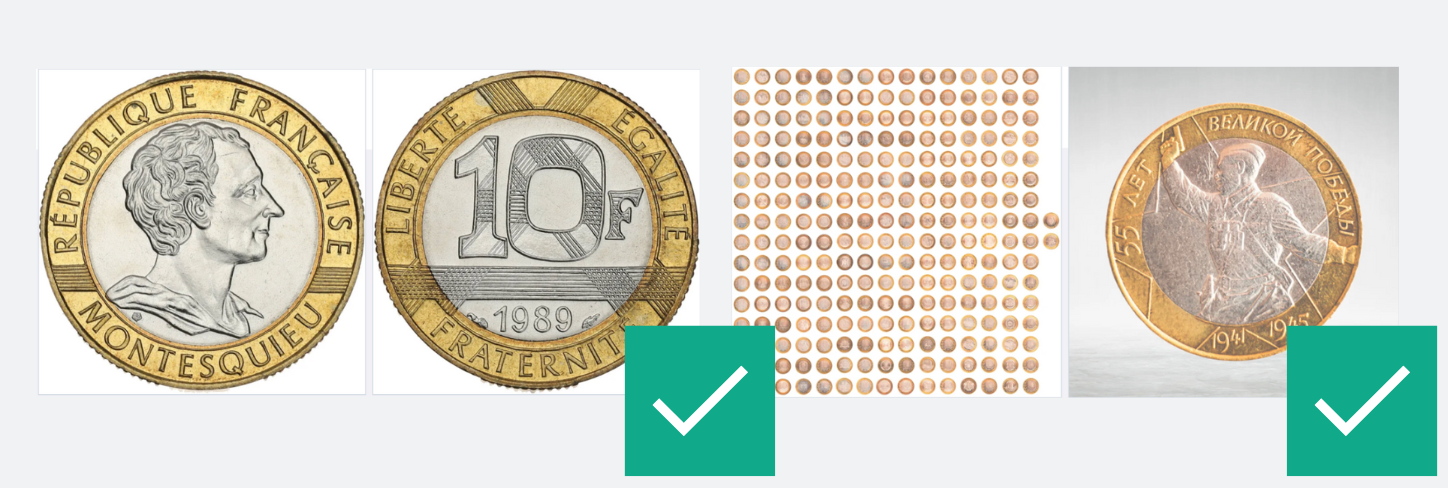
3. Additional requirements
3.1 Explicit content
Third Reich coins and banknotes featuring swastikas may be included in our auctions. However, any visible swastikas must be blurred in the public listing images. Original, unaltered images can be provided to Catawiki for internal verification purposes but will not be displayed publicly. On your behalf, we will include the following disclaimer:
Note: Following our policy concerning explicit content, the swastikas on these coins are covered. The original images are available, please feel free to reach out to Catawiki, the images can be provided upon request. Thank you for your understanding.
3.2 Policies of service providers
In order to align our guidelines with the policies of our service providers, coins, medals, and banknotes from Cuba, Iran, North Korea, Syria, and the Crimea, Donetsk, and Luhansk regions cannot be included. However, ancient coins from historical regions or empires that geographically overlap with these modern territories — such as Achaemenid coins — may be included, provided they meet all other submission criteria.
3.3 Grading / Certification
Buyers are more likely to bid if the object is certified as being authentic - and/or in a specific grade. If the coin or banknote is certified by a trusted third party grading service and placed in a seal (also called "slab"), we will give complete trust to the object, once the certification number and pictures have been verified
3.4 Provenance
For certain (mostly ancient) coins we will ask for provenance. In many cases, an export license needs to be requested in order to ship an ancient coin - similar to other archaeological finds - and (proof of) provenance might be needed. Please note that EU buyers need to request an import statement/import license in certain cases.
Ready to sell? List your coins, banknotes and bullions today
Selling with us is free – commission is only applied if your object sells.
Follow these guidelines to maximise your chances of success.
Register as a seller and submit your object for auction now.