At Catawiki, we auction rare, collectable, and playable musical instruments and equipment. Each submission is selected for quality, authenticity, and appeal to passionate musicians and collectors. Each object is reviewed by our in-house experts to ensure it’s of premium quality and ready to excite our bidders.
Follow these guidelines to increase your chances of a successful sale.
What we accept
We’re looking for high-quality, complete, and desirable bowed string instruments and related items. To be accepted, your object must:
- Fall within our accepted categories:
- Bowed String Instruments (Violins, Violas, Cellos, Double Basses).
- Bows (Archers) – Submitted with instruments or as standalone lots.
- Accessories: Collectable cases, period fittings, and vintage bows.
- Be playable and tested, OR be a Restoration Candidate of high intrinsic value (see Section 2).
- Be vintage and/or collectable and no longer widely available in retail.
- Include proper documentation, if the instrument is subject to CITES (e.g. rare woods, ivory bow tips). Remember that for CITES-regulated materials, we accept instruments only if you provide certification and for ivory parts we accept only if they are built before 1940.
- Meet the minimum expected value of €75 (You can combine objects in one submission to meet this threshold).
What increases your chances of approval:
Instruments from recognised antique, modern, or high-end makers and schools are highly encouraged:
- Historical Makers & Schools: Stradivari, Guarneri, Amati, Gagliano, Guadagnini, Milanese School, French School (p. es., Vuillaume).
- Renowned Workshops: J.B. Schweitzer, Émile Français, Pfretschner, E.H. Roth, Karl Höfner (higher-end models).
- Prestige Bows: Fine bows by respected makers (e.g., Sartory, Peccatte, Bazin).
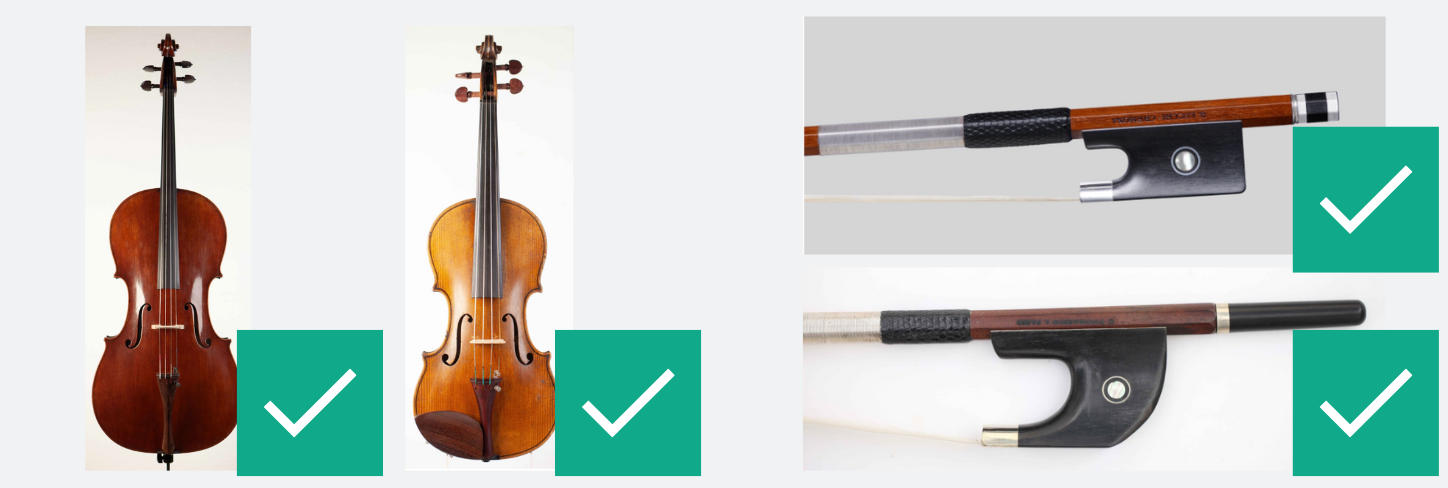
📌 Examples of accepted objects:
What we do not accept
To keep our auctions trustworthy and attractive to buyers, we do not accept:
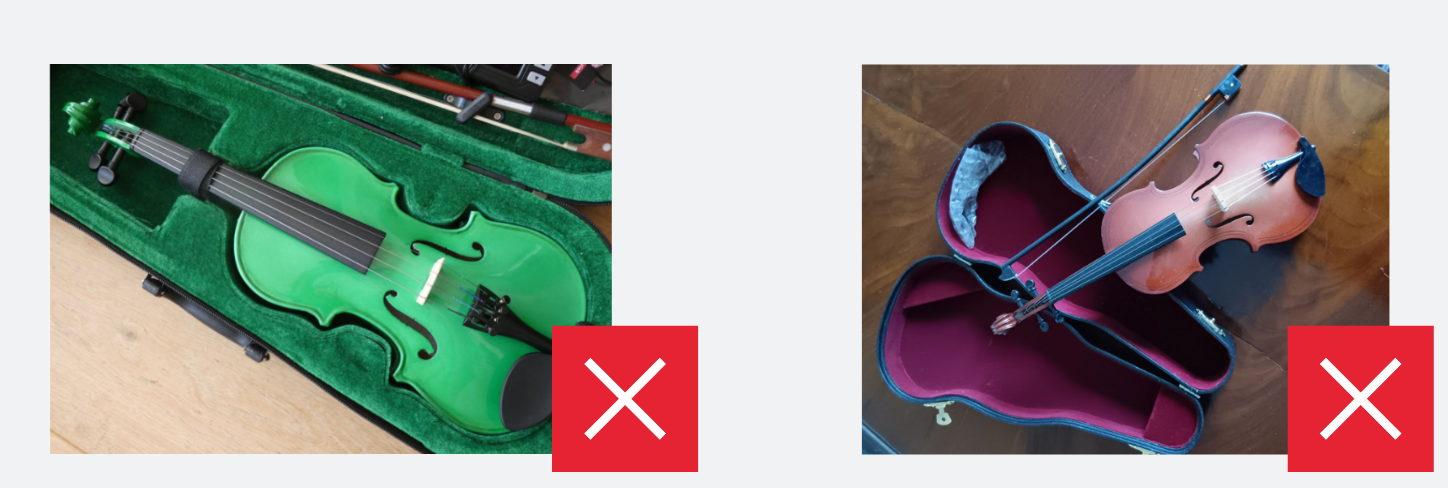
- Low-quality, mass-produced retail Items (e.g., factory-made student outfits, uncertified replicas)
- Generic/unbranded items lacking distinct, high-quality features.
- Toys, decorative items, souvenirs, miniatures, or non-functional/dummy models
- Generic accessories (e.g. rosin, new strings) submitted as single lots
- Unplayable instruments (unless qualified as a restoration candidate)
📌 Examples of rejected objects:
Getting your submission ready
1. Fill in all the details and write a clear description
When you submit an object, you’ll see fields to guide you in providing information like: maker, model, period, country of construction, materials, condition, etc. These fields ensure your listing is clear, searchable, and easy for bidders to understand.
Note on testing: Please write clearly if you are able to test the instrument properly (e.g., plays in tune, no buzzes, good projection). If you cannot perform a proper test, you must explicitly state that the instrument is offered in untested condition.
Condition definition (aesthetic & functional)
Condition is assessed on the overall state of the instrument (playability + working condition + aesthetics).
- Mint – Like new condition, including original packaging, perfect functional status, and no signs of use.
- Visually Excellent (Untested) – Aesthetically flawless, but functional status and playability have not been verified by the seller (e.g., inherited or stored item). Requires professional testing.
- Excellent – Minor cosmetic wear, fully functional with all components performing as intended.
- Very Good – Slight aesthetic scratches or marks, but fully functional and ready to play.
- Good – Working condition, with visible and declared signs of wear.
- Restoration Candidate – Requires extensive functional or structural repair, but its high intrinsic value (maker, rarity) makes it worth restoring.
- Fair / Poor – Functional issues or clear cosmetic flaws that compromise playability. NOT accepted unless designated as a Restoration Candidate.
Required information by instrument type
The descriptive part of your submission must include the maker/label and the total number of items. Additionally, you must provide the following:
Instruments (violin, viola, cello, bass):
- Measurements: Body length (excluding neck button), upper and lower bout widths, and vibrating string length (from nut to bridge).
- Identification: Clearly state the name on the label. If the seller claims the instrument is authentic or original, or made by a specific luthier, a Certificate of Authenticity from a well-known luthier is mandatory. Otherwise, the instrument must be described as "labelled." If the date or origin cannot be certified, the seller must explicitly state that this information is taken from the label or is an uncertified estimate.
- Infringement warning (critical!): Instruments labeled or stamped with names of living or contemporary luthiers must be guaranteed as authentic. Uncertified items may be rejected due to trademark/copyright infringement risks.
- Structural state: Detail all cracks (soundpost, bass bar, surface), state of seams (open or firm), and presence of worm holes or significant repairs (e.g., neck grafts).
Bows (archets):
- Identification: Maker's stamp (if present), country/school of origin, and period.
- Measurements: Weight (in grams), length (total tip-to-frog), and balance point (distance from the frog).
- Materials: Type of wood (e.g., Pernambuco), and material of the frog/tip (e.g., ebony, ivory - CITES rules apply).
- Condition: Condition of the stick (straightness/warps), hair, and any visible cracks/repairs (e.g., head repair).
Tip: The more detail you provide, the easier it is for bidders to understand the value of your object – and the more likely it is to sell. Find here more tips on how to write a clear, accurate description.
📌 Examples of a well-written description:
Maker/Label: Labelled "Giuseppe Guarneri Cremona 1742"
Lot Includes: 4/4 Violin + Stamped Bow + Vintage Hard Case.
Identification Status: "Labelled"—No Certificate of Authenticity (COA) is provided. This is an uncertified estimate taken from the label.
Measurements
The violin measurements are: Body Length (LOB) 356 mm, Upper Bout Width 167 mm, Lower Bout Width 205 mm, and Vibrating String Length 328 mm. The bow measurements are: Weight 61.5 grams, Length (Tip-to-Frog) 74.3 cm, and Balance Point 27.5 cm from the frog.
Conditions
This violin is in Very Good overall condition. It is fully tested by a musician and functional, ready for immediate playing.
Detailed Structural & Condition Report
Playability Status (Tested): The instrument has been properly tested and is fully functional. Aesthetic & Structural State: The varnish shows slight aesthetic scratches and marks consistent with age (Status: Very Good). There are no open seams and no visible soundpost or bass bar cracks. One stable, professionally repaired hairline crack (approx. 3 cm) is visible on the lower bout (declared and photographed). This repair is stable and does not affect the instrument's sound. The wood is highly-figured flamed maple on the back and ribs.
Bows (Archets) Included: The included bow is stamped "W. E. DORFLER" (German workshop). The stick is straight. The hair is old and needs replacement before use.
2. Great photos matter
Photos are the first thing bidders see – so make them count! We recommend including at least 8 high-quality images that clearly show the condition and details of your object.
Your photos should include:
For all submissions:
- Overall shots (minimum 4): Clear, full, vertical and frontal views of the entire item (front, back, sides). Avoid unfocused, diagonal, tilted, or cropped angles.
- Identification: Sharp photo of the brand/maker logo or stamp.
- Serial number/label: Clear, well-lit photo of the interior label.
- Condition details: Close-ups of all declared defects, cracks, open seams, or repairs.
Additional requirements by instrument type:
- Instrument: Complete frontal and back photos (to show wood figure and seams). Clear views of all four faces of the scroll and pegbox, close-ups of the bridge, f-holes, and the neck-to-body joint (both sides).
- Bow: Full, straight view of the entire bow stick (to show straightness/warps), close-ups of the frog (heel), the tip (head), and the maker's stamp (if present).
Tip: Use a neutral background (white or black), avoid low-quality or stock images, and aim for natural lighting. Find here more tips on how to take professional photos.
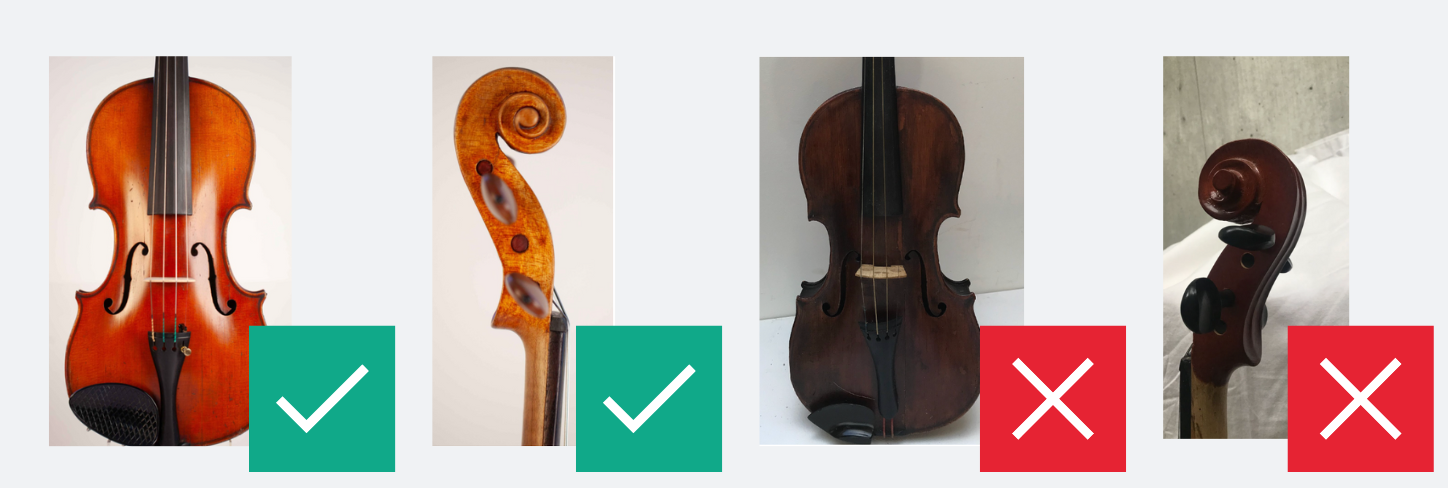
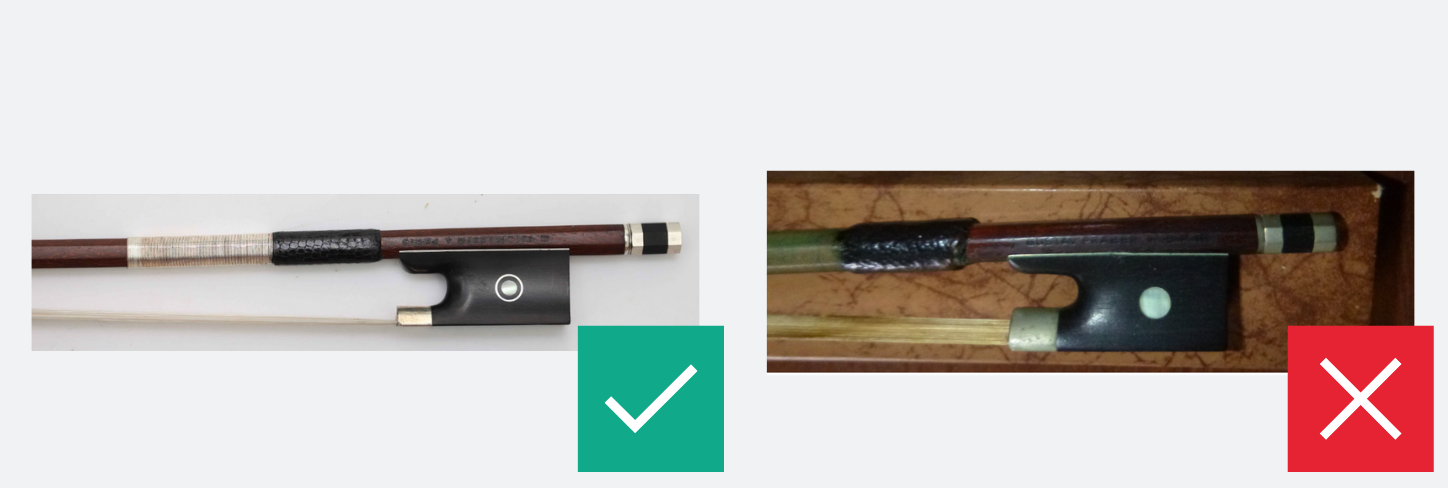
📌 Examples of good vs. bad photos:
- The photos on the left are well-lit, professionally framed, and use a neutral background, making it easy to assess the instrument’s condition. The ones on the right suffer from poor lighting, distracting backgrounds, and uneven angles, which reduce clarity and buyer confidence.
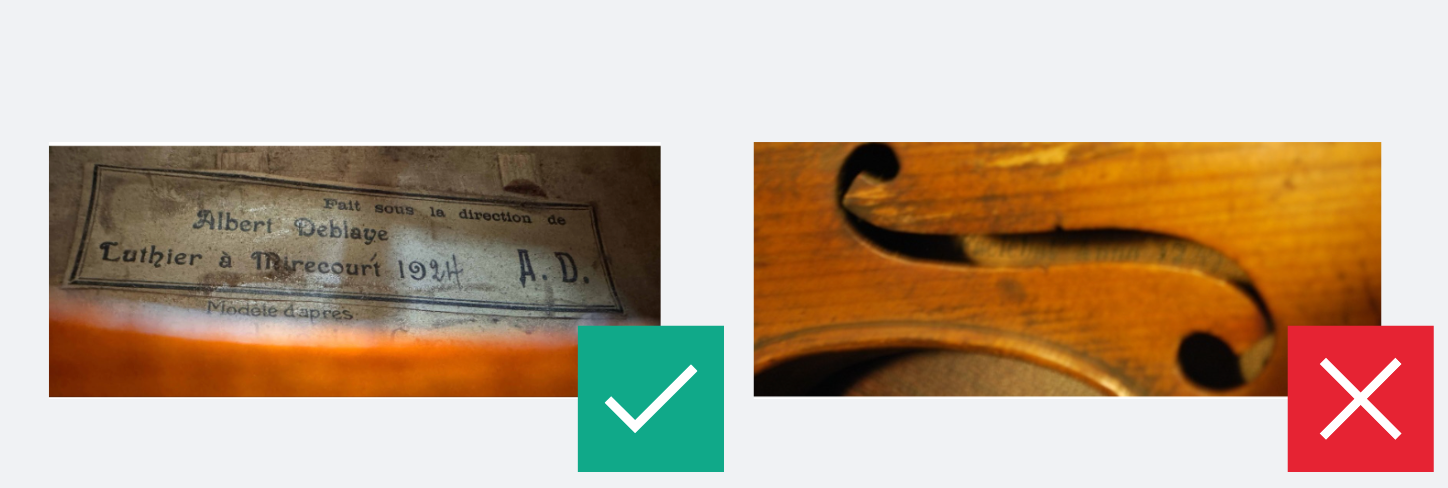
- The image on the left is a clear, focused close-up of the label inside the instrument, helping confirm its maker and origin. The image on the right is blurry and poorly framed, offering no useful detail for identification or assessment.
- The left photo is sharp, well-lit, and clearly shows the frog and winding of the bow, making it easy to assess its condition. The right photo is blurry, poorly lit, and taken at an angle that obscures key details, reducing its usefulness for evaluation.
3. Additional expert tips to maximise your auction success
Submit a complete and high-quality listing
The more accurate and detailed your submission, the faster our experts can review and approve it. Include clear, well-lit photos and a thorough, honest description to avoid delays.
Respond promptly to expert requests
Our experts may contact you for additional information or specific photos. Providing these quickly is essential: incomplete submissions may be rejected or postponed.
Use the ‘Message to the expert’ to stay connected
The messaging feature is the quickest way to communicate with your expert. Use it to clarify questions, provide updates, or ask for advice. A short message can go a long way in making your lot auction-ready.
Ready to sell? List your musical instruments today
Selling with us is free – commission is only applied if your object sells.
Follow these guidelines to maximise your chances of success.
Register as a seller and submit your object for auction now.