At Catawiki, we auction rare, collectable, and playable musical instruments and equipment. Each submission is selected for quality, authenticity, and appeal to passionate musicians and collectors. Each object is reviewed by our in-house experts to ensure it’s of premium quality and ready to excite our bidders.
Follow these guidelines to increase your chances of a successful sale.
What we accept
We’re looking for high-quality, complete, and desirable musical instruments and related items. To be accepted, your object must:
- Fall within our accepted categories:
- Electric Guitars and Basses (Modern and Vintage).
- Acoustic and Classical Guitars.
- Amplifiers and Speaker Cabinets (Tube and Solid State).
- Accessories: effect pedals, pickups, vintage components, collectable cases.
- Be playable and tested, OR be a Restoration Candidate of high intrinsic value (see Section 2).
- Be vintage and/or collectable and no longer widely available in retail.
- Include proper documentation, if the instrument is subject to CITES (e.g. Brazilian rosewood). Remember that for CITES-regulated materials, we accept instruments only if you provide certification.
- Meet the minimum expected value of €75 (You can combine objects in one submission to meet this threshold).
What increases your chances of approval:
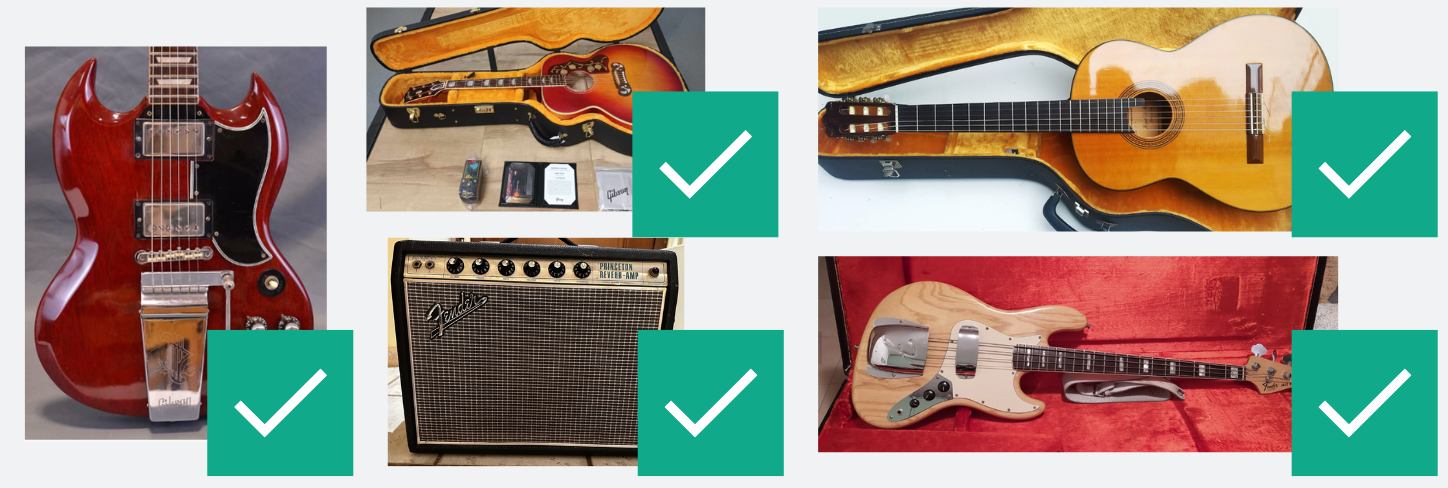
Instruments from recognised, established, or high-end brands are highly encouraged:
- Electric guitars & basses: Fender, Gibson, Ibanez (Prestige/JEM/JS), Rickenbacker, PRS, Music Man, Gretsch (High-end).
- Acoustic & classical guitars: C.F. Martin, Taylor, Gibson, Guild, Ramírez, Collings, Lowden.
- Amplifiers & cabinets: Marshall (JCM/Plexi), Vox (AC Series), Fender (Blackface/Tweed), Mesa/Boogie, Orange.
- Pedals & devices: Klon, Analog Man, Strymon, Boss (Vintage), Electro-Harmonix (Big Muff), Ibanez (Tube Screamer).
📌 Examples of accepted objects:
What we do not accept
To keep our auctions trustworthy and attractive to buyers, we do not accept:
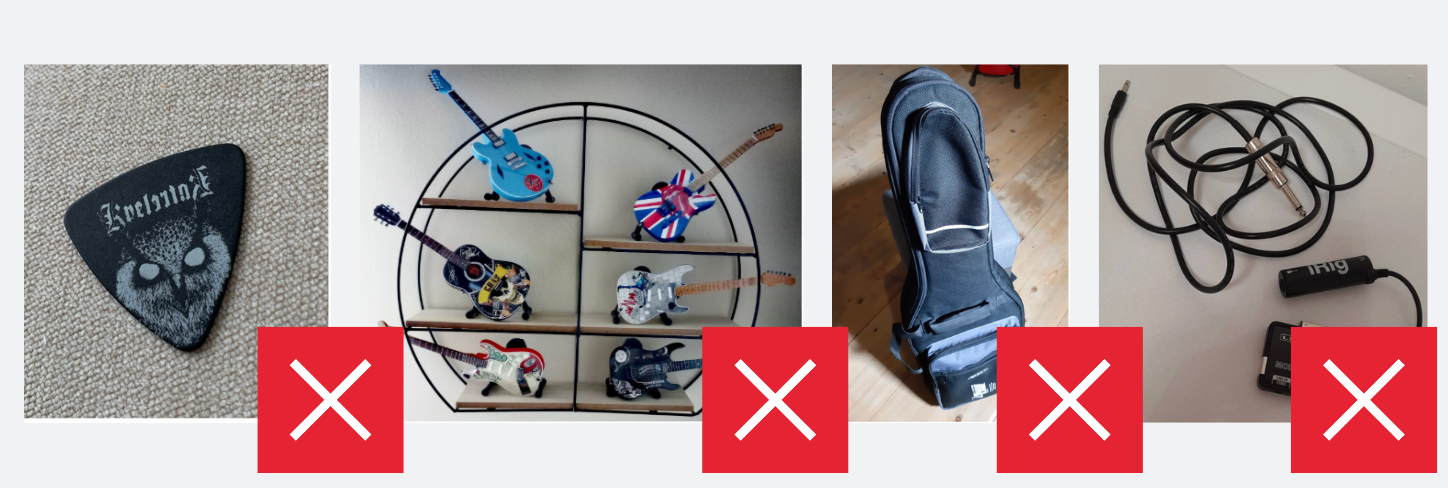
- Low-quality, mass-produced retail Items (items widely available in large online or generic shops, lacking high-quality features or intrinsic value)
- Generic/unbranded items
- Toys, decorative items, souvenirs, miniatures, or non-functional/dummy models
- Generic accessories (e.g. straps, new cases, drumsticks) submitted as single lots
- Unplayable instruments (unless qualified as a restoration candidate)
📌 Examples of rejected objects:
Getting your submission ready
1. Fill in all the details and write a clear description
When you submit an object, you’ll see fields to guide you in providing information like: brand or maker, model, type, year, country of manufacture, serial number, material, weight, condition, etc. These fields ensure your listing is clear, searchable, and easy for bidders to understand.
Note on testing: Please write clearly if you are able to test the instrument properly (e.g., tested all electronics, verified truss rod function, checked every fret). If you cannot perform a proper test, you must explicitly state that the instrument is offered in untested condition.
Condition definition (aesthetic & functional)
Condition is assessed on the overall state of the instrument (playability + working condition + aesthetics).
- Mint – Like new condition, including original packaging, perfect functional status, and no signs of use.
- Visually Excellent (Untested) – Aesthetically flawless, but functional status and playability have not been verified by the seller (e.g., inherited or stored item). Requires professional testing.
- Excellent – Minor cosmetic wear, fully functional with all components performing as intended.
- Very Good – Slight aesthetic scratches or marks, but fully functional and ready to play.
- Good – Working condition, with visible and declared signs of wear.
- Restoration Candidate – Requires extensive functional or structural repair, but its high intrinsic value (brand, rarity) makes it worth restoring.
- Fair / Poor – Functional issues or clear cosmetic flaws that compromise playability. NOT accepted unless designated as a Restoration Candidate.
Required information by instrument type
The descriptive part of your submission must include the brand, model, and the total number of items. Additionally, you must provide the following:
- Electric guitars & basses (modern): Scale length, nut width, action height at mid-scale (precise measurements), detailed condition of frets/fretboard wear, and function of all switches/pots/electronics.
- Electric guitars & basses (vintage): All modern points plus detailed history/provenance, originality status of paint/finish, and potentiometer codes (if possible to read) for dating.
- Acoustic & classical guitars: Scale length, nut width, action height at mid-scale, detailed condition of frets/fretboard wear, type of wood (top/back/sides), and detailed status of bridge lift/top belly.
- Amplifiers (tube & solid state): Wattage/power rating, confirmation that all channels/inputs/effects loops are tested and working, status/brand of tubes (if applicable), and list of included footswitches or cables.
- Pedals & devices: Confirmation of working order, power supply included (or battery status), originality status (e.g., internal component modifications), and original box/paperwork status.
Tip: The more detail you provide, the easier it is for bidders to understand the value of your object – and the more likely it is to sell. Find here more tips on how to write a clear, accurate description.
📌 Examples of a well-written description:
Brand/Model: Fender American Professional II Stratocaster (HSS)
Serial Number: US210XXXXX
Year: 2021
Lot Includes: Guitar + Original Fender Hard Case + COA/Tags.
This guitar is in Excellent condition. It is fully tested by a musician and 100% functional. Plays clean across the entire fretboard with low action.
Aesthetic Condition: Shows only minor cosmetic wear (Status: very good). There is one tiny, surface mark on the back edge near the input jack (declared and photographed). No structural damage, cracks, or heavy buckle rash.
Technical Details:
Action Height (at 12th Fret): 1.75 mm (Low E).
Truss Rod Status: Fully functional.
Fret Wear: Minimal to none on the first five frets.
Electronics: Original V-Mod II pickups. All switches and pots are clean and operate smoothly without noise.
Ready for professional use. Includes original documentation.
2. Great photos matter
Photos are the first thing bidders see – so make them count! We recommend including at least 8 high-quality images that clearly show the condition and details of your object.
Your photos should include:
For all submissions:
- Overall shots (minimum 4): Clear, full, vertical and frontal views of the front, back, and sides of the entire instrument. Avoid unfocused, diagonal, tilted, or cropped angles.
- Identification: Sharp photo of the brand logo, headstock, or visible label.
- Serial number/label: Clear, well-lit photo of the serial number, stamp, or label.
- Condition details: Close-ups of all declared defects, repairs, or wear (dents, scratches, cracks).
Additional requirements by instrument type:
- Electric guitars & basses: Back of headstock (for serial/tuners), close-ups of fret wear (first 5 frets), neck heel/pocket (if separated), and electronics/potentiometer codes (if opened).
- Acoustic & classical guitars: Interior soundhole label (clear and legible), side view of action height (at 12th fret), bridge joint (for lift/cracks).
- Amplifiers: All control knobs/panels, back panel showing I/O ports, and internal chassis showing tube condition (if applicable).
- Pedals & devices: Back plate showing battery compartment/serial, photo of the PCB (circuit board) if modifications are mentioned, and all input/output jacks.
Tip: Avoid photos with people or body parts, selfies, or screenshots. Use a neutral background (white or black), avoid low-quality or stock images, and aim for natural lighting. Find here more tips on how to take professional photos.
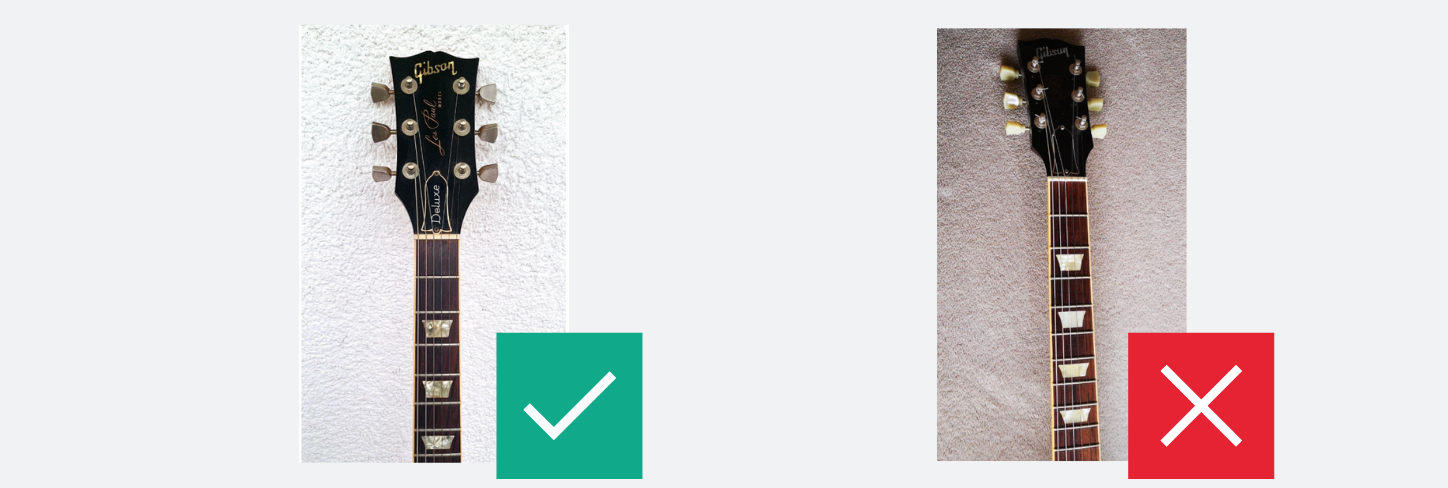
📌 Examples of good vs. bad photos:
- The left image is well-framed, evenly lit, and taken from a straight-on angle, making the guitar’s condition easy to assess. The right image is poorly composed, tilted, and has a cluttered background that distracts from the object.
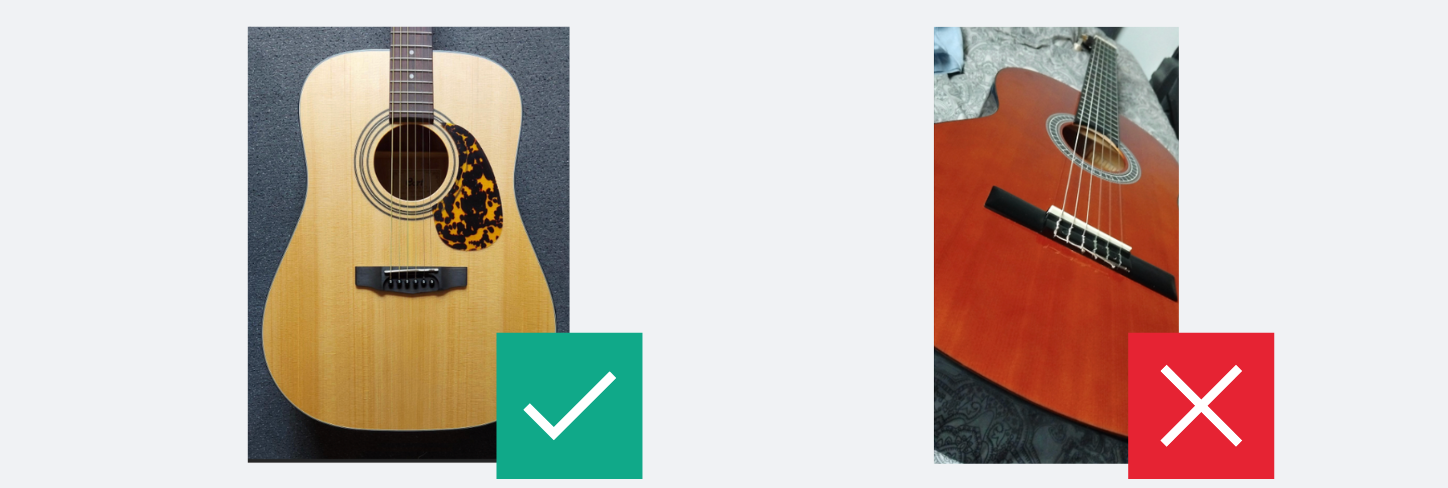
- The photo on the left is clean, well-lit, and clearly shows the full guitar against a neutral background. The photo on the right is cluttered, taken at an awkward angle, and includes multiple instruments, making it unclear which one is being sold.
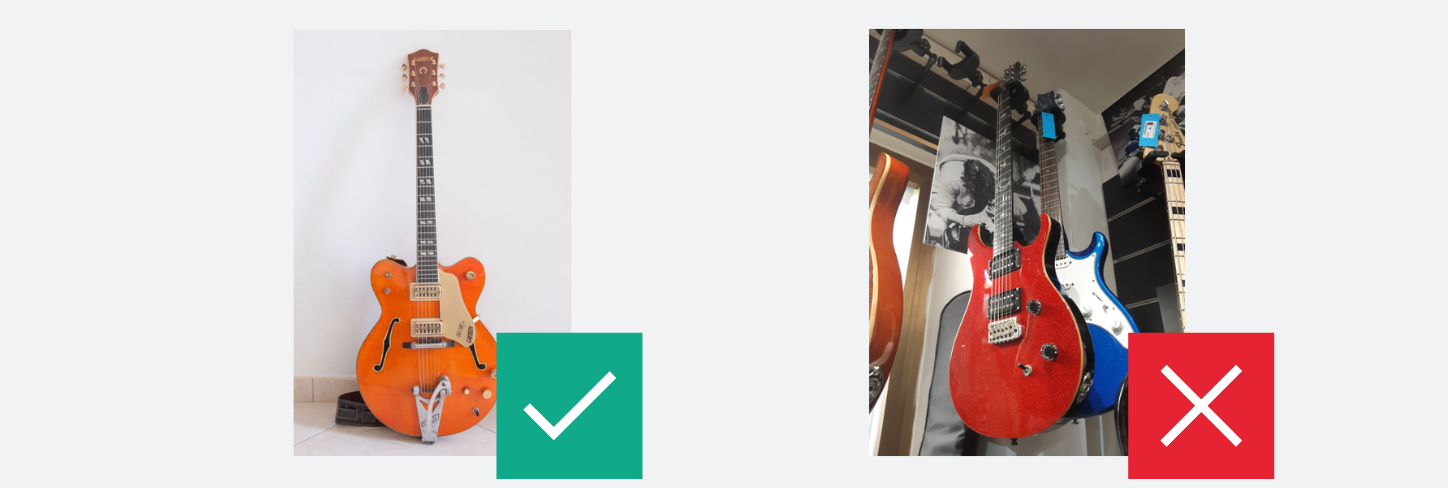
- The image on the left is sharp, well-lit, and taken straight on against a neutral background, clearly showing the headstock and fretboard. The image on the right is dim, slightly tilted, and uses a textured background that makes the photo appear less professional.
3. Additional expert tips to maximise your auction success
Submit a complete and high-quality listing
The more accurate and detailed your submission, the faster our experts can review and approve it. Include clear, well-lit photos and a thorough, honest description to avoid delays.
Respond promptly to expert requests
Our experts may contact you for additional information or specific photos. Providing these quickly is essential: incomplete submissions may be rejected or postponed.
Use the ‘Message to the expert’ to stay connected
The messaging feature is the quickest way to communicate with your expert. Use it to clarify questions, provide updates, or ask for advice. A short message can go a long way in making your object auction-ready.
Ready to sell? List your musical instruments today
Selling with us is free – commission is only applied if your object sells.
Follow these guidelines to maximise your chances of success.
Register as a seller and submit your object for auction now.