We carefully select audio equipment objects to ensure a high standard of quality, collectability, and authenticity. Our expert-curated auctions feature special, rare, and desirable pieces for audio enthusiasts—from vintage amplifiers to professional studio gear. Each object is reviewed by our in-house experts to ensure it’s of premium quality and ready to excite our bidders.
Follow these guidelines to increase your chances of a successful sale.
What we accept
We’re looking for authentic, high-quality audio equipment that appeals to collectors and audiophiles. To be accepted, your object must:
- Fall within our accepted categories:
- Professional audio devices (e.g. microphones, compressors, mixers, monitors)
- Integrated amplifiers, power and main amplifiers
- Turntables, tape decks, cassette decks
- CD players and recorders, equalizers, DSPs
- Noise reduction systems, headphones
- Hi-Fi sets (ideally pre- and post-90s)
- Shellac records (78 RPM), blank tapes (15–26 cm)
- MiniDisc players, transistor world radios, and portable audio devices
- Be at least 3 years old, authentic and in working condition
- Meet the minimum expected value of €75*
(You can combine objects in one submission to meet this threshold)
What increases your chances of approval:
- Objects from a reputable maker such as Akai, Bang & Olufsen, Marantz, NAD, JBL, Technics, Pioneer, Revox, Luxman, or Yamaha
- Equipment in mint or excellent condition with full specs listed
What we do not accept
To keep our auctions trustworthy and attractive to buyers, we do not accept:
- Non-functional equipment or untested objects unless highly collectable (At expert’s discretion)
- Speakers with cone or suspension defects
- Used vacuum tubes, or low-quality cartridges
- Televisions or video gear (except Bang & Olufsen)
- Devices with political propaganda (e.g. WW2 tube radios)
- Mass-market or widely available devices
- Karaoke sets, public address systems, or car audio
- Replica or counterfeit objects
- Equipment less than 5 years old
Getting your submission ready
1. Fill in all the details and write a clear description
When you submit an object, you’ll see fields to guide you in providing the right information, such as: brand, model name or number, type, condition, power & impedance, frequency range, THD, dimensions, weight, serial number, etc. These fields ensure your listing is clear, searchable, and easy for bidders to understand.
Note: To determine condition, we use the following grading system:
- Mint – New, boxed, and unused.
- Excellent – Used, fully tested, minimal signs of wear.
- Very good – Used, tested, visible signs of use.
- Good – Functional, with visible signs of wear such as scratches, faded print, or missing non-essential items (e.g. remote, manual).
- Fair – Tested, but may have limited functionality or minor technical issues. Cosmetic wear may include dents, cracks, or loose components. Only accepted for rare or collectable objects with clear disclosure.
- Poor – Non-functional, heavily worn, or damaged. Missing essential parts or showing major faults (e.g. broken speakers, dead displays). Objects in poor condition are not accepted.
Please also use the object description field to share:
- Brand, model name/number and type
Serial number, especially for Bang & Olufsen models and vintage professional audio devices
Condition and if the object has been tested
Specifications and technical highlights, such as power handling (Watts), impedance (Ohms), harmonic distortion in (THD%), frequency range (Hz-Khz,), and dimensions (WLH)
- Weight and size: please calculate the weight based on the technical specifications and packaging weight. Note: please remember that a speaker set consists of 2 units, while the technical information will always show the weight of 1 speaker
- What is included/not included (e.g. packaging)
- Where the object came from/how it was obtained
- If the object has any flaws or signs of wear (scratches, fading, bends, marks)
Tip: The more detail you provide, the easier it is for bidders to understand the value of your object – and the more likely it is to sell. Find here more tips on how to write a clear, accurate description.
2. Great photos matter
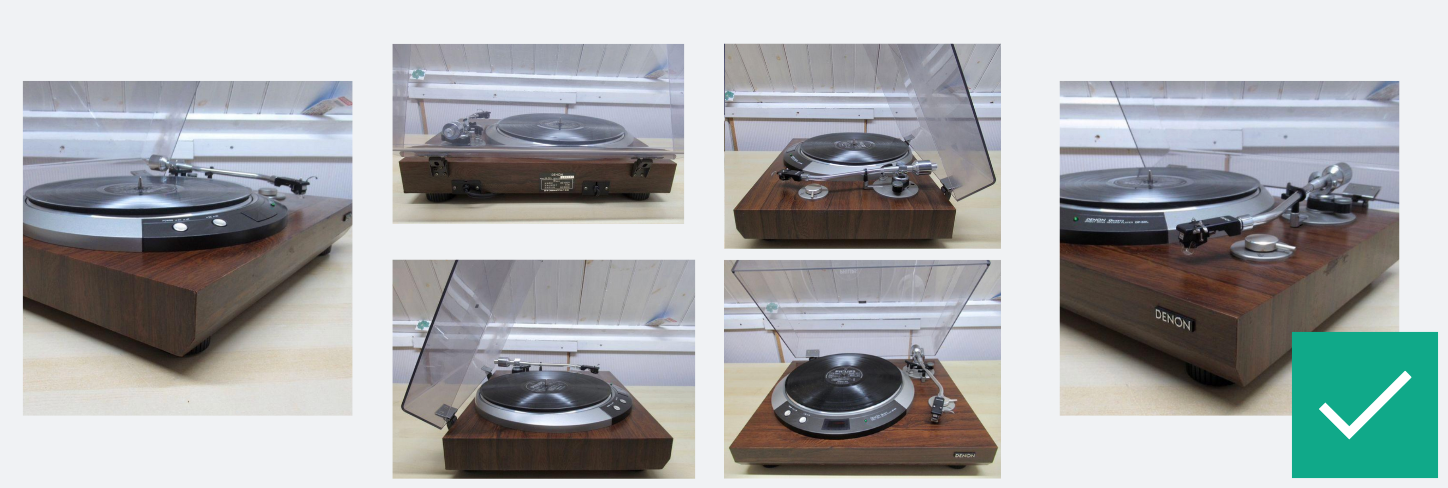
Photos are the first thing bidders see – so make them count! We recommend including at least 6 high-quality images that clearly show the condition and details of your object. This helps bidders make informed decisions and increases your chances of a successful sale.
Your photos should include:
For all submissions:
- Front, back, top, bottom, and both sides of the object
- Close-ups of ports, connections (RCA, DIN, XLR, etc.), labels, and serial number
- Photos of the device powered on, e.g. showing the display or indicator lights turned on
- Speaker cones and suspension (for speakers)
- Any visible flaws or signs of wear
For grouped submissions:
- Overview image including all items, as well as photos of each item individually
Tip: Avoid photos with people, selfies, or screenshots. Use a neutral background (white or black), avoid low-quality or stock images, and aim for natural lighting. Find here more tips on how to take professional photos.
📌 Examples of good images:
3. Additional proof of authenticity
We pay extra attention to ensure authenticity of high-value and high-risk objects to protect bidders and ensure a trustworthy marketplace, and we may request additional information, images and proof of provenance at the discretion of an expert.
Ready to sell? List your audio equipment today
Selling with us is free – commission is only applied if your object sells.
Follow these guidelines to maximise your chances of success.
Register as a seller and submit your object for auction now.