At Catawiki, we curate auctions of rare, premium, and collectable wines that attract serious collectors and wine lovers. Each object is carefully reviewed by our in-house experts to ensure authenticity, collectability, and value — offering bidders a trusted experience and sellers the best opportunity for success.
Follow these guidelines to maximise your chances of a successful sale.
What we accept
We accept a wide range of wines and accessories, provided they meet our standards for quality and collectability. To be accepted, your object must:
- Fall within our accepted categories:
- Bottles of wine, Champagne, Port, or sweet wine
- Original sealed bottles with capsules intact
- Original wooden cases (sealed or unsealed) with original bottles. For all vintages prior to 2005 we would require to open the seal case/coffret in order to insert images of the current condition (fill, color, capsule)
- Premium-quality wine and Champagne
- Collectable wine accessories such as:
- Limited edition ice buckets
- Vintage or modern branded glassware and decanters
- High-end bottle openers (e.g. Laguiole)
- EuroCaves and wine chillers
- Wine-related furniture or travel gear
- Branded Champagne sabres
- Be authentic: only original bottles (no display items) with all details matching the label and packaging
- Have an acceptable fill level:
- Neck, base neck, very top/top/upper shoulder
- Up to 4 cm below cork (Burgundy bottles)
- Mid-shoulder (in some older bottles only)
- Be in fair or better condition:
- Properly sealed with capsule & cork intact, no needle holes or shrinkage
- Label should be readable, not mouldy or crumbling
- Wine must retain natural colour, no fading or browning
Be not widely available: current mass-market or supermarket wines are not eligible
- Meet the minimum expected value of of €75, at least €15 per bottle or €25 per magnum
(You can combine objects in one submission to meet this threshold)
What increases your chances of approval
- Wines from the most desired classifications & appellations:
France:
- Bordeaux: Grand Cru Classé, Pomerol, Cru Bourgeois
- Burgundy: Grand Cru, Premier Cru
- Rhône: Côte-Rôtie, Châteauneuf-du-Pape, Hermitage
- Champagne: Grand Cru, Premier Cru, Grandes Marques
Italy:
- Barolo (Cru vineyards), Barbaresco, Brunello, Amarone
- Super Tuscans
Spain:
- Rioja, Priorat, Ribera del Duero (Reserva & Gran Reserva)
Portugal:
- Douro, Dao, Alentejo, Bairrada (red wines)
USA:
- Napa Valley, Sonoma (Russian River Valley, etc.)
Australia:
- Barossa, Coonawarra, Margaret River
South Africa:
- Stellenbosch, Franschhoek, Constantia, Old Vines
📌 Examples of accepted objects:
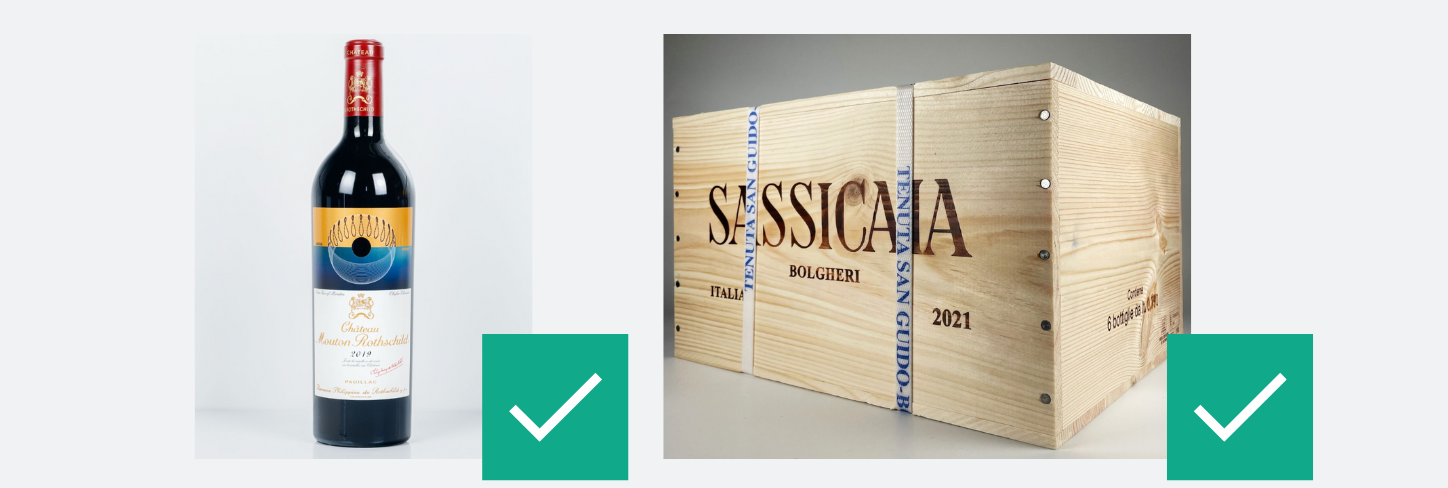
What we do not accept
To keep our auctions high-quality and trustworthy, we do not accept:
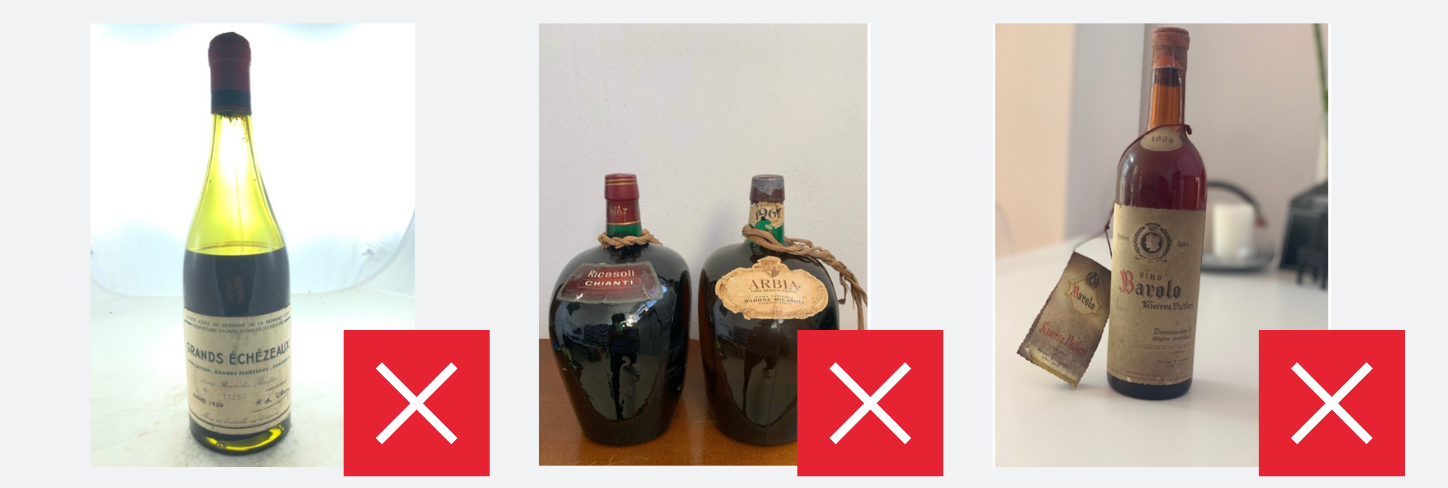
- Bottles with a fill level below mid-shoulder or more than 5 cm below cork, except for rare vintages with high commercial value (e.g. Mouton Rothschild)
- Empty or opened bottles
- Dummy/display bottles
- Champagne cap collections
- Corkscrew collections (unless collectable/limited)
- Empty wooden cases without bottles
- Wine in poor condition due to poor storage (too moist or too dry), e.g. damaged capsule, shrunk cork, needle marks, colour loss
📌 Examples of rejected objects:
Getting your submission ready
1. Fill in all the object details following the submission flow and write a clear description
When you submit a whisky, you’ll see fields to guide you in providing the right information — such as type of wine (e.g. Red, Sparkling, Port), vintage (year), name of the wine and/or producer, classification (e.g. Grand Cru, DOCG), number of bottles, bottle size (e.g. 750 ml, Magnum), country and region, fill level, original packaging (e.g. wooden case), capsule and cork condition, label condition, critic score (e.g. Parker, Wine Spectator), etc. These fields ensure your listing is clear, searchable, and easy for bidders to understand.
Please also use the object description field to share:
- Details about the release (e.g. limited edition, discontinued, vintage year)
- Condition notes (e.g. storage history, any visible wear on labels or packaging)
- Provenance
- Notes on packaging (e.g. original crate or box included) and shipping method
- Additional historical or production notes
Tip: The more detail you provide, the easier it is for bidders to understand the value of your object – and the more likely it is to sell. Find here more tips on how to write a clear, accurate description.
📌Example of a well-written description:
“Masseto 2001 in Original Wooden case 0.75L
Masseto 2001 is an iconic Tuscan Merlot, acclaimed as one of the estate’s greatest vintages. Awarded 100 points by James Suckling and Falstaff, 99 by Wine Spectator, and 98 by Robert Parker’s Wine Advocate, it stands as a benchmark of Italian winemaking. Rich and concentrated yet impeccably balanced, it offers velvety tannins, remarkable elegance, and a long, refined finish—demonstrating both exceptional quality and extraordinary aging potential.
The bottle was always kept in a professional cellar at controlled temperature. Item will be shipped using specialized packaging ensuring shock absorption and temperature stability”.
2. Great photos matter
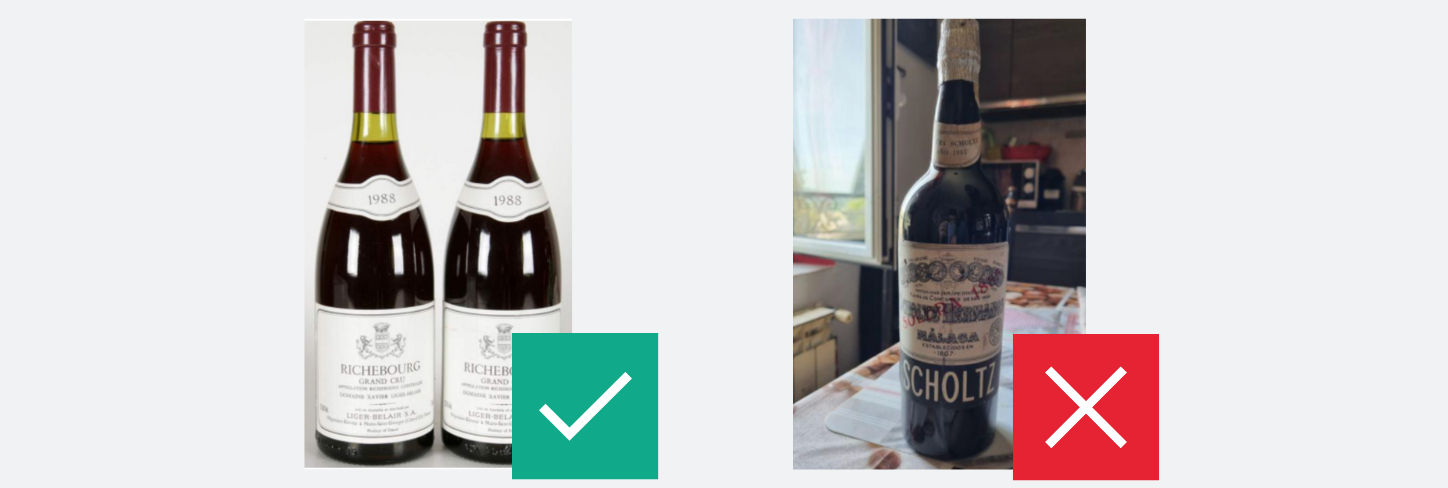
Photos are the first thing bidders see – so make them count! We recommend including high-quality images that clearly show the condition and details of your object. This helps bidders make informed decisions and increases your chances of a successful sale.
Your photos should include:
For all vintages prior to 2005:
- Open the seal case/coffret and include images of the current condition (fill, color, capsule)
For all submissions:
- Full bottle image (front and back)
- Close-ups of label, capsule (top and side), and fill level
- Bottom of bottle (for code/date)
- Packaging (e.g. crate or box)
For grouped submissions:
- Group photos and individual shots
Tip: Use a neutral background (white or black), avoid low-quality or stock images, and aim for natural lighting. Find here more tips on how to take professional photos.
📌 Examples of good vs. bad photos:
3. Additional proof of authenticity
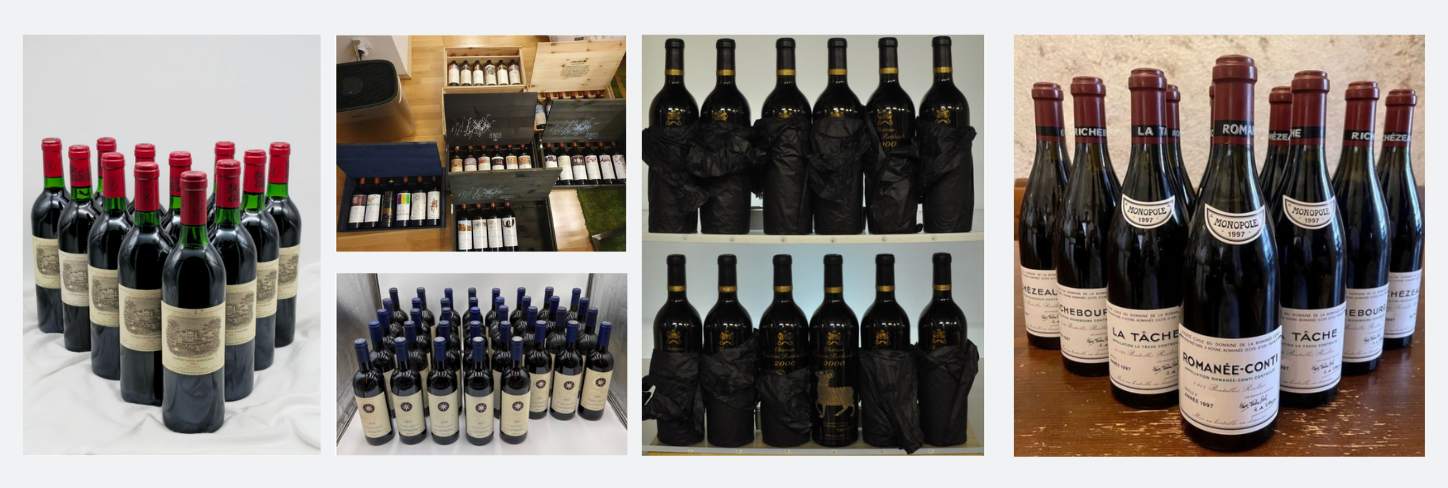
We pay extra attention to ensure authenticity of objects to protect bidders and ensure a trustworthy marketplace. While most bottles are self-evident, high-value or rare bottles may require:
✔ Clear photos of cork, capsule and the label
✔ Photographs of the original box or paperwork
✔ Receipts and other provenance details
📌Examples of high-value objects:
4. Shipping guidelines
Proper packaging and clear communication are essential to ensure your wine arrives safely and meets buyer expectations. Follow the guidance below to help protect your object during transit and avoid delivery issues.
Packaging
Use protective materials such as inflatable bottle airbags or thick polystyrene bottle protectors to prevent breakage. Wrap each bottle individually to prevent leaks or damage in case of breakage and place in a sturdy cardboard box. We also recommend wrapping the capsule and label with cling film or parafilm to protect against scuffs or moisture damage. Capsules should be tightly sealed and protected. Grouped bottles (e.g. crates) must be safely secured.
Shipping method
Always use insured shipping with a Track & Trace code. This provides security for both seller and buyer and helps resolve any delivery problems quickly.
Age verification
The sale and delivery of alcohol are subject to age restrictions that vary by country. As seller, you are solely responsible for ensuring full compliance with all applicable laws in both your own country and the buyer’s country, including any required age verification at delivery. Please check with your shipping provider to ensure that an adult signature or equivalent age check can be applied where legally required.
Import/export regulations
Some countries restrict the import of alcohol. If you're aware of any restrictions from your country to others, include this clearly in your object description.
Being transparent about shipping conditions builds trust with bidders and ensures a smoother transaction.
📌Example of a sentence to be included in the description:
“Before placing your bid, please check your country’s regulations regarding alcohol imports.”
Ready to sell? List your wine today
Listing with us is free – commission is only applied if your object sells.
Follow these guidelines to maximise your chances of success.
Register as a seller and submit your wine for auction now.