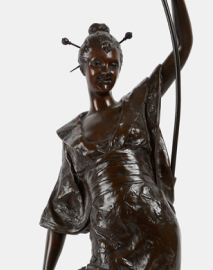
胸像, Torso del Gladiatore borghese - 100 cm - Plaster


Starting bid
€ 1
Add to your favourites to get an alert when the auction starts.

Catawiki Buyer Protection
Your payment’s safe with us until you receive your object.View details
Trustpilot 4.4 | 135350 reviews
Rated Excellent on Trustpilot.
Description from the seller
Descrizione
refined 19th-century plaster bust, made as a life-size cast of the famous Borghese Gladiator, one of the most important sculptures of Greco-Rreek classic period, today housed at the Louvre Museum in Paris.
measurements are 100 cm in height
60 cm in width and 50 cm in depth.
The original is a Greek sculpture dating to the 1st century BC, traditionally attributed, according to the inscription on the plinth, to Agasias, son of Dositeo, a sculptor active within the great Hellenistic tradition. The work is universally appreciated for its exceptional anatomical rendering, the dynamic tension of the body, and the balance between strength and grace.
This bust faithfully reproduces the head and upper torso, returning with great precision the volumes, expressiveness and formal quality of the ancient model. The 19th-century casts of this type were intended for art academies, private collections and sculptors’ studios, as study tools and as testimony to the neoclassical taste for antiquity.
Epoch
19th century (Ottocento)
Material
Plaster
Dimensions
Life-size – scale 1:1
Original model
Gladiator Borghese
Greek sculpture, 1st century BC ca.
Attributed to Agasias, son of Dositeo
Conserved at the Musée du Louvre, Paris
Style
Neoclassical / Cast from ancient original
Condition
Good, with normal signs of time consistent with the age and historical function of the work
Historical note
The Gladiator Borghese is considered one of the pinnacle examples of Greek sculpture on an heroic subject, a symbol of discipline, tension and the classical human ideal. The 19th-century casts like this today represent autonomous historical testimonies, highly sought after by collectors, interior decorators and scholars. Wood crate packaging and insured for the object's value.
SHIPMENT AND PACKING
The packing requires a wooden crate to preserve its integrity; afterward the object must be placed on a pallet
Descrizione
refined 19th-century plaster bust, made as a life-size cast of the famous Borghese Gladiator, one of the most important sculptures of Greco-Rreek classic period, today housed at the Louvre Museum in Paris.
measurements are 100 cm in height
60 cm in width and 50 cm in depth.
The original is a Greek sculpture dating to the 1st century BC, traditionally attributed, according to the inscription on the plinth, to Agasias, son of Dositeo, a sculptor active within the great Hellenistic tradition. The work is universally appreciated for its exceptional anatomical rendering, the dynamic tension of the body, and the balance between strength and grace.
This bust faithfully reproduces the head and upper torso, returning with great precision the volumes, expressiveness and formal quality of the ancient model. The 19th-century casts of this type were intended for art academies, private collections and sculptors’ studios, as study tools and as testimony to the neoclassical taste for antiquity.
Epoch
19th century (Ottocento)
Material
Plaster
Dimensions
Life-size – scale 1:1
Original model
Gladiator Borghese
Greek sculpture, 1st century BC ca.
Attributed to Agasias, son of Dositeo
Conserved at the Musée du Louvre, Paris
Style
Neoclassical / Cast from ancient original
Condition
Good, with normal signs of time consistent with the age and historical function of the work
Historical note
The Gladiator Borghese is considered one of the pinnacle examples of Greek sculpture on an heroic subject, a symbol of discipline, tension and the classical human ideal. The 19th-century casts like this today represent autonomous historical testimonies, highly sought after by collectors, interior decorators and scholars. Wood crate packaging and insured for the object's value.
SHIPMENT AND PACKING
The packing requires a wooden crate to preserve its integrity; afterward the object must be placed on a pallet
Details
時代
1900-2000
原産国
Italy
スタイル
Antique
素材
Plaster
作品タイトル
Torso del Gladiatore borghese
署名
Not signed
カラー
White
コンディション
Good condition
高さ
100 cm
幅
60 cm
奥行き
50 cm
Sold by