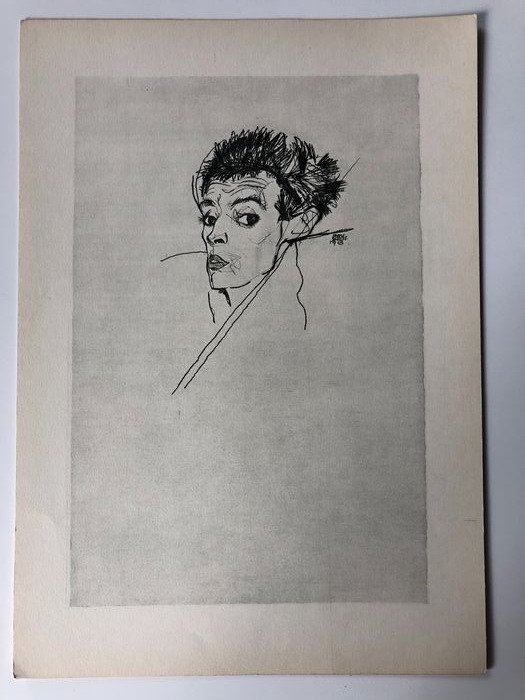
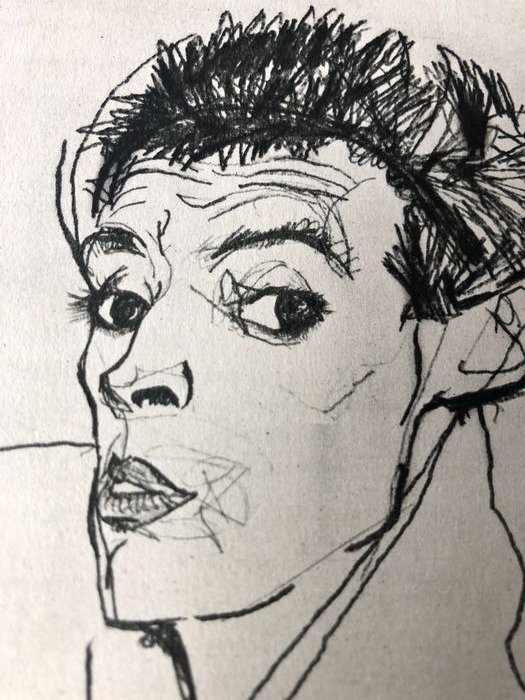
Egon Schiele (1890-1918), after - Selbstbildnis (1913)


07
days
01
hour
06
minutes
58
seconds

No bids placed
Catawiki Buyer Protection
Your payment’s safe with us until you receive your object.View details
Trustpilot 4.4 | 136909 reviews
Rated Excellent on Trustpilot.
Egon Schiele (after) Selbstbildnis (1913), a lithography print from 1951, Austria, in Expressionism, 34 × 24 cm, limited edition.
AI-assisted summary
Description from the seller
Egon Schiele
"Selbstbildnis, 1913"
From Otto Benesch Mappe:
Egon Schiele als Zeichner, 1951
Lichtdruck, Blattgröße je ca. 340x 240 mm
After Egon Schiele. Provenance: small edition printed in Vienna by the State Print Office of Austria (Staatsdruckerei Österreich) on high quality paper at the end of the 1940s / beginning of the 1950s.
この希少な版画は、シーレ独特の作風を示しており、非常に良好に保存されています。
International shipping, tracking number, insurance. Will be very carefully and securely packed.
PLEASE NOTE: We currently do not ship to USA
About the phototype technique:
Phototype is the highest quality printing process ever, with only three phototype printshops left in the world today. The colour image is broken down into up to 25 colours and then printed on top of each other in as many print cycles. The finished image achieved a colour quality that was almost comparable to that of an oil image.
This technique was mainly used for illustrating books or prints in small editions. It makes possible to achieve prints of incredibly high original fidelity.
Egon Schiele
"Selbstbildnis, 1913"
From Otto Benesch Mappe:
Egon Schiele als Zeichner, 1951
Lichtdruck, Blattgröße je ca. 340x 240 mm
After Egon Schiele. Provenance: small edition printed in Vienna by the State Print Office of Austria (Staatsdruckerei Österreich) on high quality paper at the end of the 1940s / beginning of the 1950s.
この希少な版画は、シーレ独特の作風を示しており、非常に良好に保存されています。
International shipping, tracking number, insurance. Will be very carefully and securely packed.
PLEASE NOTE: We currently do not ship to USA
About the phototype technique:
Phototype is the highest quality printing process ever, with only three phototype printshops left in the world today. The colour image is broken down into up to 25 colours and then printed on top of each other in as many print cycles. The finished image achieved a colour quality that was almost comparable to that of an oil image.
This technique was mainly used for illustrating books or prints in small editions. It makes possible to achieve prints of incredibly high original fidelity.
Details
アーティスト
Egon Schiele (1890-1918), after
販売元
Gallery
エディション
Limited edition
作品タイトル
Selbstbildnis (1913)
技法
Lithograph
署名
Plate signed
原産国
Austria
年
1951
コンディション
Excellent condition
高さ
34 cm
幅
24 cm
描写/テーマ
Portrait
スタイル
Expressionism
時代
1910-1920
フレーム付き
いいえ'
Sold by