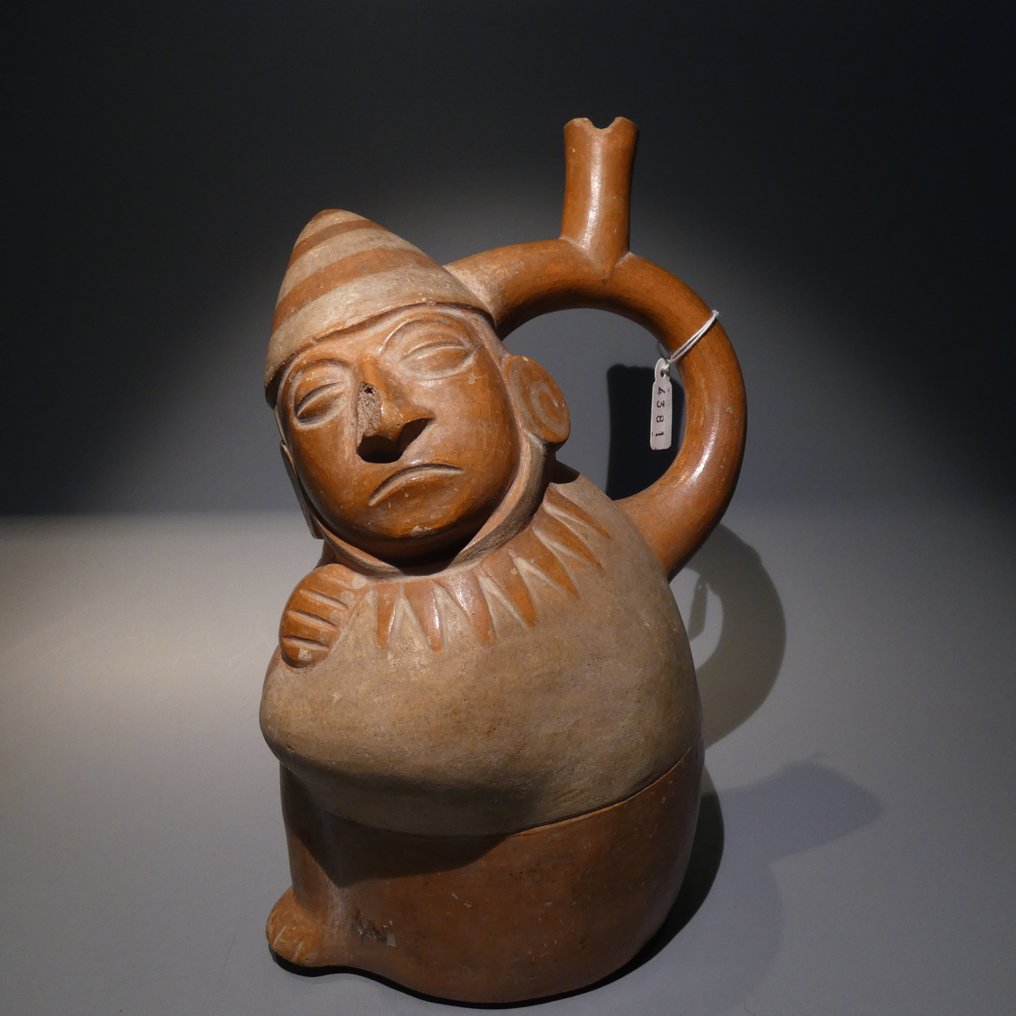
モチェ、ペルー Terracotta 上質な Huaco の首長像。高さ23 cm。紀元400年〜800年。スペイン輸出許可


09
days
08
hours
14
minutes
33
seconds

No bids placed
Catawiki Buyer Protection
Your payment’s safe with us until you receive your object.View details
Trustpilot 4.4 | 137663 reviews
Rated Excellent on Trustpilot.
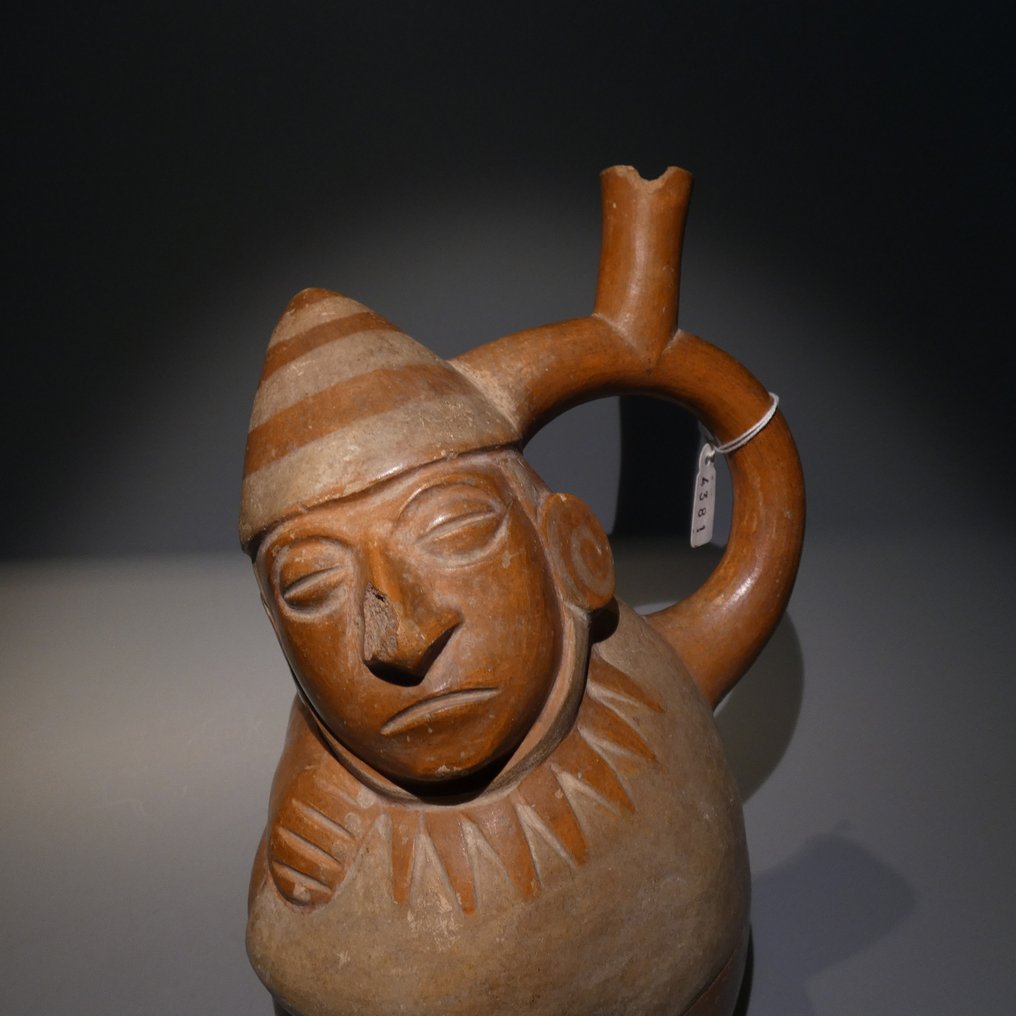
Fine Huaco Chief Figure, a 23 cm tall terracotta Moche portrait of a chief from Peru dating 400–800 AD, with pigments and a Spanish export license, in good condition.
AI-assisted summary
Description from the seller
Fine Stirrup jar Huaco figure of a chief
Moche, Peru, 400 - 800 AD.
Terracotta and pigments
23 cm height
Provenance:
- Private collection, J. R. (1928 - 2013) Barcelona, formed since 1950 until 2000. Thence by descendent. Old label of the collection number 4381.
DOCUMENTS:
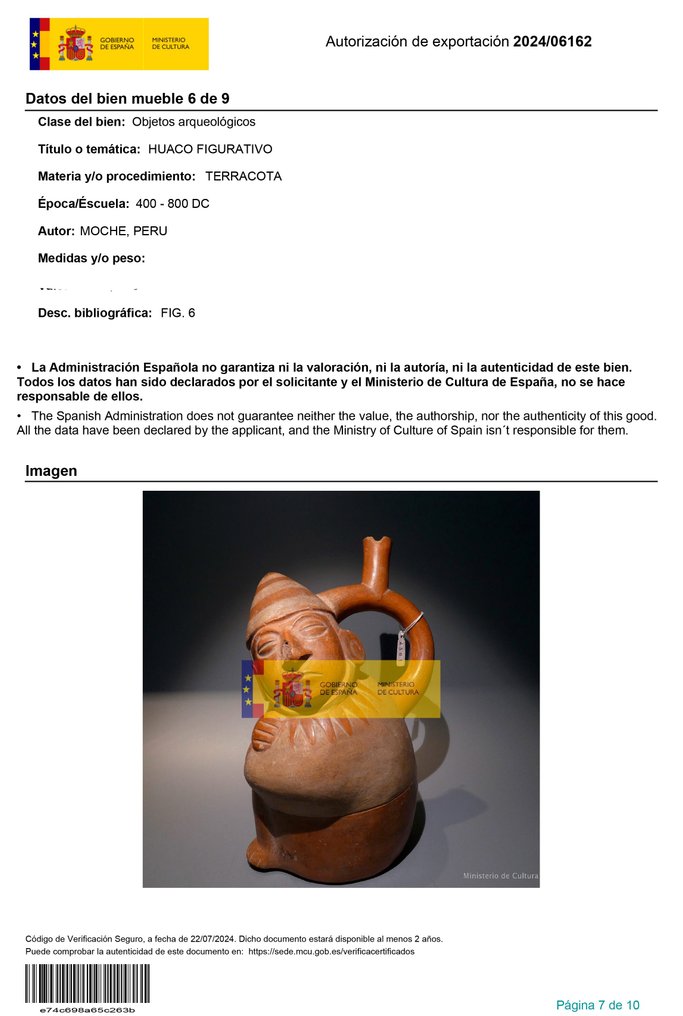
- Spanish Export License.
Condition: Good condition, see photos.
The Moche culture inhabited the coast of present-day northern Peru, concentrating in the valleys of Lambayeque, Chicama, Moche and Virú. This desert region is crossed by several rivers that flow down into the Pacific Ocean, where marine resources are plentiful.
The Moche produced fine ceramic, textile and precious metal pieces. Their characteristic style can be seen in a wide range of goods such as fire-engraved gourds, wall murals, featherwork art, body painting and tattoos. Their ceramic decoration displays a level of skill that has rarely been surpassed, and included such techniques as incision, bas-relief with stamps, and painting on smooth surfaces. Many were made in state-run workshops that mass-produced pieces from molds. Their ceramics came in a variety of forms and decorative styles and displayed myths and ritual motifs as well. Notable among these earthenware forms were the so-called “portrait bottles”, bottles molded with the face of a well-known Moche figure. These highly detailed facial portraits reflect the Moche’s own use of face paint and/or tattoos, as well as elaborate headdresses. This portrait-making expertise can also be observed in everyday scenes and erotic representations, as well as in figures of individuals that were hunch backed, blind, or suffered from other disorders. They were skillful metalworkers, using gold, copper and silver to make ear ornaments, nose rings, bracelets, necklace beads, tweezers and a variety of tools. Especially notable is the tumi or ceremonial knife that was usually only carried by Moche officials.
Moche ceramics provide detailed representations of the culture’s supernatural world, including deities, myths, sacred animals and ceremonial practices. Their deities take the form of foxes, owls, hummingbirds, falcons and felines. These figures were servants of greater gods that had human form and sported elaborate outfits and ferocious faces with crossed fangs.
Tombs of important Moche individuals were rectangular and made of adobe, with niches for offerings. Some bodies were laid on cane mats, while others were left in caves inside cane coffins. People of the elite class were buried with metal masks and a rich array of grave goods, servants and animals accompanying them. The famous “Lord of Sipán” is the most notable example of this kind of burial.
Notes:
- The piece includes authenticity certificate.
- The piece includes Spanish Export License (Passport for European Union). NOT TAXES.
- According to Spanish legislation, items sent outside the European Union are subject to export taxes and will be added to the invoice, at the buyer's expense. These export fees are fixed on the final auction price and the tax rate is not applied directly on the total value of the item to be exported, but rather the different percentages by sections are applied to it:
- Up to 6,000 euros: 5%.
- From 6,001 to 60,000 euros: 10%.
This export permit application process can take between 1-2 months maximum.
- The seller guarantees that he acquired this piece according to all national and international laws related to the ownership of cultural property. Provenance statement seen by Catawiki.
Seller's Story
IMPORTANT NOTES:
-We are a professional seller.
- All items sold will come with their professional invoice.
- All items sold will come with their own Certificate of Authenticity (warranty document), including the description, image and provenance of the item.
- All items will be shipped via private courier with insurance (DHL express, CORREOS of Spain, or other similar with tracking number).
- All items when shipped (if required) will be declared as antiques over 100 years old and their price valued.
- For shipping outside of EU: Delivery time subject to customs clearance. Liability and Customs Regulations or Import Requirements applicable in the destination country are the sole responsibility of the buyer. We are not responsible for delays caused by customs procedures. Import taxes and vat are not included in the shipping costs. The import tax or VAT payable depends on the country of destination. Payments of any taxes or any disputes with the Customs Authorities are the sole responsibility of the buyer.
- For some of the items offered, for shipment outside the European Union it is necessary to obtain an Export Permit which will detail the payment by the buyer of Export Fees according to Spanish legislation. If it is necessary it will be mentioned in the description of the article, BECAUSE NOT IN ALL THE CASES IT IS LIKE THAT. These fees will be added to the invoice, at the buyer's expense. These export fees are fixed on the final auction price and the tax rate is not applied directly on the total value of the item to be exported, but rather the different percentages by sections are applied to it: Up to 6,000 euros: 5%. From 6,001 to 60,000 euros: 10%.
This export permit application process can take between 1-2 months maximum.
- We guarantee that he acquired this piece according to all national and international laws related to the ownership of cultural property.
Translated by Google TranslateFine Stirrup jar Huaco figure of a chief
Moche, Peru, 400 - 800 AD.
Terracotta and pigments
23 cm height
Provenance:
- Private collection, J. R. (1928 - 2013) Barcelona, formed since 1950 until 2000. Thence by descendent. Old label of the collection number 4381.
DOCUMENTS:
- Spanish Export License.
Condition: Good condition, see photos.
The Moche culture inhabited the coast of present-day northern Peru, concentrating in the valleys of Lambayeque, Chicama, Moche and Virú. This desert region is crossed by several rivers that flow down into the Pacific Ocean, where marine resources are plentiful.
The Moche produced fine ceramic, textile and precious metal pieces. Their characteristic style can be seen in a wide range of goods such as fire-engraved gourds, wall murals, featherwork art, body painting and tattoos. Their ceramic decoration displays a level of skill that has rarely been surpassed, and included such techniques as incision, bas-relief with stamps, and painting on smooth surfaces. Many were made in state-run workshops that mass-produced pieces from molds. Their ceramics came in a variety of forms and decorative styles and displayed myths and ritual motifs as well. Notable among these earthenware forms were the so-called “portrait bottles”, bottles molded with the face of a well-known Moche figure. These highly detailed facial portraits reflect the Moche’s own use of face paint and/or tattoos, as well as elaborate headdresses. This portrait-making expertise can also be observed in everyday scenes and erotic representations, as well as in figures of individuals that were hunch backed, blind, or suffered from other disorders. They were skillful metalworkers, using gold, copper and silver to make ear ornaments, nose rings, bracelets, necklace beads, tweezers and a variety of tools. Especially notable is the tumi or ceremonial knife that was usually only carried by Moche officials.
Moche ceramics provide detailed representations of the culture’s supernatural world, including deities, myths, sacred animals and ceremonial practices. Their deities take the form of foxes, owls, hummingbirds, falcons and felines. These figures were servants of greater gods that had human form and sported elaborate outfits and ferocious faces with crossed fangs.
Tombs of important Moche individuals were rectangular and made of adobe, with niches for offerings. Some bodies were laid on cane mats, while others were left in caves inside cane coffins. People of the elite class were buried with metal masks and a rich array of grave goods, servants and animals accompanying them. The famous “Lord of Sipán” is the most notable example of this kind of burial.
Notes:
- The piece includes authenticity certificate.
- The piece includes Spanish Export License (Passport for European Union). NOT TAXES.
- According to Spanish legislation, items sent outside the European Union are subject to export taxes and will be added to the invoice, at the buyer's expense. These export fees are fixed on the final auction price and the tax rate is not applied directly on the total value of the item to be exported, but rather the different percentages by sections are applied to it:
- Up to 6,000 euros: 5%.
- From 6,001 to 60,000 euros: 10%.
This export permit application process can take between 1-2 months maximum.
- The seller guarantees that he acquired this piece according to all national and international laws related to the ownership of cultural property. Provenance statement seen by Catawiki.
Seller's Story
IMPORTANT NOTES:
-We are a professional seller.
- All items sold will come with their professional invoice.
- All items sold will come with their own Certificate of Authenticity (warranty document), including the description, image and provenance of the item.
- All items will be shipped via private courier with insurance (DHL express, CORREOS of Spain, or other similar with tracking number).
- All items when shipped (if required) will be declared as antiques over 100 years old and their price valued.
- For shipping outside of EU: Delivery time subject to customs clearance. Liability and Customs Regulations or Import Requirements applicable in the destination country are the sole responsibility of the buyer. We are not responsible for delays caused by customs procedures. Import taxes and vat are not included in the shipping costs. The import tax or VAT payable depends on the country of destination. Payments of any taxes or any disputes with the Customs Authorities are the sole responsibility of the buyer.
- For some of the items offered, for shipment outside the European Union it is necessary to obtain an Export Permit which will detail the payment by the buyer of Export Fees according to Spanish legislation. If it is necessary it will be mentioned in the description of the article, BECAUSE NOT IN ALL THE CASES IT IS LIKE THAT. These fees will be added to the invoice, at the buyer's expense. These export fees are fixed on the final auction price and the tax rate is not applied directly on the total value of the item to be exported, but rather the different percentages by sections are applied to it: Up to 6,000 euros: 5%. From 6,001 to 60,000 euros: 10%.
This export permit application process can take between 1-2 months maximum.
- We guarantee that he acquired this piece according to all national and international laws related to the ownership of cultural property.
Translated by Google TranslateDetails
文化
Moche, Peru,
世紀/年代
400 - 800 AD
商品名
Fine Huaco Chief Figure. 23 cm H. 400 - 800 AD. Spanish Export License
取得先
Private collection
取得年
2024
素材
Terracotta
取得国
Spain
コンディション
Good
前所有者の取得先
Private collection
前所有者 - 取得年
1960
前所有者 - 取得国
Spain
この商品を合法的に取得し、販売する権利があることを保証します
はい'
Authenticity
Original/official
Disclaimer
The seller was informed by Catawiki about documentation requirements and guarantees the following: - the object was legally obtained, - the seller has the right to sell and/or export the object, as relevant, - the seller will provide the necessary provenance information and arrange required documentation and permits/licenses, as applicable and as per local laws, - the seller will notify the buyer of any delays in obtaining permits/licenses. By bidding, you acknowledge that import documentation may be required depending on your country of residence and that obtaining permits/licenses may cause delays in the delivery of your object.
The seller was informed by Catawiki about documentation requirements and guarantees the following: - the object was legally obtained, - the seller has the right to sell and/or export the object, as relevant, - the seller will provide the necessary provenance information and arrange required documentation and permits/licenses, as applicable and as per local laws, - the seller will notify the buyer of any delays in obtaining permits/licenses. By bidding, you acknowledge that import documentation may be required depending on your country of residence and that obtaining permits/licenses may cause delays in the delivery of your object.
