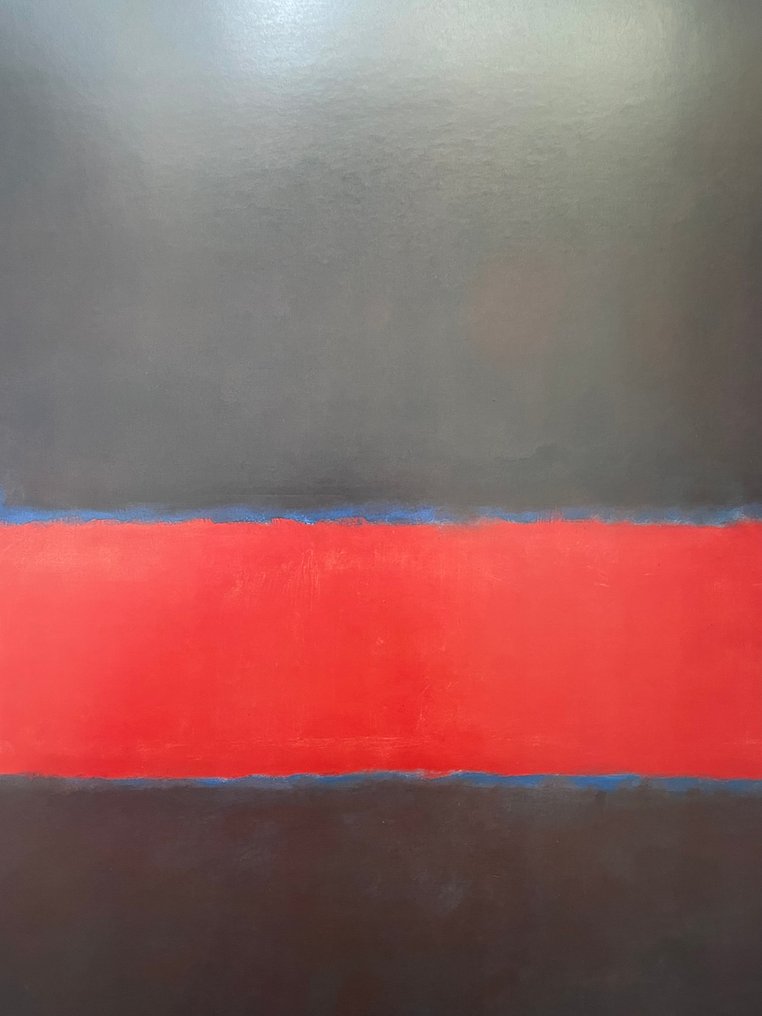
Mark Rothko (after) - Maroon on Blue - Offset lithography - VG licensed print - 2004




05
天
07
小时
49
分钟
19
秒

没有出价记录
Catawiki买家保障
在您收到物品之前,您的付款将在我们这里受到安全保管。查看详细信息
Trustpilot 4.4分 | 137914条评论
在Trustpilot上被评为优秀。
卖家的描述
Offset Lithography after Mark Rothko (*)
Reproduction of the work “Maroon on Blue” created by Rothko in 1957,
Printed on thick Fine Art 200g cardboard
Published by VG Bild-Kunst, Bonn in 2004.
Authorized print with copyright by Kate Rothko-Prizel & Christopher Rothko.
Large Format.
- Page dimensions: 80 x 60 cm
- Year: 2004
- Condition: Excellent (this work has never been framed or displayed, always kept in a professional art folder, thus in perfect condition).
- Provenance: Private collection.
The work will be carefully handled and packed in reinforced cardboard. The shipment will be shipped with tracking number.
The shipment will also include transport insurance for the final value of the work with full reimbursement in case of loss or damage, at no cost to the buyer.
(*) Mark Rothko, together with Pollock, was the leading figure of American abstraction. With his painting he aimed to achieve an ambitious utopia: to express the most basic universal emotions. And for many he achieved it.
Markus Rothkovitz was born in Russia. From a clearly Jewish family, he emigrated to Oregon in 1910, probably escaping the antisemitism that drove many minds to flee.
He studied art in the 1920s, but considered himself self-taught. Before World War II he cultivated expressive figuration and soaked up the spirit of the vanguards he saw in exhibitions organized by the MoMA.
After the war he began to explore color field painting, gradually abandoning figurative references, and in the 1950s, with abstract expressionism already established, he initiated the personal abstraction that would define his painting from then on.
Rothko’s paintings, huge, show broad rectangular color fields with undefined boundaries between them. They are blurred colors that float suspended on the canvas, stimulating quite interesting mystical sensations.
From there, Mark Rothko would become an institution of American art. Protected by Peggy Guggenheim, his successes would be notable. But in the late 1960s, amid a depressive crisis, after painting his series with black acrylics, he would end up taking his own life.
卖家故事
使用Google翻译翻译Offset Lithography after Mark Rothko (*)
Reproduction of the work “Maroon on Blue” created by Rothko in 1957,
Printed on thick Fine Art 200g cardboard
Published by VG Bild-Kunst, Bonn in 2004.
Authorized print with copyright by Kate Rothko-Prizel & Christopher Rothko.
Large Format.
- Page dimensions: 80 x 60 cm
- Year: 2004
- Condition: Excellent (this work has never been framed or displayed, always kept in a professional art folder, thus in perfect condition).
- Provenance: Private collection.
The work will be carefully handled and packed in reinforced cardboard. The shipment will be shipped with tracking number.
The shipment will also include transport insurance for the final value of the work with full reimbursement in case of loss or damage, at no cost to the buyer.
(*) Mark Rothko, together with Pollock, was the leading figure of American abstraction. With his painting he aimed to achieve an ambitious utopia: to express the most basic universal emotions. And for many he achieved it.
Markus Rothkovitz was born in Russia. From a clearly Jewish family, he emigrated to Oregon in 1910, probably escaping the antisemitism that drove many minds to flee.
He studied art in the 1920s, but considered himself self-taught. Before World War II he cultivated expressive figuration and soaked up the spirit of the vanguards he saw in exhibitions organized by the MoMA.
After the war he began to explore color field painting, gradually abandoning figurative references, and in the 1950s, with abstract expressionism already established, he initiated the personal abstraction that would define his painting from then on.
Rothko’s paintings, huge, show broad rectangular color fields with undefined boundaries between them. They are blurred colors that float suspended on the canvas, stimulating quite interesting mystical sensations.
From there, Mark Rothko would become an institution of American art. Protected by Peggy Guggenheim, his successes would be notable. But in the late 1960s, amid a depressive crisis, after painting his series with black acrylics, he would end up taking his own life.
卖家故事
使用Google翻译翻译详细资料
时代
1900-2000
Designer/artist
Mark Rothko (after)
Poster title
Maroon on Blue - Offset lithography - VG licensed print - 2004
物品
艺术
国家
德国
状态
A(优秀 - 全新状态)
高度
80 cm
宽度
60 cm