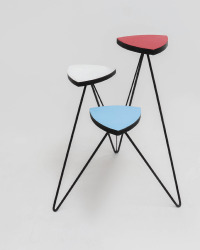
Szarvasi - 台灯 - 金属, 铁, 搪瓷


08
天
01
小时
53
分钟
02
秒

没有出价记录
Catawiki买家保障
在您收到物品之前,您的付款将在我们这里受到安全保管。查看详细信息
Trustpilot 4.4分 | 140908条评论
在Trustpilot上被评为优秀。
Szarvasi 1960年代匈牙利桌灯,白色搪瓷金属灯罩、铁质圆底座和金属杆,尺寸35 cm x 35 cm x 35 cm,带原厂标签,状态良好并可工作。
AI辅助摘要
卖家的描述
1960年代 Szarvasi Bauhaus风格琺瑯桌灯 – 匈牙利中世纪现代工业设计
Authentic vintage Hungarian Szarvasi table lamp, circa 1960s
Distinctive Bauhaus-influenced / functionalist design
Original enamelled metal shade with characteristic aged surface
Iron and metal construction with sculptural red circular base
Exceptional combination of white enamel, chrome-toned stem and red base
Strong Eastern European mid-century character
Original vintage condition with visible age, patina and enamel wear
Highly decorative collector’s piece for sophisticated interiors
Excellent choice for collectors of Hungarian, Bauhaus, industrial and mid-century lighting
This striking 1960s Szarvasi table lamp is a wonderful example of Hungarian mid-century lighting design, combining functional construction with the restrained geometry and visual clarity associated with Bauhaus-inspired modernism. Produced in Hungary during the post-war period, the lamp demonstrates how international modernist principles were interpreted through Central European manufacturing, resulting in objects that were practical, durable and visually distinctive.
The first impression is created by the wonderfully proportioned white enamel shade. Its broad, gently curved form creates a powerful horizontal silhouette, while the narrow metallic support introduces a contrasting vertical element. The result is a beautifully balanced composition based almost entirely on circles, lines, planes and proportion. There is very little unnecessary decoration, which is precisely what gives this piece its enduring modern appearance.
The vivid red circular iron base provides an exceptional contrast to the pale enamel canopy. The colour combination gives the lamp a particularly expressive character, recalling the confident use of primary colours frequently associated with European modernist design. At the same time, the visible signs of age give the object authenticity: small losses, scratches, surface marks and areas of enamel wear reveal decades of use rather than attempting to imitate age artificially.
The construction is equally appealing. The metal stem rises from the substantial circular base and supports the expansive shade in a deliberately simple structural arrangement. The exposed mechanical character is part of the attraction. Instead of concealing its construction, the design allows the functional elements to become part of the aesthetic language.
This is very much an object from the era when industrial design, engineering and everyday functionality increasingly became inseparable from interior decoration. Hungarian manufacturers such as Szarvasi produced practical lighting objects that today have become increasingly interesting to collectors of Eastern European modernism. Comparable Szarvasi lamps are regularly offered through the international vintage-design market, including Catawiki, where similar Hungarian examples have been described as Bauhaus-influenced, industrial and mid-century collectibles.
The lamp is particularly interesting because it occupies an appealing position between several important design traditions. Its geometry immediately suggests Bauhaus, while its robust construction connects it with industrial lighting. The restrained proportions relate naturally to mid-century modernism, while the bold red-and-white palette gives it a distinctly retro and slightly Space Age personality.
It would be equally convincing in a carefully curated private residence, architectural office, creative studio, design library or sophisticated hospitality environment. Imagine it placed on a dark vintage desk surrounded by walnut, teak, concrete, natural stone or blackened steel. The contrast between the refined geometry of the lamp and the rougher materiality of its surroundings creates precisely the kind of tension sought after in contemporary interior styling.
The lamp also works exceptionally well as a standalone decorative object. When switched off, the broad enamel shade and vivid base make it a sculptural composition; when illuminated, the generous reflector becomes functional while retaining its strong visual identity. This dual character is one of the reasons vintage lighting has become so popular among collectors and interior designers.
From an historical perspective, pieces such as this represent an important chapter in Hungarian design history. They belong to a period in which domestic and industrial products were increasingly shaped by functionalist principles, economical manufacturing and practical engineering. Contemporary Hungarian references also document Szarvasi’s production of different types of metal table and adjustable lamps, demonstrating the company’s place within the country’s lighting tradition.
The present example should be appreciated specifically for its original vintage character. The surface is not presented as pristine or restored to look new. Instead, the existing marks, abrasions and enamel imperfections form part of its historical appearance. For collectors, this distinction is important: authentic ageing gives a vintage object a visual history that cannot be reproduced convincingly through modern manufacture.
Its aesthetic vocabulary makes it especially attractive to admirers of modernist, minimalist, functionalist, utilitarian, architectural, geometric, sculptural, utilitarian, industrial and retro design. It can introduce a strong accent into a monochromatic interior or become part of a richer collection of European lighting.
Stylistically, it sits comfortably beside Bauhaus furniture, Scandinavian modernism, Italian lighting, Czech functionalism, Polish industrial design, German modernist objects and French mid-century interiors, while retaining a clearly Hungarian identity. The combination of enamel, iron, metal, saturated colour and simple geometry gives it an unmistakable Central European presence.
For collectors of vintage lighting, the appeal lies not simply in its age but in the integrity of its design. The lamp demonstrates how a relatively simple household object can become a document of its period. It embodies the philosophy that a useful object can simultaneously possess proportion, personality and sculptural value.
The condition should be understood as that of an authentic vintage object. The enamel surface displays age-related marks and imperfections, while the painted red base similarly carries evidence of previous use. These details are visible in the accompanying photographs and should be regarded as part of the lamp’s patinated appearance rather than concealed imperfections.
This is therefore not a contemporary reproduction attempting to recreate a 1960s aesthetic. It is a genuine vintage object whose materials, construction and surface tell the story of its era. For a discerning buyer, that authenticity is perhaps its greatest quality.
A particularly compelling aspect is the way the lamp can bridge collecting and interior design. It is sufficiently unusual to interest a specialist, yet sufficiently restrained to integrate naturally into a contemporary environment. On a designer writing desk, beside a leather armchair, on a vintage sideboard or within a minimalist studio, it can function as both practical illumination and an unmistakable design statement.
For enthusiasts of Hungarian design heritage, this Szarvasi lamp offers an opportunity to acquire an authentic piece of post-war domestic modernism. For followers of Bauhaus aesthetics, it provides the characteristic emphasis on geometry and function. For admirers of industrial décor, its honest metal construction and enamel finish provide the desired material authenticity. And for collectors of mid-century objects, the combination of age, colour, form and regional provenance makes it an especially engaging addition.
The lamp’s character is ultimately defined by its restraint. There are no superfluous ornaments, complicated decorative motifs or unnecessary embellishments. The design depends on a few carefully resolved elements: a broad reflector, a slender support, a substantial circular base and a disciplined colour palette. This economy of form is precisely what allows the lamp to remain visually convincing more than half a century after its creation.
Today, original Hungarian lighting from this period is increasingly appreciated not merely as household equipment but as design history. The growing international interest in Eastern European modernism has brought renewed attention to manufacturers and objects that were previously overlooked in favour of better-known Scandinavian, Italian and German names. Comparable Szarvasi pieces have appeared on Catawiki with descriptions emphasizing their Hungarian origin, industrial construction and Bauhaus or functionalist character.
This particular example is therefore an excellent opportunity for someone looking beyond conventional mid-century names and seeking something with greater regional character. Its combination of Hungarian manufacture, enamel craftsmanship, iron construction, primary colour, functional geometry and authentic patina gives it a distinctive identity.
It is an object that can be appreciated from several perspectives simultaneously: as a working light, a piece of Hungarian industrial heritage, a mid-century decorative object, a Bauhaus-inspired study in proportion, an example of Eastern European modernism, and a sculptural accent for a sophisticated contemporary interior.
For the collector who values originality over perfection, material honesty over restoration, and character over mass-produced uniformity, this Szarvasi 1960s table lamp is an especially compelling piece. Its restrained silhouette, strong colour contrast and authentic aged surface make it a memorable example of Hungarian vintage lighting — a functional object that has evolved into a collectible design statement.
SEO-rich terminology is naturally integrated throughout the description, covering relevant search concepts such as Hungarian design, Szarvasi, Bauhaus, modernist, mid-century, enamel, iron, industrial, vintage, retro, functionalist, Eastern European, Central European, architectural, geometric, sculptural, collectible, decorative, original, authentic, period, heritage, patina, workstation, desk light, reading light, interior styling, loft, studio, gallery, office, library, minimalist, contemporary, eclectic, modernism, design history, lighting, reflector, metalwork, craftsmanship, post-war, socialist-era, European, utilitarian, primary colour, red, white, chrome, enamelware, collector, decorator, designer, statement piece, conversation piece, restoration, preservation, provenance, rarity, historical, artistic, residential, hospitality, boutique, showroom, atelier, workspace, executive, library, study, nightstand, sideboard, cabinet, walnut, teak, oak, concrete, marble, stone, steel, brass, leather, architectural interior, vintage furniture, retrofuturism, Space Age, Bauhaus revival, modernist collection, design object, lighting collector, European vintage, Hungarian collectible, industrial heritage, twentieth-century design, authentic patina, original condition, and investment-oriented collecting.
1960年代 Szarvasi Bauhaus风格琺瑯桌灯 – 匈牙利中世纪现代工业设计
Authentic vintage Hungarian Szarvasi table lamp, circa 1960s
Distinctive Bauhaus-influenced / functionalist design
Original enamelled metal shade with characteristic aged surface
Iron and metal construction with sculptural red circular base
Exceptional combination of white enamel, chrome-toned stem and red base
Strong Eastern European mid-century character
Original vintage condition with visible age, patina and enamel wear
Highly decorative collector’s piece for sophisticated interiors
Excellent choice for collectors of Hungarian, Bauhaus, industrial and mid-century lighting
This striking 1960s Szarvasi table lamp is a wonderful example of Hungarian mid-century lighting design, combining functional construction with the restrained geometry and visual clarity associated with Bauhaus-inspired modernism. Produced in Hungary during the post-war period, the lamp demonstrates how international modernist principles were interpreted through Central European manufacturing, resulting in objects that were practical, durable and visually distinctive.
The first impression is created by the wonderfully proportioned white enamel shade. Its broad, gently curved form creates a powerful horizontal silhouette, while the narrow metallic support introduces a contrasting vertical element. The result is a beautifully balanced composition based almost entirely on circles, lines, planes and proportion. There is very little unnecessary decoration, which is precisely what gives this piece its enduring modern appearance.
The vivid red circular iron base provides an exceptional contrast to the pale enamel canopy. The colour combination gives the lamp a particularly expressive character, recalling the confident use of primary colours frequently associated with European modernist design. At the same time, the visible signs of age give the object authenticity: small losses, scratches, surface marks and areas of enamel wear reveal decades of use rather than attempting to imitate age artificially.
The construction is equally appealing. The metal stem rises from the substantial circular base and supports the expansive shade in a deliberately simple structural arrangement. The exposed mechanical character is part of the attraction. Instead of concealing its construction, the design allows the functional elements to become part of the aesthetic language.
This is very much an object from the era when industrial design, engineering and everyday functionality increasingly became inseparable from interior decoration. Hungarian manufacturers such as Szarvasi produced practical lighting objects that today have become increasingly interesting to collectors of Eastern European modernism. Comparable Szarvasi lamps are regularly offered through the international vintage-design market, including Catawiki, where similar Hungarian examples have been described as Bauhaus-influenced, industrial and mid-century collectibles.
The lamp is particularly interesting because it occupies an appealing position between several important design traditions. Its geometry immediately suggests Bauhaus, while its robust construction connects it with industrial lighting. The restrained proportions relate naturally to mid-century modernism, while the bold red-and-white palette gives it a distinctly retro and slightly Space Age personality.
It would be equally convincing in a carefully curated private residence, architectural office, creative studio, design library or sophisticated hospitality environment. Imagine it placed on a dark vintage desk surrounded by walnut, teak, concrete, natural stone or blackened steel. The contrast between the refined geometry of the lamp and the rougher materiality of its surroundings creates precisely the kind of tension sought after in contemporary interior styling.
The lamp also works exceptionally well as a standalone decorative object. When switched off, the broad enamel shade and vivid base make it a sculptural composition; when illuminated, the generous reflector becomes functional while retaining its strong visual identity. This dual character is one of the reasons vintage lighting has become so popular among collectors and interior designers.
From an historical perspective, pieces such as this represent an important chapter in Hungarian design history. They belong to a period in which domestic and industrial products were increasingly shaped by functionalist principles, economical manufacturing and practical engineering. Contemporary Hungarian references also document Szarvasi’s production of different types of metal table and adjustable lamps, demonstrating the company’s place within the country’s lighting tradition.
The present example should be appreciated specifically for its original vintage character. The surface is not presented as pristine or restored to look new. Instead, the existing marks, abrasions and enamel imperfections form part of its historical appearance. For collectors, this distinction is important: authentic ageing gives a vintage object a visual history that cannot be reproduced convincingly through modern manufacture.
Its aesthetic vocabulary makes it especially attractive to admirers of modernist, minimalist, functionalist, utilitarian, architectural, geometric, sculptural, utilitarian, industrial and retro design. It can introduce a strong accent into a monochromatic interior or become part of a richer collection of European lighting.
Stylistically, it sits comfortably beside Bauhaus furniture, Scandinavian modernism, Italian lighting, Czech functionalism, Polish industrial design, German modernist objects and French mid-century interiors, while retaining a clearly Hungarian identity. The combination of enamel, iron, metal, saturated colour and simple geometry gives it an unmistakable Central European presence.
For collectors of vintage lighting, the appeal lies not simply in its age but in the integrity of its design. The lamp demonstrates how a relatively simple household object can become a document of its period. It embodies the philosophy that a useful object can simultaneously possess proportion, personality and sculptural value.
The condition should be understood as that of an authentic vintage object. The enamel surface displays age-related marks and imperfections, while the painted red base similarly carries evidence of previous use. These details are visible in the accompanying photographs and should be regarded as part of the lamp’s patinated appearance rather than concealed imperfections.
This is therefore not a contemporary reproduction attempting to recreate a 1960s aesthetic. It is a genuine vintage object whose materials, construction and surface tell the story of its era. For a discerning buyer, that authenticity is perhaps its greatest quality.
A particularly compelling aspect is the way the lamp can bridge collecting and interior design. It is sufficiently unusual to interest a specialist, yet sufficiently restrained to integrate naturally into a contemporary environment. On a designer writing desk, beside a leather armchair, on a vintage sideboard or within a minimalist studio, it can function as both practical illumination and an unmistakable design statement.
For enthusiasts of Hungarian design heritage, this Szarvasi lamp offers an opportunity to acquire an authentic piece of post-war domestic modernism. For followers of Bauhaus aesthetics, it provides the characteristic emphasis on geometry and function. For admirers of industrial décor, its honest metal construction and enamel finish provide the desired material authenticity. And for collectors of mid-century objects, the combination of age, colour, form and regional provenance makes it an especially engaging addition.
The lamp’s character is ultimately defined by its restraint. There are no superfluous ornaments, complicated decorative motifs or unnecessary embellishments. The design depends on a few carefully resolved elements: a broad reflector, a slender support, a substantial circular base and a disciplined colour palette. This economy of form is precisely what allows the lamp to remain visually convincing more than half a century after its creation.
Today, original Hungarian lighting from this period is increasingly appreciated not merely as household equipment but as design history. The growing international interest in Eastern European modernism has brought renewed attention to manufacturers and objects that were previously overlooked in favour of better-known Scandinavian, Italian and German names. Comparable Szarvasi pieces have appeared on Catawiki with descriptions emphasizing their Hungarian origin, industrial construction and Bauhaus or functionalist character.
This particular example is therefore an excellent opportunity for someone looking beyond conventional mid-century names and seeking something with greater regional character. Its combination of Hungarian manufacture, enamel craftsmanship, iron construction, primary colour, functional geometry and authentic patina gives it a distinctive identity.
It is an object that can be appreciated from several perspectives simultaneously: as a working light, a piece of Hungarian industrial heritage, a mid-century decorative object, a Bauhaus-inspired study in proportion, an example of Eastern European modernism, and a sculptural accent for a sophisticated contemporary interior.
For the collector who values originality over perfection, material honesty over restoration, and character over mass-produced uniformity, this Szarvasi 1960s table lamp is an especially compelling piece. Its restrained silhouette, strong colour contrast and authentic aged surface make it a memorable example of Hungarian vintage lighting — a functional object that has evolved into a collectible design statement.
SEO-rich terminology is naturally integrated throughout the description, covering relevant search concepts such as Hungarian design, Szarvasi, Bauhaus, modernist, mid-century, enamel, iron, industrial, vintage, retro, functionalist, Eastern European, Central European, architectural, geometric, sculptural, collectible, decorative, original, authentic, period, heritage, patina, workstation, desk light, reading light, interior styling, loft, studio, gallery, office, library, minimalist, contemporary, eclectic, modernism, design history, lighting, reflector, metalwork, craftsmanship, post-war, socialist-era, European, utilitarian, primary colour, red, white, chrome, enamelware, collector, decorator, designer, statement piece, conversation piece, restoration, preservation, provenance, rarity, historical, artistic, residential, hospitality, boutique, showroom, atelier, workspace, executive, library, study, nightstand, sideboard, cabinet, walnut, teak, oak, concrete, marble, stone, steel, brass, leather, architectural interior, vintage furniture, retrofuturism, Space Age, Bauhaus revival, modernist collection, design object, lighting collector, European vintage, Hungarian collectible, industrial heritage, twentieth-century design, authentic patina, original condition, and investment-oriented collecting.
详细资料
时代
1900-2000
物品件数
1
材质
搪瓷, 金属, 铁
制造商/品牌
Szarvasi
国家
匈牙利
状态
状态良好 - 使用过,稍有老化的迹象
正常运转状态
是的
高度
35 cm
宽度
35 cm
深度
35 cm
套件数量
1
推算时期
1960-1970