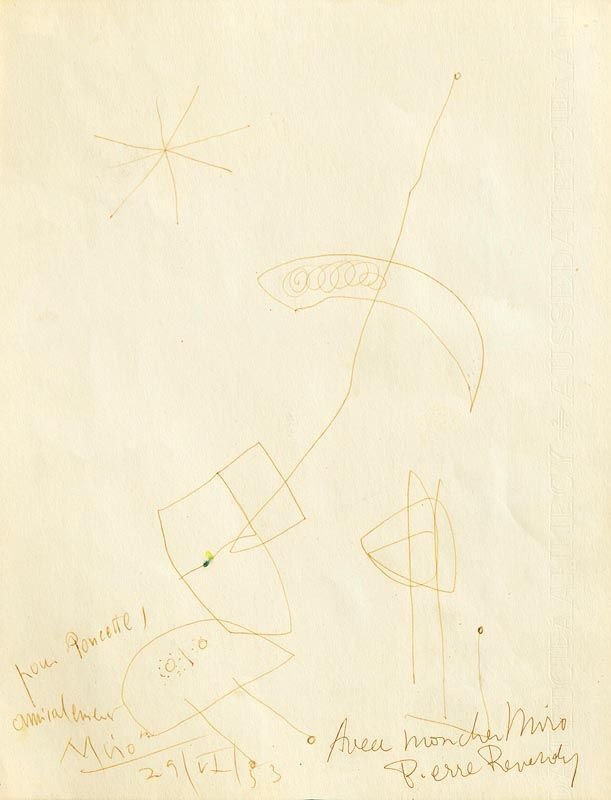
Joan Miro (1893-1983) - No title


17
天
03
小时
11
分钟
55
秒

8名其他人正在关注此物品
 竞买人 8355 竞买人 8355 | €3 | |
|---|---|---|
| 竞买人 8355 | €2 | |
 竞买人 1934 竞买人 1934 | €1 |
Catawiki买家保障
在您收到物品之前,您的付款将在我们这里受到安全保管。查看详细信息
Trustpilot 4.4分 | 122385条评论
在Trustpilot上被评为优秀。
1953年乔安·米罗的有框原作,手签,献给皮埃尔,以记号笔在纸上创作。
AI辅助摘要
卖家的描述
Joan Miró (Barcelona, 1893 – Palma, 1983).
No title.
29/VI/1953.
Ink on paper.
32 x 25 cm and 59 x 51 cm with the frame.
Hand signed and dedicated to Pierre.
Certificate of authenticity by A.D.O.M. Paris, 18/03/2014.
CONDITION: Good condition.
PROVENANCE: Private Collection, Barcelona, Spain.
DESCRIPTION:
Joan Miró (Barcelona, 1893 – Palma, 1983) was one of the most important figures of Western art of the 20th century, and developed a personal language close to surrealism that strongly influenced both his contemporaries and subsequent generations. From his formative years at the La Llotja School and the innovative Galí Academy, Miró was involved in the circles of the Barcelona avant-garde, where he met some of his great friends: the critic Sebastià Gasch, the poet J. V. Foix, the painter Llorens Artigas and the art dealer Joan Prats. In 1918 he held his first exhibition at the Galerias Dalmau in Barcelona, and two years later he went to Paris, where he would spend the most crucial years of his artistic career, during which he would develop his own artistic language.
In the French capital, Miró became friends with André Masson, around whom the so-called Rue Blomet group, the future nucleus of surrealism, was grouped. Under the influence of surrealist poets and painters, with whom he shared many of his theoretical approaches, the young Miró matured his style, trying to transpose surrealist poetry into the visual and resorting to memory, fantasy and the irrational. His style then began to evolve towards increasingly ethereal works, where organic shapes and figures were reduced to abstract points, lines and patches of colour. In 1924 he signed the first surrealist manifesto, although the evolution of his work, too complex, did not allow him to be attributed to any particular orthodoxy. His third exhibition in Paris, in 1928, was his first great triumph: the Museum of Modern Art in New York acquired two of his works. From the following decade onwards Miró would establish himself as one of the most outstanding figures on the international art scene.
It was at this time that the artist, a nonconformist by nature, entered a phase that he called the “murder of painting,” in which he voluntarily gave up being a painter and experimented with other media, such as collage, drawing on paper of different textures or the construction of “objects” with found elements, his first approach to sculpture. Thus, although he soon resumed the practice of painting, Miró never abandoned his desire to experiment with all kinds of materials and techniques. He returned to Spain in 1941, and that same year the Museum of Modern Art in New York dedicated a retrospective to him that marked his definitive international consecration. From 1956 until his death in 1983, he lived in Palma in a sort of internal exile, while his international fame grew.
Miró received important awards such as the Grand Prix at the Venice Biennale in 1954 and from the Guggenheim Foundation in 1959, the Carnegie Prize for Painting in 1966 and the Gold Medals of the Generalitat of Catalonia (1978) and the Fine Arts Medal (1980). His work can currently be seen at the Joan Miró Foundation in Barcelona, opened in 1975, as well as in the Thyssen-Bornemisza Museum and the MNCARS in Madrid, the MoMA in New York, the National Gallery in Washington, the MNAM in Paris and the Albright-Knox Art Gallery in Buffalo, among other collections.
卖家故事
古代艺术画廊 - 位于巴塞罗那的考古学,拥有超过 15 年的经验。擅长古典艺术、埃及艺术、亚洲艺术和前哥伦布时期艺术。它保证其所有作品的真实性。它参加了西班牙最重要的艺术博览会,例如 Feriaarte,以及国外的博览会,BRAFA、Parcours des Mondes、Cultures Brussels。
所有作品均附有西班牙文化部颁发的出口许可证。
我们通过 DHL Express 或 Direct Art Transport 快速发货。
使用Google翻译翻译Joan Miró (Barcelona, 1893 – Palma, 1983).
No title.
29/VI/1953.
Ink on paper.
32 x 25 cm and 59 x 51 cm with the frame.
Hand signed and dedicated to Pierre.
Certificate of authenticity by A.D.O.M. Paris, 18/03/2014.
CONDITION: Good condition.
PROVENANCE: Private Collection, Barcelona, Spain.
DESCRIPTION:
Joan Miró (Barcelona, 1893 – Palma, 1983) was one of the most important figures of Western art of the 20th century, and developed a personal language close to surrealism that strongly influenced both his contemporaries and subsequent generations. From his formative years at the La Llotja School and the innovative Galí Academy, Miró was involved in the circles of the Barcelona avant-garde, where he met some of his great friends: the critic Sebastià Gasch, the poet J. V. Foix, the painter Llorens Artigas and the art dealer Joan Prats. In 1918 he held his first exhibition at the Galerias Dalmau in Barcelona, and two years later he went to Paris, where he would spend the most crucial years of his artistic career, during which he would develop his own artistic language.
In the French capital, Miró became friends with André Masson, around whom the so-called Rue Blomet group, the future nucleus of surrealism, was grouped. Under the influence of surrealist poets and painters, with whom he shared many of his theoretical approaches, the young Miró matured his style, trying to transpose surrealist poetry into the visual and resorting to memory, fantasy and the irrational. His style then began to evolve towards increasingly ethereal works, where organic shapes and figures were reduced to abstract points, lines and patches of colour. In 1924 he signed the first surrealist manifesto, although the evolution of his work, too complex, did not allow him to be attributed to any particular orthodoxy. His third exhibition in Paris, in 1928, was his first great triumph: the Museum of Modern Art in New York acquired two of his works. From the following decade onwards Miró would establish himself as one of the most outstanding figures on the international art scene.
It was at this time that the artist, a nonconformist by nature, entered a phase that he called the “murder of painting,” in which he voluntarily gave up being a painter and experimented with other media, such as collage, drawing on paper of different textures or the construction of “objects” with found elements, his first approach to sculpture. Thus, although he soon resumed the practice of painting, Miró never abandoned his desire to experiment with all kinds of materials and techniques. He returned to Spain in 1941, and that same year the Museum of Modern Art in New York dedicated a retrospective to him that marked his definitive international consecration. From 1956 until his death in 1983, he lived in Palma in a sort of internal exile, while his international fame grew.
Miró received important awards such as the Grand Prix at the Venice Biennale in 1954 and from the Guggenheim Foundation in 1959, the Carnegie Prize for Painting in 1966 and the Gold Medals of the Generalitat of Catalonia (1978) and the Fine Arts Medal (1980). His work can currently be seen at the Joan Miró Foundation in Barcelona, opened in 1975, as well as in the Thyssen-Bornemisza Museum and the MNCARS in Madrid, the MoMA in New York, the National Gallery in Washington, the MNAM in Paris and the Albright-Knox Art Gallery in Buffalo, among other collections.
卖家故事
古代艺术画廊 - 位于巴塞罗那的考古学,拥有超过 15 年的经验。擅长古典艺术、埃及艺术、亚洲艺术和前哥伦布时期艺术。它保证其所有作品的真实性。它参加了西班牙最重要的艺术博览会,例如 Feriaarte,以及国外的博览会,BRAFA、Parcours des Mondes、Cultures Brussels。
所有作品均附有西班牙文化部颁发的出口许可证。
我们通过 DHL Express 或 Direct Art Transport 快速发货。
使用Google翻译翻译详细资料
艺术家
Joan Miro (1893-1983)
带框出售
是的
出售者
画廊
版本
原创作品
作品名称
No title
技术
毡尖笔
签名
Hand signed
国家
西班牙
年份
1953
状态
良好状态
高度
33 cm
宽度
24 cm
风格
超现实主义
时间段
1950-1960
