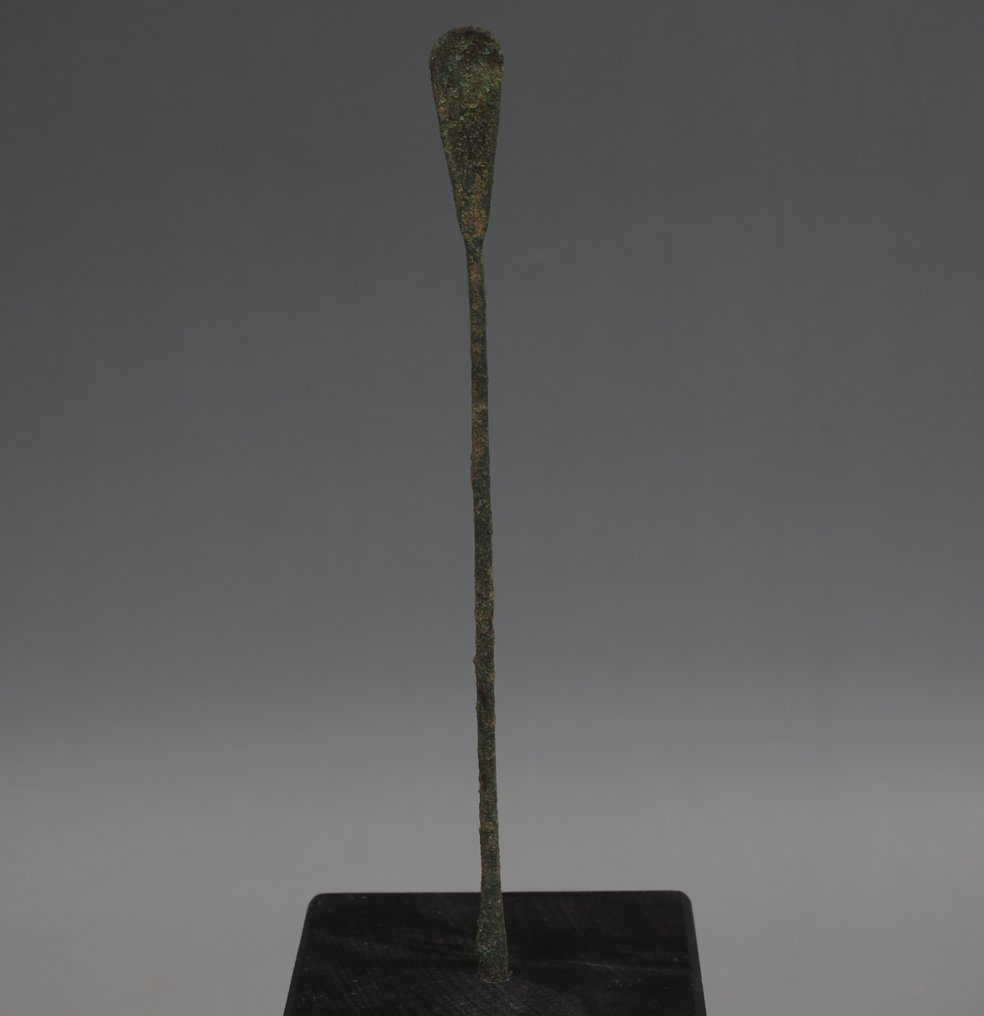
古罗马 黄铜色 医疗器械,刮刀,展出自博物馆 (没有保留价)


02
天
01
小时
47
分钟
56
秒

21名其他人正在关注此物品
 竞买人 2578 竞买人 2578 | €25 | |
|---|---|---|
 竞买人 1040 竞买人 1040 | €20 | |
| 竞买人 2578 | €15 | |
Catawiki买家保障
在您收到物品之前,您的付款将在我们这里受到安全保管。查看详细信息
Trustpilot 4.4分 | 121899条评论
在Trustpilot上被评为优秀。
这件罗马青铜医用刮匙工具,公元一至三世纪之间,展现真实的古代医疗工艺并具博物馆来源.
AI辅助摘要
卖家的描述
ITEM: Medical instrument, Spatula
MATERIAL: Bronze
CULTURE: Roman
PERIOD: 1st - 3rd Century A.D
DIMENSIONS: 140 mm x 10 mm
CONDITION: Good condition
PROVENANCE: Ex Museum für Asiatische Kunst, Ex Galerie Hardt, Germany, acquired between 1970 - 2010
Roman bronze medical instruments, meticulously fashioned with skill and care, epitomize the sophistication of ancient healthcare. These robust implements, encompassing scalpels, forceps, and probes, manifest the Romans’ dedication to surgical precision and patient well-being. These tools played pivotal roles in an array of medical procedures, from intricate surgeries to wound management, underscoring the Romans’ unwavering commitment to the practice and science of healing. In contemporary times, these relics remain enduring symbols of the enduring influence of Roman medicine and surgical prowess.
The Spatula probe consists of a long thin handle and tends to range in size from roughly 6 to 15 centimetres with a spatula on one end of its handle and an olivary probe on its other end, indicating its multifunctionality. The spatula is usually leaf-shaped and tends to be flat on one side and slightly rounded on the other. Some spatula ends are quite thin, perhaps five or six millimetres in width, whilst others are short and blunt. Some have more of a rectangular shape to them and others have a spatulat blade on both ends. It could be used for spreading medicaments on infected areas of the body as well as mixing medicines on an ointment pallet. Sometimes the spatula could be used as a cautery, as Soranus mentions using it on the umbilical cord (Gyn 3. 27, Milne 1907: 60). It could also be used as a tongue depressor and as a blunt dissector (Milne 1907: 59-60). The olivary end could be used in the same way as many already suggested for the double-ended olivary probe.
Comes with Certificate of Authenticity and Export license
If you bid outside the European Union and win the item, we will have to apply for an export licence for your country and shipping will take 3 to 5 weeks.
The Seller can prove that the lot was obtained legally , provenance statement seen by Catawiki.
卖家故事
您的古董商提供古代艺术品和古钱币。我们的主要目标是以最优惠的价格提供最高的质量,尊重并严格遵守遗产保护法和联合国教科文组织遗产规范。因此,出版的作品全部来自可查出处的私人收藏或国际拍卖。我们所有的古物和硬币都附有真品证书。我们有 90 天无条件退货政策。在 Your Antiquarian,我们致力于帮助弱势群体,因此每次购买的产品都会捐赠一部分给慈善机构,以帮助有需要的人。
使用Google翻译翻译ITEM: Medical instrument, Spatula
MATERIAL: Bronze
CULTURE: Roman
PERIOD: 1st - 3rd Century A.D
DIMENSIONS: 140 mm x 10 mm
CONDITION: Good condition
PROVENANCE: Ex Museum für Asiatische Kunst, Ex Galerie Hardt, Germany, acquired between 1970 - 2010
Roman bronze medical instruments, meticulously fashioned with skill and care, epitomize the sophistication of ancient healthcare. These robust implements, encompassing scalpels, forceps, and probes, manifest the Romans’ dedication to surgical precision and patient well-being. These tools played pivotal roles in an array of medical procedures, from intricate surgeries to wound management, underscoring the Romans’ unwavering commitment to the practice and science of healing. In contemporary times, these relics remain enduring symbols of the enduring influence of Roman medicine and surgical prowess.
The Spatula probe consists of a long thin handle and tends to range in size from roughly 6 to 15 centimetres with a spatula on one end of its handle and an olivary probe on its other end, indicating its multifunctionality. The spatula is usually leaf-shaped and tends to be flat on one side and slightly rounded on the other. Some spatula ends are quite thin, perhaps five or six millimetres in width, whilst others are short and blunt. Some have more of a rectangular shape to them and others have a spatulat blade on both ends. It could be used for spreading medicaments on infected areas of the body as well as mixing medicines on an ointment pallet. Sometimes the spatula could be used as a cautery, as Soranus mentions using it on the umbilical cord (Gyn 3. 27, Milne 1907: 60). It could also be used as a tongue depressor and as a blunt dissector (Milne 1907: 59-60). The olivary end could be used in the same way as many already suggested for the double-ended olivary probe.
Comes with Certificate of Authenticity and Export license
If you bid outside the European Union and win the item, we will have to apply for an export licence for your country and shipping will take 3 to 5 weeks.
The Seller can prove that the lot was obtained legally , provenance statement seen by Catawiki.
卖家故事
您的古董商提供古代艺术品和古钱币。我们的主要目标是以最优惠的价格提供最高的质量,尊重并严格遵守遗产保护法和联合国教科文组织遗产规范。因此,出版的作品全部来自可查出处的私人收藏或国际拍卖。我们所有的古物和硬币都附有真品证书。我们有 90 天无条件退货政策。在 Your Antiquarian,我们致力于帮助弱势群体,因此每次购买的产品都会捐赠一部分给慈善机构,以帮助有需要的人。
使用Google翻译翻译详细资料
文化
古罗马
世纪/时段
1st - 3rd Century A.D
Name of object
Medical instrument, Spatula, Ex MUSEUM
获得来源
私人收藏
获得年份
2025
材质
黄铜色
获得国家
奥地利
状态
好
前任拥有者获得来源
古董市场
前任拥有者获得年份
1976
前任拥有者获得国家
德国
我确认我合法获得此物品,并且我有权将它出售
是的
免责声明
卖家已就文件要求收到了Catawiki的通知并保证以下内容: - 该物品是合法获得的, - 卖家有权出售和/或出口该物品(如适用), - 卖家将提供必要的出处或来源地信息,并根据当地法律安排所需的文件和许可证/执照, - 如果在获取许可证/执照方面出现任何延误,卖家将通知买家。 出价竞投,表明您知晓根据您居住的国家和地区可能会被需要提供进口文件,以及获得许可证/执照可能会导致物品交付的延迟。
卖家已就文件要求收到了Catawiki的通知并保证以下内容: - 该物品是合法获得的, - 卖家有权出售和/或出口该物品(如适用), - 卖家将提供必要的出处或来源地信息,并根据当地法律安排所需的文件和许可证/执照, - 如果在获取许可证/执照方面出现任何延误,卖家将通知买家。 出价竞投,表明您知晓根据您居住的国家和地区可能会被需要提供进口文件,以及获得许可证/执照可能会导致物品交付的延迟。
