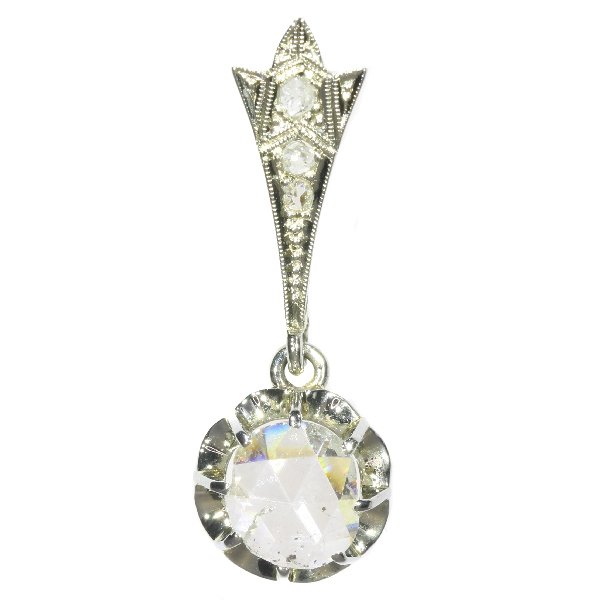
墜飾 - 18 克拉 白金, 黃金 - 鉆石 - Belle Epoque 1920


02
天
17
小時
32
分鐘
57
秒

另有41人對此物品感興趣
 競投者 2134 競投者 2134 | €275 | |
|---|---|---|
 競投者 2469 競投者 2469 | €185 | |
| 競投者 2134 | €175 | |
Catawiki買家保障
在您收到物品前,我們會妥善保管您的付款。查看詳情
Trustpilot評分 4.4 | 127619 則評論
在Trustpilot獲得極佳評等。
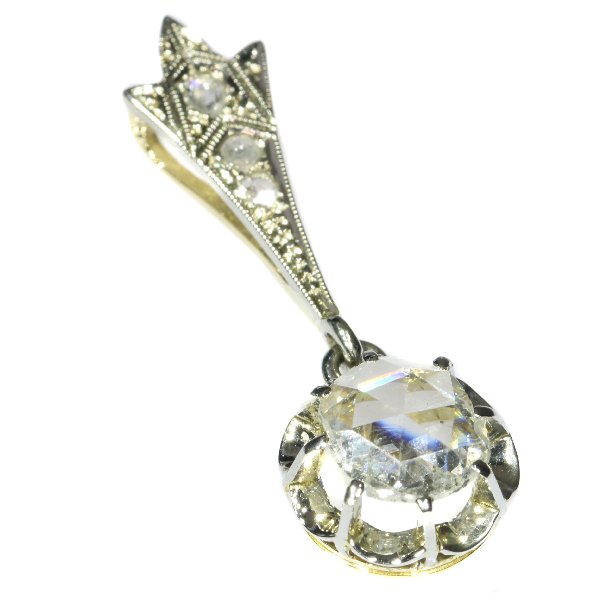
18K 白金與黃金製成的古董墜飾,總重1.6克,鑲嵌四顆玫瑰切圍鑽石環繞,無實驗室報告,狀態極好,原產地比利時,約1920年風格介於美樂時代和裝飾藝術時期之間。
AI輔助摘要
賣家描述
antique jewelry object group: pendant
Condition: excellent condition
- (关于我们条件等级的更多信息)
Country of origin: Although it does not carry any legible control marks we believe this to be of Belgian origin.
Style: Something between Art Deco and Belle Époque - Art Deco is an eclectic artistic and design style which had its origins in Paris in the first decades of the 20th century. The style originated in the 1920s and continued to be employed until after World War II. The term "art deco" first saw wide use after an exhibition in 1966, referring to the 1925 Exposition Internationale des Arts Décoratifs et Industriels Modernes that was the culmination of high-end style modern in Paris. Led by the best designers in the decorative arts such as fashion, and interior design, Art Deco affected all areas of design throughout the 1920s and 1930s, including architecture and industrial design, as well as the visual arts such as painting, the graphic arts and film. At the time, this style was seen as elegant, glamorous, functional and modern. - See also: Art Deco.
And the Belle Époque (French for "Beautiful Era") was a period in European social history that began during the late 19th century and lasted until World War I. Occurring during the time of the French Third Republic and the German Empire, the "Belle Époque" was named in retrospect, when it began to be considered a "golden age" the major powers of Europe, new technologies improved lives and the commercial arts adapted Renaissance and eighteenth-century styles to modern forms. In the newly rich United States, emerging from the Panic of 1873, the comparable epoch was dubbed the Gilded Age. In the United Kingdom, this epoch overlaps the end of what is called the Victorian Era there and the period named the Edwardian Era. or more info on styles
Style specifics: This is something between Belle Époque and Art Deco.
The Belle Époque (French for "Beautiful Era") was a period in European social history that began during the late 19th century from the Franco-Prussian War (1870-1871) and lasted until World War I (1914-18).
Occurring during the time of the French Third Republic and the German Empire, the "Belle Époque" was named in retrospect, when it began to be considered a "golden age" the major powers of Europe, new technologies improved lives and the commercial arts adapted Renaissance and eighteenth-century styles to modern forms.
In the newly rich United States, emerging from the Panic of 1873, the comparable epoch was dubbed the Gilded Age. In the United Kingdom, this epoch overlaps the end of what is called the Victorian Era there and the period named the Edwardian Era.
In the Belle Époque cheap coal and cheap labour contributed to the cult of the orchid and made possible the perfection of fruits grown under glass, as the apparatus of state dinners extended to the upper classes; champagne was perfected during the Belle Époque. Exotic feathers and furs were more prominently featured in fashion than ever before, as haute couture was invented in Paris, the centre of the Belle Époque, where fashion began to move in a yearly cycle; in Paris restaurants such as Maxim's achieved a new splendour and cachet as places for the rich to parade, and the Opéra Garnier devoted enormous spaces to staircases as similar show places.
After mid-century, railways linked all the major cities of Europe to spa towns like Biarritz and Deauville; their carriages were rigorously divided into first-class and second-class, but the super-rich now began to commission private railway coaches, as exclusivity was a hallmark of opulent luxury. Bohemian lifestyles gained a different glamour, pursued in the cabarets of Montmartre.
Art Deco
Abstract motives and geometrical forms are quite typical for the Art Deco period. Art Deco moved away from the soft pastels and organic forms of its style predecessor, Art Nouveau, and embraced influences from many different styles and movements of the early 20th century, including Neoclassical, Constructivism, Cubism, Modernism, and Futurism. Its popularity peaked in Europe during the Roaring Twenties and continued strongly in the United States through the 1930s. Although many design movements have political or philosophical roots or intentions, Art Deco was purely decorative.
Period: ca. 1920
- (events & facts of this era, poetry of this era, fashion of this era)
Material: 18K white and yellow gold
- (more info on precious metals)
Diamond(s): One large and three smaller rose cut diamonds. We do not have the weight of the diamonds which is normal in our trade when it comes to rose cuts.
Total diamond count: Four pcs.
Birthstones: Diamond is the birthstone (or month stone) for April.
- (more info on birthstones)
Hallmarks: No trace.
- (more info on hallmarks)
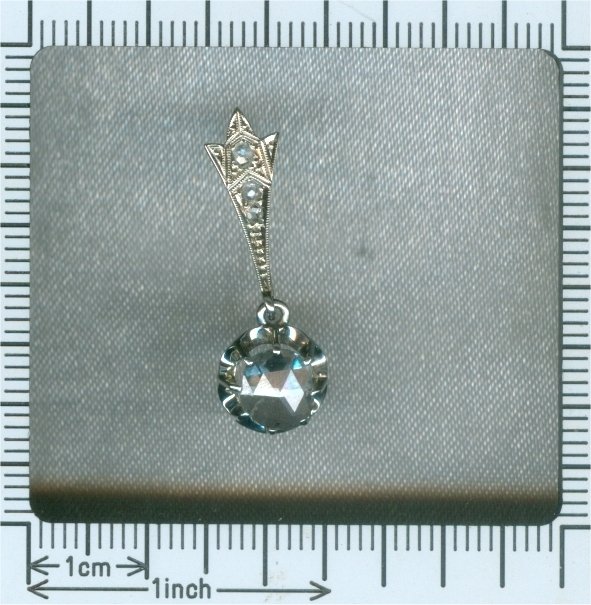
Dimensions: height 2,80 cm (1,10 inch)
Weight: 1,60 gram (1,03 dwt)
Reference Nº: 17317-0278
- All jewels are delivered in an Adin jewellery box. Jewellery boxes shown in photos are for display purposes only and are not included with the jewel, unless stated otherwise.
- Accompanied by a professional report of authenticity for your peace of mind.
- Shipped insured and registered for your security, though you're most welcome to collect in person.
- For shipments outside the EU, import duties and other charges may apply. We advise checking this in advance.
- We invite you to browse through our customer feedback to discover the level of satisfaction we consistently provide.
- See more of our products, visit: https://auction.catawiki.com/lotsfrom/Adin
- Antique and vintage jewellery often undergoes thoughtful refurbishment, remodelling, or repairs to enhance its longevity and wearability. Such pieces frequently bear marks of this tender care. Furthermore, we present our antique and vintage jewellery in its authentic state, refraining from removing scratches or applying rhodium plating to white gold items. Our priority is to preserve the genuine allure and history of each piece. However, as the new owner, you have the option to take it to a local goldsmith for a cosmetic refresh, should you choose.
賣家的故事
阿丁(Adin)擁有超過4年的專業知識,並彙集了他們的古董和古董首飾。在我們的提供商頁面上,您將獲得探索我們位於世界鑽石中心安特衛普的精品店的經驗。阿丁(Adin)的創始人兼首席執行官Elkan Wijnberg是比利時法院司法專家會以及英國和美國珠寶史學家協會的成員。
由Google翻譯翻譯antique jewelry object group: pendant
Condition: excellent condition
- (关于我们条件等级的更多信息)
Country of origin: Although it does not carry any legible control marks we believe this to be of Belgian origin.
Style: Something between Art Deco and Belle Époque - Art Deco is an eclectic artistic and design style which had its origins in Paris in the first decades of the 20th century. The style originated in the 1920s and continued to be employed until after World War II. The term "art deco" first saw wide use after an exhibition in 1966, referring to the 1925 Exposition Internationale des Arts Décoratifs et Industriels Modernes that was the culmination of high-end style modern in Paris. Led by the best designers in the decorative arts such as fashion, and interior design, Art Deco affected all areas of design throughout the 1920s and 1930s, including architecture and industrial design, as well as the visual arts such as painting, the graphic arts and film. At the time, this style was seen as elegant, glamorous, functional and modern. - See also: Art Deco.
And the Belle Époque (French for "Beautiful Era") was a period in European social history that began during the late 19th century and lasted until World War I. Occurring during the time of the French Third Republic and the German Empire, the "Belle Époque" was named in retrospect, when it began to be considered a "golden age" the major powers of Europe, new technologies improved lives and the commercial arts adapted Renaissance and eighteenth-century styles to modern forms. In the newly rich United States, emerging from the Panic of 1873, the comparable epoch was dubbed the Gilded Age. In the United Kingdom, this epoch overlaps the end of what is called the Victorian Era there and the period named the Edwardian Era. or more info on styles
Style specifics: This is something between Belle Époque and Art Deco.
The Belle Époque (French for "Beautiful Era") was a period in European social history that began during the late 19th century from the Franco-Prussian War (1870-1871) and lasted until World War I (1914-18).
Occurring during the time of the French Third Republic and the German Empire, the "Belle Époque" was named in retrospect, when it began to be considered a "golden age" the major powers of Europe, new technologies improved lives and the commercial arts adapted Renaissance and eighteenth-century styles to modern forms.
In the newly rich United States, emerging from the Panic of 1873, the comparable epoch was dubbed the Gilded Age. In the United Kingdom, this epoch overlaps the end of what is called the Victorian Era there and the period named the Edwardian Era.
In the Belle Époque cheap coal and cheap labour contributed to the cult of the orchid and made possible the perfection of fruits grown under glass, as the apparatus of state dinners extended to the upper classes; champagne was perfected during the Belle Époque. Exotic feathers and furs were more prominently featured in fashion than ever before, as haute couture was invented in Paris, the centre of the Belle Époque, where fashion began to move in a yearly cycle; in Paris restaurants such as Maxim's achieved a new splendour and cachet as places for the rich to parade, and the Opéra Garnier devoted enormous spaces to staircases as similar show places.
After mid-century, railways linked all the major cities of Europe to spa towns like Biarritz and Deauville; their carriages were rigorously divided into first-class and second-class, but the super-rich now began to commission private railway coaches, as exclusivity was a hallmark of opulent luxury. Bohemian lifestyles gained a different glamour, pursued in the cabarets of Montmartre.
Art Deco
Abstract motives and geometrical forms are quite typical for the Art Deco period. Art Deco moved away from the soft pastels and organic forms of its style predecessor, Art Nouveau, and embraced influences from many different styles and movements of the early 20th century, including Neoclassical, Constructivism, Cubism, Modernism, and Futurism. Its popularity peaked in Europe during the Roaring Twenties and continued strongly in the United States through the 1930s. Although many design movements have political or philosophical roots or intentions, Art Deco was purely decorative.
Period: ca. 1920
- (events & facts of this era, poetry of this era, fashion of this era)
Material: 18K white and yellow gold
- (more info on precious metals)
Diamond(s): One large and three smaller rose cut diamonds. We do not have the weight of the diamonds which is normal in our trade when it comes to rose cuts.
Total diamond count: Four pcs.
Birthstones: Diamond is the birthstone (or month stone) for April.
- (more info on birthstones)
Hallmarks: No trace.
- (more info on hallmarks)
Dimensions: height 2,80 cm (1,10 inch)
Weight: 1,60 gram (1,03 dwt)
Reference Nº: 17317-0278
- All jewels are delivered in an Adin jewellery box. Jewellery boxes shown in photos are for display purposes only and are not included with the jewel, unless stated otherwise.
- Accompanied by a professional report of authenticity for your peace of mind.
- Shipped insured and registered for your security, though you're most welcome to collect in person.
- For shipments outside the EU, import duties and other charges may apply. We advise checking this in advance.
- We invite you to browse through our customer feedback to discover the level of satisfaction we consistently provide.
- See more of our products, visit: https://auction.catawiki.com/lotsfrom/Adin
- Antique and vintage jewellery often undergoes thoughtful refurbishment, remodelling, or repairs to enhance its longevity and wearability. Such pieces frequently bear marks of this tender care. Furthermore, we present our antique and vintage jewellery in its authentic state, refraining from removing scratches or applying rhodium plating to white gold items. Our priority is to preserve the genuine allure and history of each piece. However, as the new owner, you have the option to take it to a local goldsmith for a cosmetic refresh, should you choose.
賣家的故事
阿丁(Adin)擁有超過4年的專業知識,並彙集了他們的古董和古董首飾。在我們的提供商頁面上,您將獲得探索我們位於世界鑽石中心安特衛普的精品店的經驗。阿丁(Adin)的創始人兼首席執行官Elkan Wijnberg是比利時法院司法專家會以及英國和美國珠寶史學家協會的成員。
由Google翻譯翻譯詳細資料
時代
1900-2000
鑑定證書
沒有實驗室報告
金屬
白金, 黃金
鑽石數量
4
品牌珠寶
不是
材質細度
18 克拉
Cutting style of surrounding stones
玫瑰式切割
重量
1,6 g
圍繞的寶石
鉆石
狀態
優良狀態-絕少使用,絕少穿戴的痕跡
性別
中性
標題附加資訊
Belle Epoque 1920
免責聲明
Catawiki始終致力於為您提供最佳的購買體驗。我們的專家會依據提交指南,對每件物品進行虛擬審查和挑選。雖然我們努力提供每件珠寶的詳細描述和照片,但可能會出現不一致或不準確的情況。 在進行購買前,您有責任檢查所提供的有關物品的一切資訊,包括狀況和描述。賣家應對所提供的資訊、圖片和描述負責,包括所售珠寶的品質、數量和性質。若物品存在的小瑕疵在照片中看不到,但已於描述中予以說明,那麼這並非不合規之情形。 實驗室報告不是對報告中所述物品的保證、評估或鑑定。實驗室報告僅提供所述物品的特質,這是在特定實驗室進行檢驗之時所使用的技術和設備來評級、測試、檢查和分析而得到的結果。對物品進行的任何其他檢驗之結果可能會有所不同,具體取決於檢驗物品的時間、方式、人員和評級標準。 此外,技術和設備可能發生的任何變化和改進,使得檢驗者能夠有新的發現,其中包括物品進行過此前未能檢測到的處理以改變其特質,而這並不就表示物品不符合其描述。
Catawiki始終致力於為您提供最佳的購買體驗。我們的專家會依據提交指南,對每件物品進行虛擬審查和挑選。雖然我們努力提供每件珠寶的詳細描述和照片,但可能會出現不一致或不準確的情況。 在進行購買前,您有責任檢查所提供的有關物品的一切資訊,包括狀況和描述。賣家應對所提供的資訊、圖片和描述負責,包括所售珠寶的品質、數量和性質。若物品存在的小瑕疵在照片中看不到,但已於描述中予以說明,那麼這並非不合規之情形。 實驗室報告不是對報告中所述物品的保證、評估或鑑定。實驗室報告僅提供所述物品的特質,這是在特定實驗室進行檢驗之時所使用的技術和設備來評級、測試、檢查和分析而得到的結果。對物品進行的任何其他檢驗之結果可能會有所不同,具體取決於檢驗物品的時間、方式、人員和評級標準。 此外,技術和設備可能發生的任何變化和改進,使得檢驗者能夠有新的發現,其中包括物品進行過此前未能檢測到的處理以改變其特質,而這並不就表示物品不符合其描述。