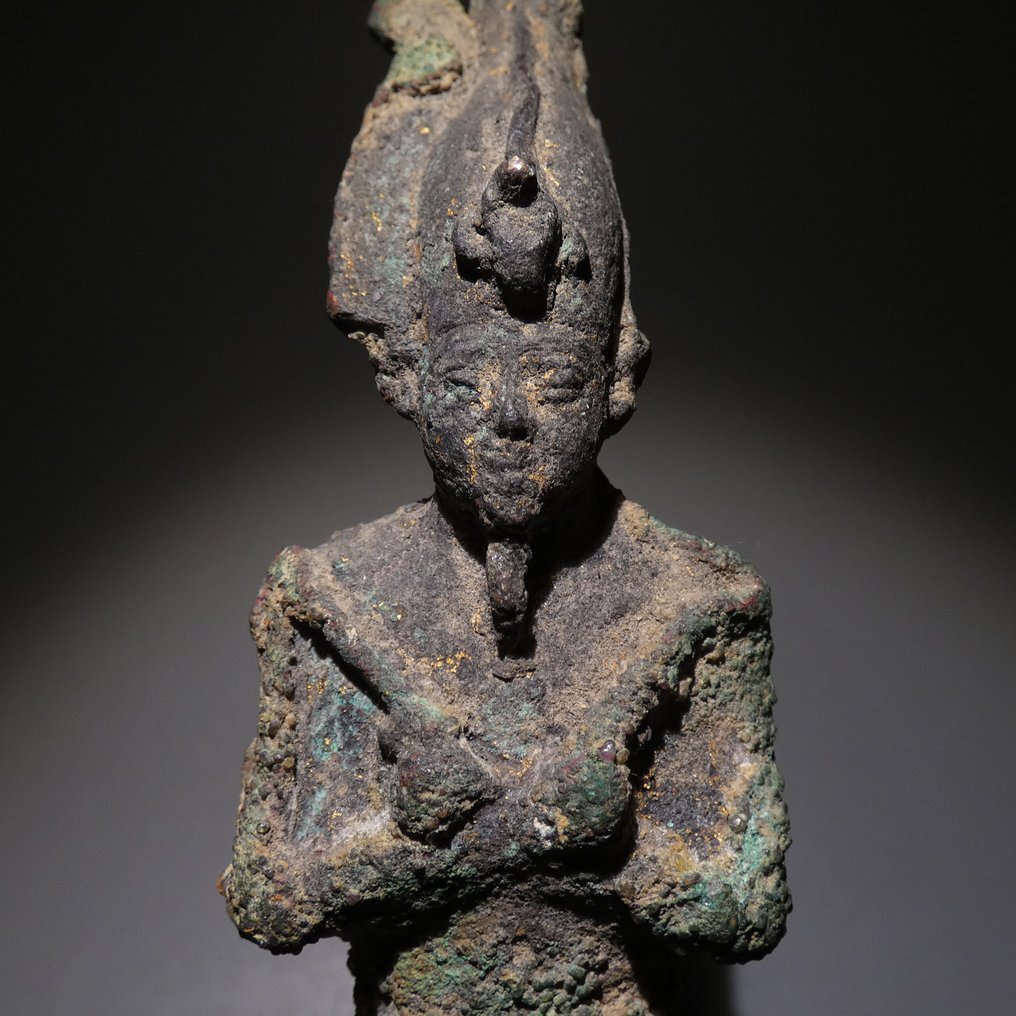
古埃及 青銅色 奥赛里斯神像。高15.5厘米。晚期,公元前664年至公元前332年。



07
天
06
小時
40
分鐘
20
秒

另有8人對此物品感興趣
 競投者 8660 競投者 8660 | €1 |
|---|
Catawiki買家保障
在您收到物品前,我們會妥善保管您的付款。查看詳情
Trustpilot評分 4.4 | 130049 則評論
在Trustpilot獲得極佳評等。
古埃及青銅 Osiris 神像,晚期(公元前664–332年),高約13公分(連底座15.5公分),有殘留金箔,品相良好;於2025年自法國私人收藏取得。
AI輔助摘要
賣家描述
God Osiris
- very fine -
Ancient Egypt, Late Period, 664 - 332 BC
Solid Bronze with rest of gilted
13 cm height, 15,5 cm height with stand.
PROVENANCE:
- Private collection, Mr. I, France, before 1980.
CONDITION: Good condition, see photos.
Osiris, one of the most important gods of ancient Egypt. The origin of Osiris is obscure; he was a local god of Busiris, in Lower Egypt, and may have been a personification of chthonic (underworld) fertility. By about 2400 bce, however, Osiris clearly played a double role: he was both a god of fertility and the embodiment of the dead and resurrected king. This dual role was in turn combined with the Egyptian concept of divine kingship: the king at death became Osiris, god of the underworld; and the dead king’s son, the living king, was identified with Horus, a god of the sky. Osiris and Horus were thus father and son. The goddess Isis was the mother of the king and was thus the mother of Horus and consort of Osiris. The god Seth was considered the murderer of Osiris and adversary of Horus.
According to the form of the myth reported by the Greek author Plutarch, Osiris was slain or drowned by Seth, who tore the corpse into 14 pieces and flung them over Egypt. Eventually, Isis and her sister Nephthys found and buried all the pieces, except the phallus, thereby giving new life to Osiris, who thenceforth remained in the underworld as ruler and judge. His son Horus successfully fought against Seth, avenging Osiris and becoming the new king of Egypt.
Osiris was not only ruler of the dead but also the power that granted all life from the underworld, from sprouting vegetation to the annual flood of the Nile River. From about 2000 bce onward it was believed that every man, not just the deceased kings, became associated with Osiris at death. This identification with Osiris, however, did not imply resurrection, for even Osiris did not rise from the dead. Instead, it signified the renewal of life both in the next world and through one’s descendants on Earth. In this universalized form Osiris’s cult spread throughout Egypt, often joining with the cults of local fertility and underworld deities.
The idea that rebirth in the next life could be gained by following Osiris was maintained through certain cult forms. In the Middle Kingdom (1938–c. 1630 bce) the god’s festivals consisted of processions and nocturnal rites and were celebrated at the temple of Abydos, where Osiris had assimilated the very ancient god of the dead, Khenty-Imentiu. This name, meaning “Foremost of the Westerners,” was adopted by Osiris as an epithet. Because the festivals took place in the open, public participation was permitted, and by the early 2nd millennium bce it had become fashionable to be buried along the processional road at Abydos or to erect a cenotaph there as a representative of the dead.
Osiris festivals symbolically reenacting the god’s fate were celebrated annually in various towns throughout Egypt. A central feature of the festivals during the late period was the construction of the “Osiris garden,” a mold in the shape of Osiris, filled with soil. The mold was moistened with the water of the Nile and sown with grain. Later, the sprouting grain symbolized the vital strength of Osiris.
At Memphis the holy bull, Apis, was linked with Osiris, becoming Osiris-Apis, which eventually became the name of the Hellenistic god Serapis. Greco-Roman authors connected Osiris with the god Dionysus. Osiris was also identified with Soker, an ancient Memphite god of the dead.
The oldest known depiction of Osiris dates to about 2300 bce, but representations of him are rare before the New Kingdom (1539–1075 bce), when he was shown in an archaizing form as a mummy with his arms crossed on his breast, one hand holding a crook, the other a flail. On his head was the atef-crown, composed of the white crown of Upper Egypt and two ostrich feathers.
賣家的故事
重要提示:
-我們是專業賣家。
- 所有販售的商品均附有專業發票。
- 所有出售的商品都將附有自己的真品證書(保固文件),包括商品的描述、圖像和來源。
- 所有物品將透過帶有保險的私人快遞(DHL 快遞、西班牙 CORREOS 或其他類似的帶有追蹤號碼的快遞)運送。
- 所有物品在發貨時(如果需要)將被聲明為具有 100 年以上歷史的古董,並對其價格進行估價。
- 對於歐盟以外的運輸:交貨時間以清關為準。目的地國家/地區適用的責任和海關法規或進口要求由買方全權負責。我們對海關手續造成的延誤不承擔任何責任。進口稅和增值稅不包含在運費中。應付的進口稅或增值稅取決於目的地國家。任何稅款的支付或與海關當局的任何爭議均由買方自行承擔。
- 對於所提供的某些商品,如果要運送到歐盟以外的地區,則需要獲得出口許可證,該許可證將詳細說明買方根據西班牙立法支付的出口費用。如果有必要,它將在文章的描述中提及,因為並非在所有情況下都是如此。這些費用將添加到發票中,費用由買方承擔。這些出口費用根據最終拍賣價格決定,稅率並非直接適用於出口商品的總價值,而是以部分應用不同的百分比: 6,000 歐元以下:5%。 6,001 歐元至 60,000 歐元:10%。
此出口許可證申請過程最多可能需要 1-2 個月。
- 我們保證他根據與文化財產所有權相關的所有國家和國際法律獲得了這件作品。
由Google翻譯翻譯God Osiris
- very fine -
Ancient Egypt, Late Period, 664 - 332 BC
Solid Bronze with rest of gilted
13 cm height, 15,5 cm height with stand.
PROVENANCE:
- Private collection, Mr. I, France, before 1980.
CONDITION: Good condition, see photos.
Osiris, one of the most important gods of ancient Egypt. The origin of Osiris is obscure; he was a local god of Busiris, in Lower Egypt, and may have been a personification of chthonic (underworld) fertility. By about 2400 bce, however, Osiris clearly played a double role: he was both a god of fertility and the embodiment of the dead and resurrected king. This dual role was in turn combined with the Egyptian concept of divine kingship: the king at death became Osiris, god of the underworld; and the dead king’s son, the living king, was identified with Horus, a god of the sky. Osiris and Horus were thus father and son. The goddess Isis was the mother of the king and was thus the mother of Horus and consort of Osiris. The god Seth was considered the murderer of Osiris and adversary of Horus.
According to the form of the myth reported by the Greek author Plutarch, Osiris was slain or drowned by Seth, who tore the corpse into 14 pieces and flung them over Egypt. Eventually, Isis and her sister Nephthys found and buried all the pieces, except the phallus, thereby giving new life to Osiris, who thenceforth remained in the underworld as ruler and judge. His son Horus successfully fought against Seth, avenging Osiris and becoming the new king of Egypt.
Osiris was not only ruler of the dead but also the power that granted all life from the underworld, from sprouting vegetation to the annual flood of the Nile River. From about 2000 bce onward it was believed that every man, not just the deceased kings, became associated with Osiris at death. This identification with Osiris, however, did not imply resurrection, for even Osiris did not rise from the dead. Instead, it signified the renewal of life both in the next world and through one’s descendants on Earth. In this universalized form Osiris’s cult spread throughout Egypt, often joining with the cults of local fertility and underworld deities.
The idea that rebirth in the next life could be gained by following Osiris was maintained through certain cult forms. In the Middle Kingdom (1938–c. 1630 bce) the god’s festivals consisted of processions and nocturnal rites and were celebrated at the temple of Abydos, where Osiris had assimilated the very ancient god of the dead, Khenty-Imentiu. This name, meaning “Foremost of the Westerners,” was adopted by Osiris as an epithet. Because the festivals took place in the open, public participation was permitted, and by the early 2nd millennium bce it had become fashionable to be buried along the processional road at Abydos or to erect a cenotaph there as a representative of the dead.
Osiris festivals symbolically reenacting the god’s fate were celebrated annually in various towns throughout Egypt. A central feature of the festivals during the late period was the construction of the “Osiris garden,” a mold in the shape of Osiris, filled with soil. The mold was moistened with the water of the Nile and sown with grain. Later, the sprouting grain symbolized the vital strength of Osiris.
At Memphis the holy bull, Apis, was linked with Osiris, becoming Osiris-Apis, which eventually became the name of the Hellenistic god Serapis. Greco-Roman authors connected Osiris with the god Dionysus. Osiris was also identified with Soker, an ancient Memphite god of the dead.
The oldest known depiction of Osiris dates to about 2300 bce, but representations of him are rare before the New Kingdom (1539–1075 bce), when he was shown in an archaizing form as a mummy with his arms crossed on his breast, one hand holding a crook, the other a flail. On his head was the atef-crown, composed of the white crown of Upper Egypt and two ostrich feathers.
賣家的故事
重要提示:
-我們是專業賣家。
- 所有販售的商品均附有專業發票。
- 所有出售的商品都將附有自己的真品證書(保固文件),包括商品的描述、圖像和來源。
- 所有物品將透過帶有保險的私人快遞(DHL 快遞、西班牙 CORREOS 或其他類似的帶有追蹤號碼的快遞)運送。
- 所有物品在發貨時(如果需要)將被聲明為具有 100 年以上歷史的古董,並對其價格進行估價。
- 對於歐盟以外的運輸:交貨時間以清關為準。目的地國家/地區適用的責任和海關法規或進口要求由買方全權負責。我們對海關手續造成的延誤不承擔任何責任。進口稅和增值稅不包含在運費中。應付的進口稅或增值稅取決於目的地國家。任何稅款的支付或與海關當局的任何爭議均由買方自行承擔。
- 對於所提供的某些商品,如果要運送到歐盟以外的地區,則需要獲得出口許可證,該許可證將詳細說明買方根據西班牙立法支付的出口費用。如果有必要,它將在文章的描述中提及,因為並非在所有情況下都是如此。這些費用將添加到發票中,費用由買方承擔。這些出口費用根據最終拍賣價格決定,稅率並非直接適用於出口商品的總價值,而是以部分應用不同的百分比: 6,000 歐元以下:5%。 6,001 歐元至 60,000 歐元:10%。
此出口許可證申請過程最多可能需要 1-2 個月。
- 我們保證他根據與文化財產所有權相關的所有國家和國際法律獲得了這件作品。
由Google翻譯翻譯詳細資料
文化
古埃及
世紀/時間框架
Late Period, 664 - 332 BC
Name of object
Osiris God Sculpture. 15.5 H. Late Period, 664 - 332 BC
獲得來源
私人收藏
獲得年份
2025
材質
青銅色
獲得國家
法國
狀態
好
前任擁有者獲得來源
私人收藏
前任擁有者獲得年份
1970
前任擁有者獲得國家
法國
我保證此物品為合法取得,且本人有權出售。
是
免責聲明
Catawiki已告知賣家有關文件的要求,賣家須保證如下: - 物品為合法獲得; - 賣家有權出售和/或出口相關物品; - 賣家依據當地法規(如適用)提供必要的原產地資訊,並辦理所需文件和許可證/執照; - 若許可證/執照的取得發生任何延誤,賣家須通知買家。 參與競標即表示您知悉,根據您的居住國,可能需要進口文件,而取得許可證/執照可能導致您的物品延遲交付。
Catawiki已告知賣家有關文件的要求,賣家須保證如下: - 物品為合法獲得; - 賣家有權出售和/或出口相關物品; - 賣家依據當地法規(如適用)提供必要的原產地資訊,並辦理所需文件和許可證/執照; - 若許可證/執照的取得發生任何延誤,賣家須通知買家。 參與競標即表示您知悉,根據您的居住國,可能需要進口文件,而取得許可證/執照可能導致您的物品延遲交付。
