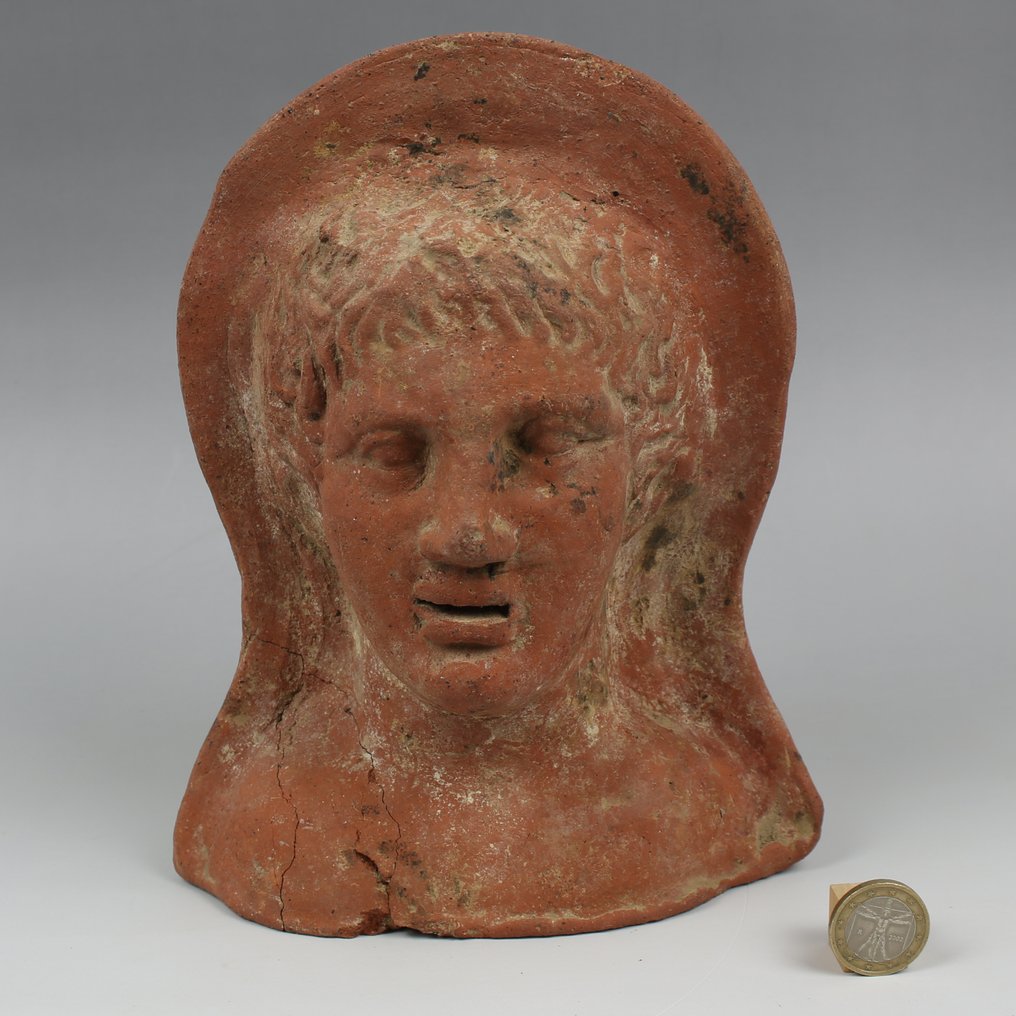
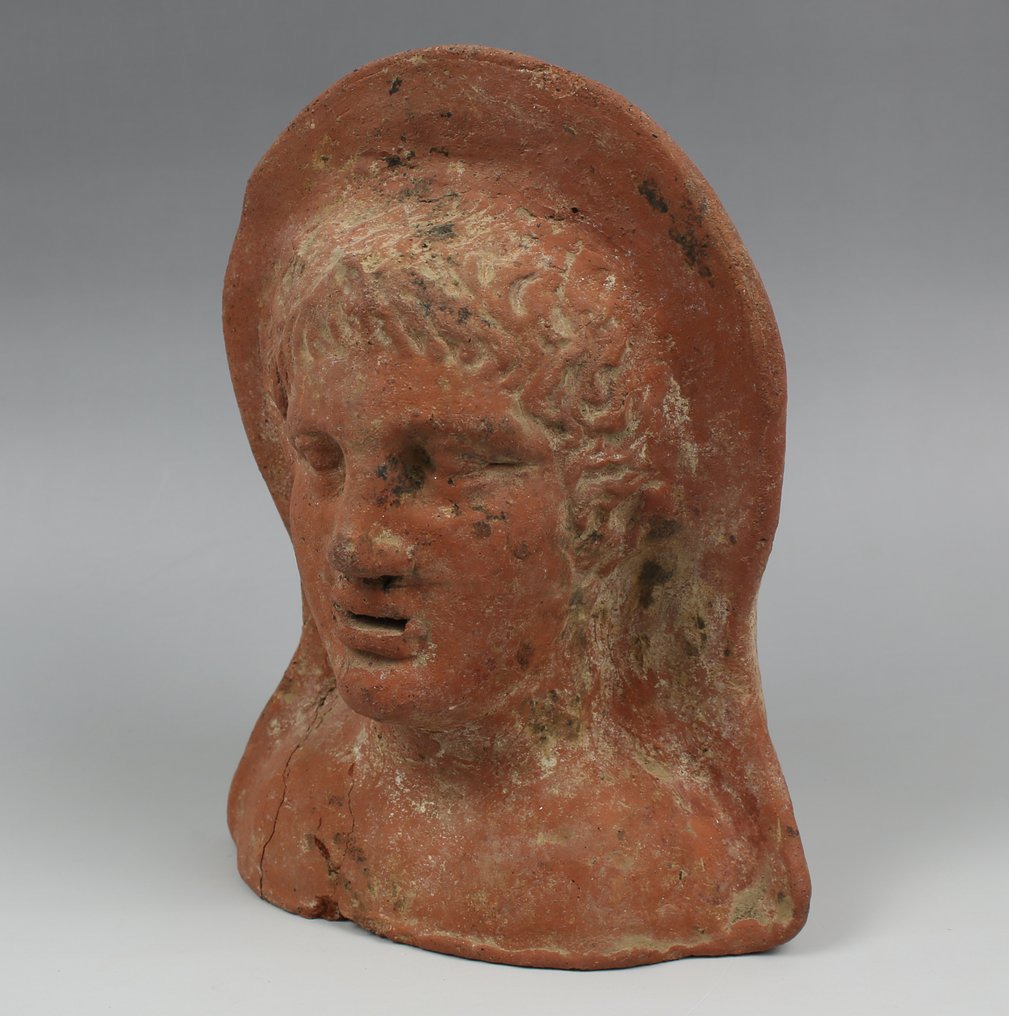
Etruscan 陶器 带有热释光(TL)测试的头部解剖供奉模型



明天開始

Catawiki買家保障
在您收到物品前,我們會妥善保管您的付款。查看詳情
Trustpilot評分 4.4 | 130284 則評論
在Trustpilot獲得極佳評等。
賣家描述
ITEM: Anatomical votive model of a head
MATERIAL: Terracotta
CULTURE: Etruscan
PERIOD: 5th – 4th Century B.C
DIMENSIONS: 218 mm x 173 mm x 110 mm
CONDITION: Good condition. Includes Thermoluminescence test by QED Laboratory (Reference: QED2533/EG-0105)
PROVENANCE: Ex Belgian private collection, Ex Spanish antiquities dealer (2022), Ex Belgian private collection, Brussels
Etruscan pottery reflects a dynamic blend of indigenous innovation and external influence, particularly from Greek and Near Eastern cultures. During the 7th century B.C., Etruscan potters developed the bucchero style—distinctive for its black, glossy surface achieved through a reducing firing technique. Bucchero vessels, often finely crafted and decorated with incised or relief patterns, served both everyday and ceremonial functions. Early examples were elegant and light, while later ones grew heavier and more elaborate, often mimicking metal prototypes.
By the 6th century B.C., the influence of Greek pottery became more pronounced, especially through the importation of Corinthian and Attic ceramics. Etruscan artisans began producing their own painted wares, imitating Greek black-figure and later red-figure techniques. These locally made vases, especially from workshops in places like Vulci and Cerveteri, frequently depict mythological scenes, banquets, and athletic contests, sometimes with uniquely Etruscan interpretations. Shapes such as amphorae, kraters, and kylikes were common, reflecting the importance of symposium culture.
In the 5th century B.C., Etruscan pottery production became increasingly regionalized and somewhat conservative compared to the innovations in Greek pottery. However, the continued production of impasto wares—coarse, hand-formed ceramics used for domestic purposes—demonstrates a parallel tradition alongside the finer, painted pieces.
Comes with Certificate of Authenticity and European Union export license
If you bid outside European Union and win the item, we must request a new export license to your country and the shipment will delay between 3 - 5 weeks.
#CollectorsFairMarch2026
賣家的故事
您的古董商提供古代藝術品和古錢幣。我們的主要目標是以最優惠的價格提供最高的質量,尊重並嚴格遵守遺產保護法和聯合國教科文組織遺產規範。因此,出版的作品全部來自可查出處的私人收藏或國際拍賣。我們所有的古物和硬幣都附有真品證書。我們有 90 天無條件退貨政策。在 Your Antiquarian,我們致力於幫助弱勢群體,因此每次購買的產品都會捐贈一部分給慈善機構,以幫助有需要的人。
由Google翻譯翻譯ITEM: Anatomical votive model of a head
MATERIAL: Terracotta
CULTURE: Etruscan
PERIOD: 5th – 4th Century B.C
DIMENSIONS: 218 mm x 173 mm x 110 mm
CONDITION: Good condition. Includes Thermoluminescence test by QED Laboratory (Reference: QED2533/EG-0105)
PROVENANCE: Ex Belgian private collection, Ex Spanish antiquities dealer (2022), Ex Belgian private collection, Brussels
Etruscan pottery reflects a dynamic blend of indigenous innovation and external influence, particularly from Greek and Near Eastern cultures. During the 7th century B.C., Etruscan potters developed the bucchero style—distinctive for its black, glossy surface achieved through a reducing firing technique. Bucchero vessels, often finely crafted and decorated with incised or relief patterns, served both everyday and ceremonial functions. Early examples were elegant and light, while later ones grew heavier and more elaborate, often mimicking metal prototypes.
By the 6th century B.C., the influence of Greek pottery became more pronounced, especially through the importation of Corinthian and Attic ceramics. Etruscan artisans began producing their own painted wares, imitating Greek black-figure and later red-figure techniques. These locally made vases, especially from workshops in places like Vulci and Cerveteri, frequently depict mythological scenes, banquets, and athletic contests, sometimes with uniquely Etruscan interpretations. Shapes such as amphorae, kraters, and kylikes were common, reflecting the importance of symposium culture.
In the 5th century B.C., Etruscan pottery production became increasingly regionalized and somewhat conservative compared to the innovations in Greek pottery. However, the continued production of impasto wares—coarse, hand-formed ceramics used for domestic purposes—demonstrates a parallel tradition alongside the finer, painted pieces.
Comes with Certificate of Authenticity and European Union export license
If you bid outside European Union and win the item, we must request a new export license to your country and the shipment will delay between 3 - 5 weeks.
#CollectorsFairMarch2026
賣家的故事
您的古董商提供古代藝術品和古錢幣。我們的主要目標是以最優惠的價格提供最高的質量,尊重並嚴格遵守遺產保護法和聯合國教科文組織遺產規範。因此,出版的作品全部來自可查出處的私人收藏或國際拍賣。我們所有的古物和硬幣都附有真品證書。我們有 90 天無條件退貨政策。在 Your Antiquarian,我們致力於幫助弱勢群體,因此每次購買的產品都會捐贈一部分給慈善機構,以幫助有需要的人。
由Google翻譯翻譯詳細資料
文化
Etruscan
世紀/時間框架
5th – 4th Century B.C
Name of object
Anatomical votive model of a head with TL Thermoluminescence test
獲得來源
私人收藏
獲得年份
2025
材質
陶器
獲得國家
比利時
狀態
好
前任擁有者獲得來源
古董市場
前任擁有者獲得年份
1980
前任擁有者獲得國家
比利時
我保證此物品為合法取得,且本人有權出售。
是
真偽
原創/正版
免責聲明
Catawiki已告知賣家有關文件的要求,賣家須保證如下: - 物品為合法獲得; - 賣家有權出售和/或出口相關物品; - 賣家依據當地法規(如適用)提供必要的原產地資訊,並辦理所需文件和許可證/執照; - 若許可證/執照的取得發生任何延誤,賣家須通知買家。 參與競標即表示您知悉,根據您的居住國,可能需要進口文件,而取得許可證/執照可能導致您的物品延遲交付。
Catawiki已告知賣家有關文件的要求,賣家須保證如下: - 物品為合法獲得; - 賣家有權出售和/或出口相關物品; - 賣家依據當地法規(如適用)提供必要的原產地資訊,並辦理所需文件和許可證/執照; - 若許可證/執照的取得發生任何延誤,賣家須通知買家。 參與競標即表示您知悉,根據您的居住國,可能需要進口文件,而取得許可證/執照可能導致您的物品延遲交付。
