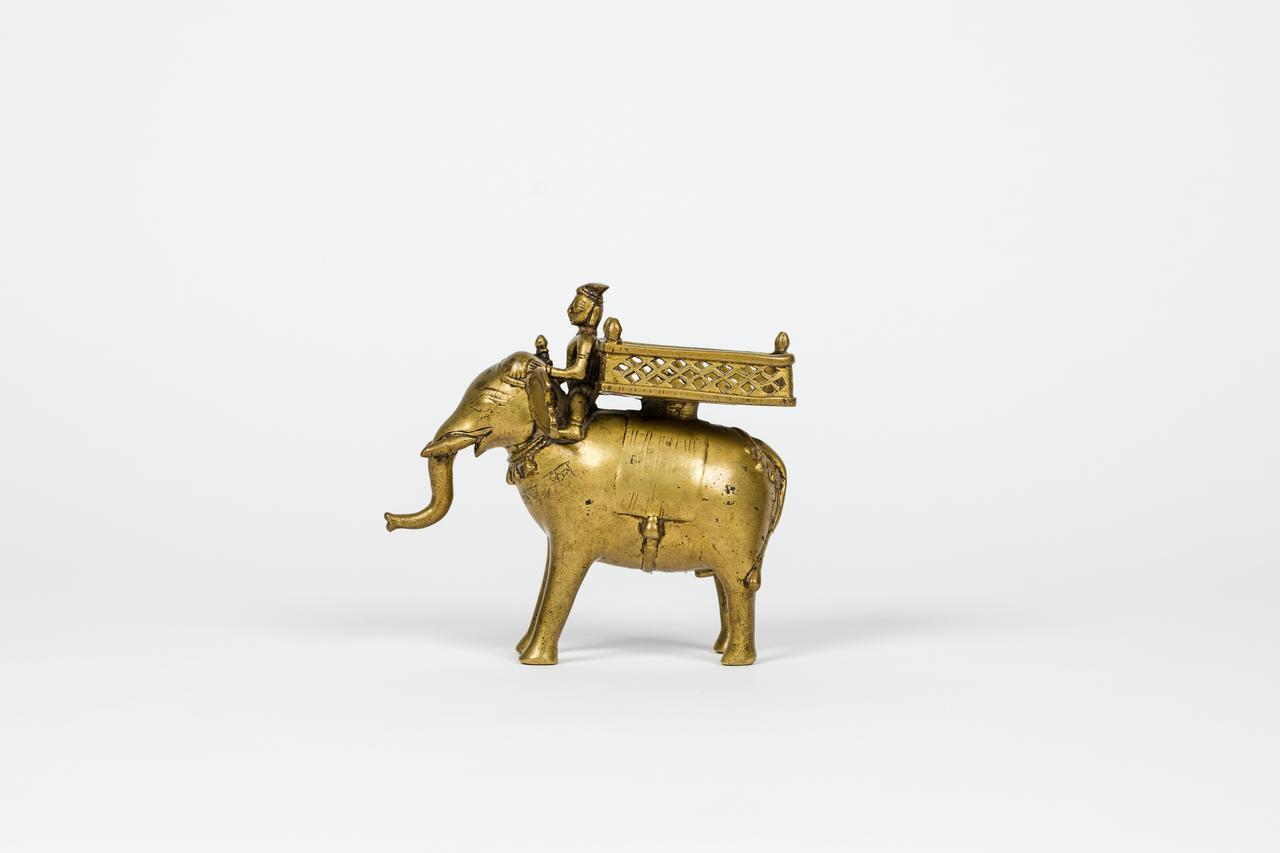
寺庙玩具——象背上有骑象人(象师)的象玩具,装在轮子上 - 青銅色 - 印度 - 19世纪末至20世纪初


06
天
01
小時
35
分鐘
30
秒

沒有出價記錄
Catawiki買家保障
在您收到物品前,我們會妥善保管您的付款。查看詳情
Trustpilot評分 4.4 | 134742 則評論
在Trustpilot獲得極佳評等。
Temple toy – Elephant with rider (Mahout) on wheels,一件印度原裝青銅雕塑,年代為19世紀末至20世紀初,狀況良好。
AI輔助摘要
賣家描述
Temple toy – Elephant with rider (Mahout) on wheels – ca. 1890–1930 Detailed DescriptionAn original and rare piece of Hindu tribal art, representing a ritual temple toy (Temple Toy) hand-cast in solid solid bronze. The figurine depicts a ceremonial elephant guided by a rider (mahout) positioned on its back. It is a collector's item specific to Colonial India from the late 19th or early 20th century.Head and Ornaments: The animal’s forehead is richly ornamented with a granular pearl decoration (bronze beads in relief), and in the central area it presents a prominent decorative medallion in the shape of a sacred bell. The trunk is directed downwards and curved at the tip, symbolising calm strength and stability. The rider (Mahout): The anthropomorphic figurine is modelled in a naive-tribal style, with strongly stylised facial features (large, almond-shaped eyes), traditional hairstyle and a sacred dot (Bindi/Tilak) visible in relief on the forehead. Manufacturing technique and elements of authenticity Dhokra (Lost Wax) casting: The object is entirely handmade. On the back (under the tail) it shows a primitive material void. This is an original casting defect from the archaic workshop (air bubble in the clay mould), a detail that guarantees historical authenticity and excludes modern industrial copies. Riveted iron axles: A supreme indicator of the age of the piece is the rolling system. Only the axles are made of ferrous metal (hand-forged iron). The wheels are permanently fixed at the ends by coarse riveting by manual hot hammering, a completely archaic process.Technical specificationsLength: 11 cmHeight: 11 cmWidth (wheel gauge): 8 cmWeight: 450 grams (solid metal, high density, full casting)Conservation conditionPatina: Piece with natural, historical patina, chemically untreated. It retains the original gray-brown oxidation in the recesses and handling gloss on the prominent areas.Details: The object is structurally stable. The two bronze tusks of the elephant are broken from old age (during its active use), the edges of the breaks being naturally blunted and covered over time by patina. Small structural wear (age porosity) on the rider's chest
Temple toy – Elephant with rider (Mahout) on wheels – ca. 1890–1930 Detailed DescriptionAn original and rare piece of Hindu tribal art, representing a ritual temple toy (Temple Toy) hand-cast in solid solid bronze. The figurine depicts a ceremonial elephant guided by a rider (mahout) positioned on its back. It is a collector's item specific to Colonial India from the late 19th or early 20th century.Head and Ornaments: The animal’s forehead is richly ornamented with a granular pearl decoration (bronze beads in relief), and in the central area it presents a prominent decorative medallion in the shape of a sacred bell. The trunk is directed downwards and curved at the tip, symbolising calm strength and stability. The rider (Mahout): The anthropomorphic figurine is modelled in a naive-tribal style, with strongly stylised facial features (large, almond-shaped eyes), traditional hairstyle and a sacred dot (Bindi/Tilak) visible in relief on the forehead. Manufacturing technique and elements of authenticity Dhokra (Lost Wax) casting: The object is entirely handmade. On the back (under the tail) it shows a primitive material void. This is an original casting defect from the archaic workshop (air bubble in the clay mould), a detail that guarantees historical authenticity and excludes modern industrial copies. Riveted iron axles: A supreme indicator of the age of the piece is the rolling system. Only the axles are made of ferrous metal (hand-forged iron). The wheels are permanently fixed at the ends by coarse riveting by manual hot hammering, a completely archaic process.Technical specificationsLength: 11 cmHeight: 11 cmWidth (wheel gauge): 8 cmWeight: 450 grams (solid metal, high density, full casting)Conservation conditionPatina: Piece with natural, historical patina, chemically untreated. It retains the original gray-brown oxidation in the recesses and handling gloss on the prominent areas.Details: The object is structurally stable. The two bronze tusks of the elephant are broken from old age (during its active use), the edges of the breaks being naturally blunted and covered over time by patina. Small structural wear (age porosity) on the rider's chest
詳細資料
朝代風格/時期
late 19th - early 20th century
原產國
印度
Attribution
原版
物料
青銅色
Height
0 cm
Width
0 cm
藝術品標題
Temple toy – Elephant with rider (Mahout) on wheels
Depth
0 cm
Condition
良好狀態
真偽
原創/正版