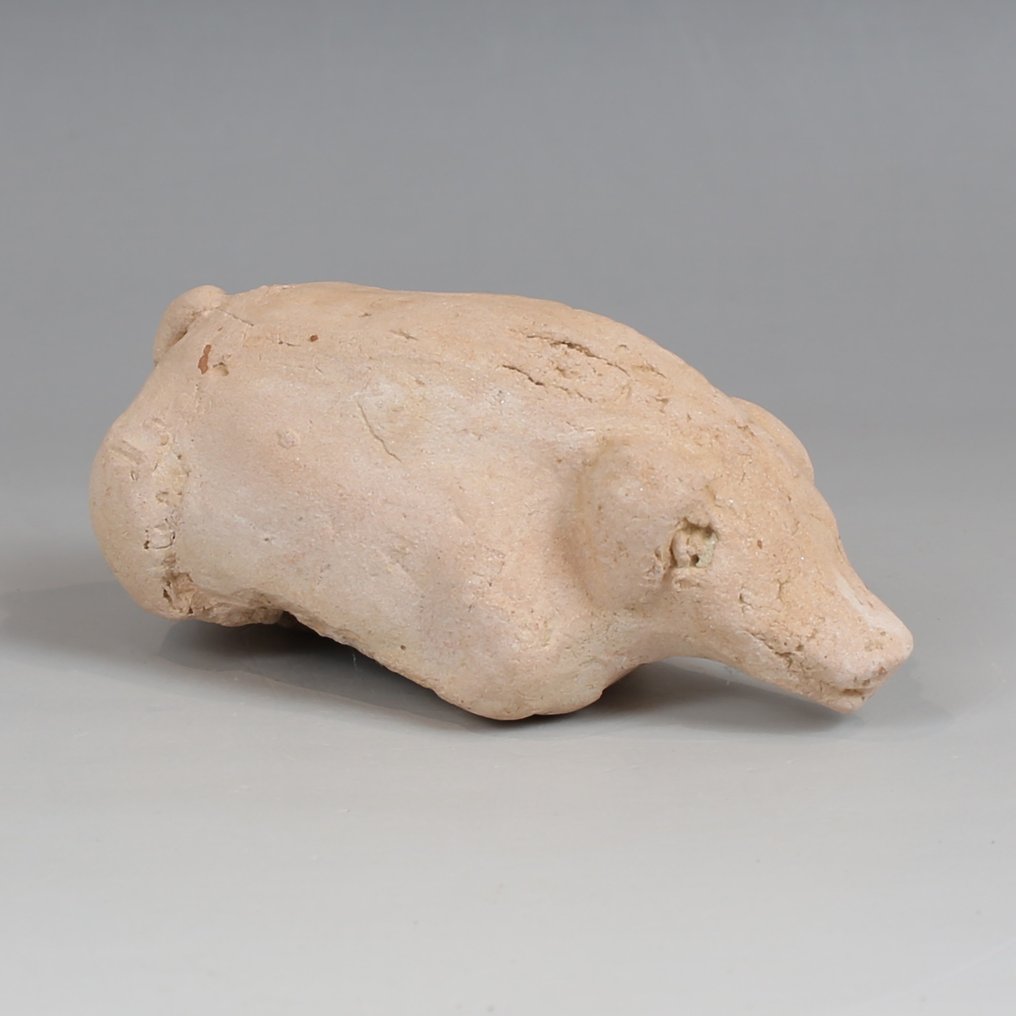
Ancient Chinese, Tang Dynasty 陶器 一只小猪雕像 (沒有保留價)


00
天
22
小時
04
分鐘
02
秒

另有15人對此物品感興趣
 競投者 3578 競投者 3578 | €35 | |
|---|---|---|
 競投者 3735 競投者 3735 | €30 | |
| 競投者 3578 | €30 | |
Catawiki買家保障
在您收到物品前,我們會妥善保管您的付款。查看詳情
Trustpilot評分 4.4 | 121980 則評論
在Trustpilot獲得極佳評等。
唐代中國陶器雕像「Statuette of a piggy」,尺寸45 mm×45 mm×94 mm,於2025年自德國私人收藏取得,狀況良好,附真實性證明書與歐盟出口許可。
AI輔助摘要
賣家描述
ITEM: Statuette of a piggy
MATERIAL: Pottery
CULTURE: Chinese
PERIOD: Tang dynasty, 618 - 907 A.D
DIMENSIONS: 45 mm x 45 mm x 94 mm
CONDITION: Good condition
PROVENANCE: Ex German private collection, F.B., acquired in European antiquities auctions between 2000 - 2009.
Comes with Certificate of Authenticity and European Union export license
If you bid outside European Union and win the item, we must request a new export license to your country and the shipment will delay between 3 - 5 weeks.
The Tang Dynasty (618–907 CE) succeeded the brief Sui Dynasty and is universally regarded as a Golden Age and a zenith of Chinese civilization, characterized by extraordinary political stability, economic prosperity, and cultural flourishing. Founded by Emperor Gaozu and solidified by his son, Emperor Taizong, the Tang state successfully refined the centralized bureaucracy and legal code inherited from the Sui, establishing a powerful and efficient government that would serve as a model for subsequent dynasties. The capital, Chang’an (modern Xi'an) , became the largest and most cosmopolitan city in the world, a vibrant hub of international exchange where merchants, clerics, and envoys from Central Asia, Persia, India, and Japan mingled freely.
The Tang era is best known for an unparalleled bloom in arts and literature. It is considered the classical age of Chinese poetry, producing masters like Li Bai and Du Fu, whose approximately 50,000 surviving works captured both the courtly splendor and the hardships of the time. The dynasty also saw significant technological advancements, including the widespread adoption of woodblock printing, which facilitated greater literacy and the circulation of texts, including the world's oldest dated complete printed book, the Diamond Sutra (868 CE). Other innovations, such as the initial development of gunpowder (initially for fireworks) and sophisticated clockwork mechanisms, cemented China's position as a technological leader.
The dynasty reached its territorial and cultural height under Emperor Xuanzong in the early 8th century, a period of peace and prosperity that was famously interrupted by the An Lushan Rebellion (755–763 CE). This devastating civil war severely weakened the central government, leading to the rise of powerful, semi-autonomous regional military governors (jiedushi). Although the Tang was restored, the dynasty never fully recovered its former power. The ensuing decline saw the increasing influence of court eunuchs and a series of rebellions, culminating in its final collapse in 907 CE. Despite its eventual end, the Tang left an enduring legacy, profoundly shaping the legal, administrative, and cultural norms of East Asia, including Japan and Korea.
Catawiki disclaimer: This piece has been dated based on style by the seller . No further tests, such as, a TL test, analysis of metals(XRF-test), lapidary tests, analysis of pigments or radiography scans have been conducted to check the integrity of the piece.
賣家的故事
您的古董商提供古代藝術品和古錢幣。我們的主要目標是以最優惠的價格提供最高的質量,尊重並嚴格遵守遺產保護法和聯合國教科文組織遺產規範。因此,出版的作品全部來自可查出處的私人收藏或國際拍賣。我們所有的古物和硬幣都附有真品證書。我們有 90 天無條件退貨政策。在 Your Antiquarian,我們致力於幫助弱勢群體,因此每次購買的產品都會捐贈一部分給慈善機構,以幫助有需要的人。
由Google翻譯翻譯ITEM: Statuette of a piggy
MATERIAL: Pottery
CULTURE: Chinese
PERIOD: Tang dynasty, 618 - 907 A.D
DIMENSIONS: 45 mm x 45 mm x 94 mm
CONDITION: Good condition
PROVENANCE: Ex German private collection, F.B., acquired in European antiquities auctions between 2000 - 2009.
Comes with Certificate of Authenticity and European Union export license
If you bid outside European Union and win the item, we must request a new export license to your country and the shipment will delay between 3 - 5 weeks.
The Tang Dynasty (618–907 CE) succeeded the brief Sui Dynasty and is universally regarded as a Golden Age and a zenith of Chinese civilization, characterized by extraordinary political stability, economic prosperity, and cultural flourishing. Founded by Emperor Gaozu and solidified by his son, Emperor Taizong, the Tang state successfully refined the centralized bureaucracy and legal code inherited from the Sui, establishing a powerful and efficient government that would serve as a model for subsequent dynasties. The capital, Chang’an (modern Xi'an) , became the largest and most cosmopolitan city in the world, a vibrant hub of international exchange where merchants, clerics, and envoys from Central Asia, Persia, India, and Japan mingled freely.
The Tang era is best known for an unparalleled bloom in arts and literature. It is considered the classical age of Chinese poetry, producing masters like Li Bai and Du Fu, whose approximately 50,000 surviving works captured both the courtly splendor and the hardships of the time. The dynasty also saw significant technological advancements, including the widespread adoption of woodblock printing, which facilitated greater literacy and the circulation of texts, including the world's oldest dated complete printed book, the Diamond Sutra (868 CE). Other innovations, such as the initial development of gunpowder (initially for fireworks) and sophisticated clockwork mechanisms, cemented China's position as a technological leader.
The dynasty reached its territorial and cultural height under Emperor Xuanzong in the early 8th century, a period of peace and prosperity that was famously interrupted by the An Lushan Rebellion (755–763 CE). This devastating civil war severely weakened the central government, leading to the rise of powerful, semi-autonomous regional military governors (jiedushi). Although the Tang was restored, the dynasty never fully recovered its former power. The ensuing decline saw the increasing influence of court eunuchs and a series of rebellions, culminating in its final collapse in 907 CE. Despite its eventual end, the Tang left an enduring legacy, profoundly shaping the legal, administrative, and cultural norms of East Asia, including Japan and Korea.
Catawiki disclaimer: This piece has been dated based on style by the seller . No further tests, such as, a TL test, analysis of metals(XRF-test), lapidary tests, analysis of pigments or radiography scans have been conducted to check the integrity of the piece.
賣家的故事
您的古董商提供古代藝術品和古錢幣。我們的主要目標是以最優惠的價格提供最高的質量,尊重並嚴格遵守遺產保護法和聯合國教科文組織遺產規範。因此,出版的作品全部來自可查出處的私人收藏或國際拍賣。我們所有的古物和硬幣都附有真品證書。我們有 90 天無條件退貨政策。在 Your Antiquarian,我們致力於幫助弱勢群體,因此每次購買的產品都會捐贈一部分給慈善機構,以幫助有需要的人。
由Google翻譯翻譯詳細資料
文化
Ancient Chinese, Tang Dynasty
世紀/時間框架
618 - 907 A.D
Name of object
Statuette of a piggy
獲得來源
私人收藏
獲得年份
2025
材質
陶器
獲得國家
德國
狀態
好
前任擁有者獲得來源
古董市場
前任擁有者獲得年份
2000
前任擁有者獲得國家
德國
我保證此物品為合法取得,且本人有權出售。
是
免責聲明
Catawiki已告知賣家有關文件的要求,賣家須保證如下: - 物品為合法獲得; - 賣家有權出售和/或出口相關物品; - 賣家依據當地法規(如適用)提供必要的原產地資訊,並辦理所需文件和許可證/執照; - 若許可證/執照的取得發生任何延誤,賣家須通知買家。 參與競標即表示您知悉,根據您的居住國,可能需要進口文件,而取得許可證/執照可能導致您的物品延遲交付。
Catawiki已告知賣家有關文件的要求,賣家須保證如下: - 物品為合法獲得; - 賣家有權出售和/或出口相關物品; - 賣家依據當地法規(如適用)提供必要的原產地資訊,並辦理所需文件和許可證/執照; - 若許可證/執照的取得發生任何延誤,賣家須通知買家。 參與競標即表示您知悉,根據您的居住國,可能需要進口文件,而取得許可證/執照可能導致您的物品延遲交付。
