We carefully select submissions to maintain high-quality and authenticity standards. We only accept authentic contemporary artworks, directly from the artists, valued at €150 or more. Our experts review every submission to ensure bidders find unique, original works directly from the artist.
Follow these guidelines to maximise your chances of a successful sale.
What we accept
We’re looking for authentic, high-quality artworks that appeal to serious collectors. To be accepted, your object must:
For all submissions:
- Fall within our accepted categories:
- Paintings & Mixed Media
- Prints & Limited Editions
- Sculptures & 3D objects
- Be authentic and in good condition
- Meet the minimum expected value of €150
- Not have a reserve price if valued below €200
- Have shipping costs proportionate to the object's value
For pop art submissions:
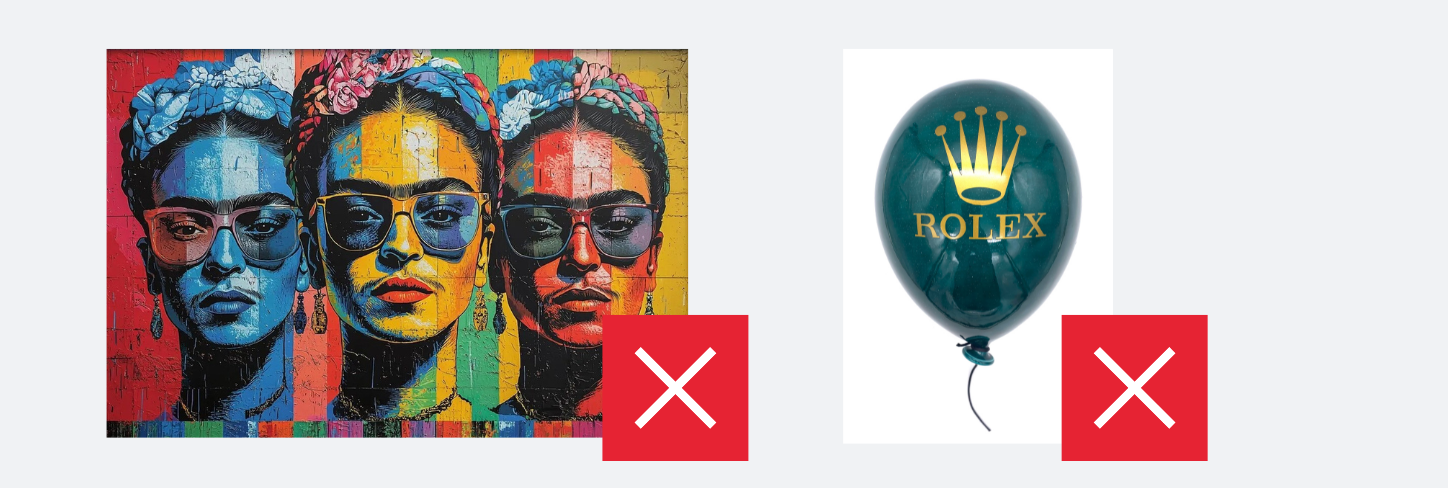
Pop-art using brand references may be accepted if:
- The artwork clearly transforms or critiques the brand
- There is no implied affiliation or endorsement
- It is clearly attributed to the artist
- A disclaimer is included (e.g. “This is an independent artwork with no affiliation to [brand]”)
For AI-generated artworks:
Please refer to our AI Art guidelines.
📌 Examples of accepted objects: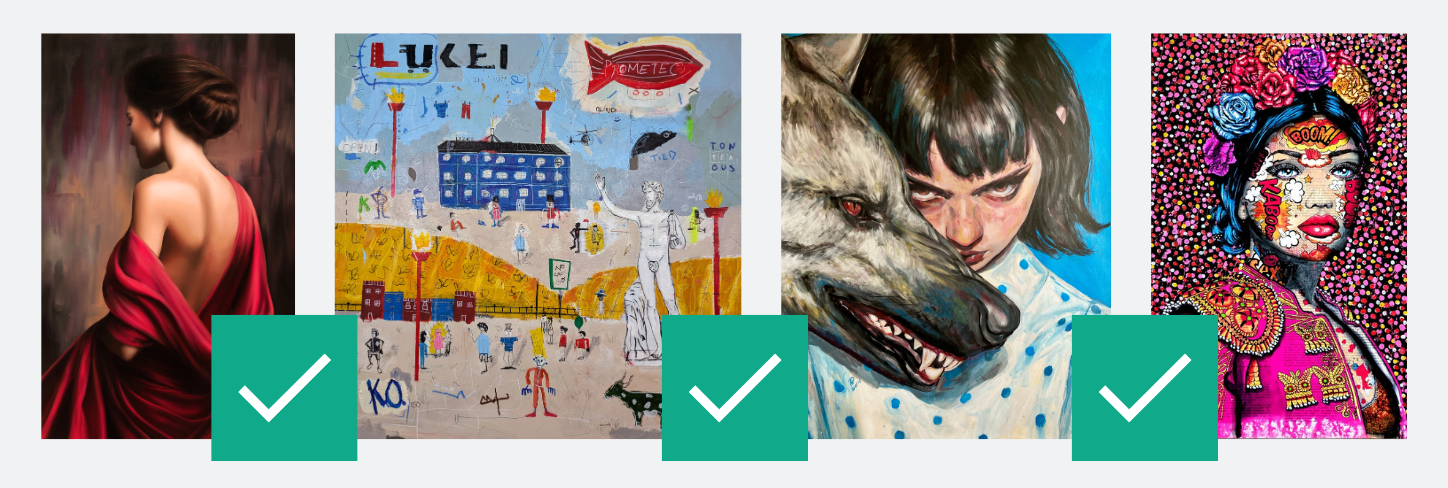
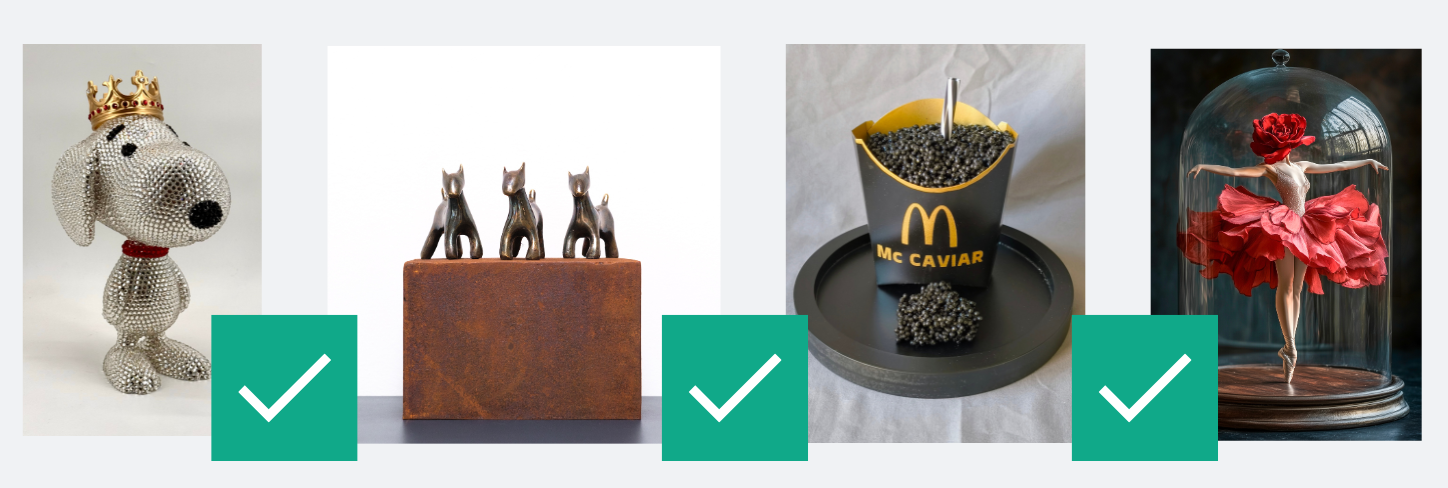
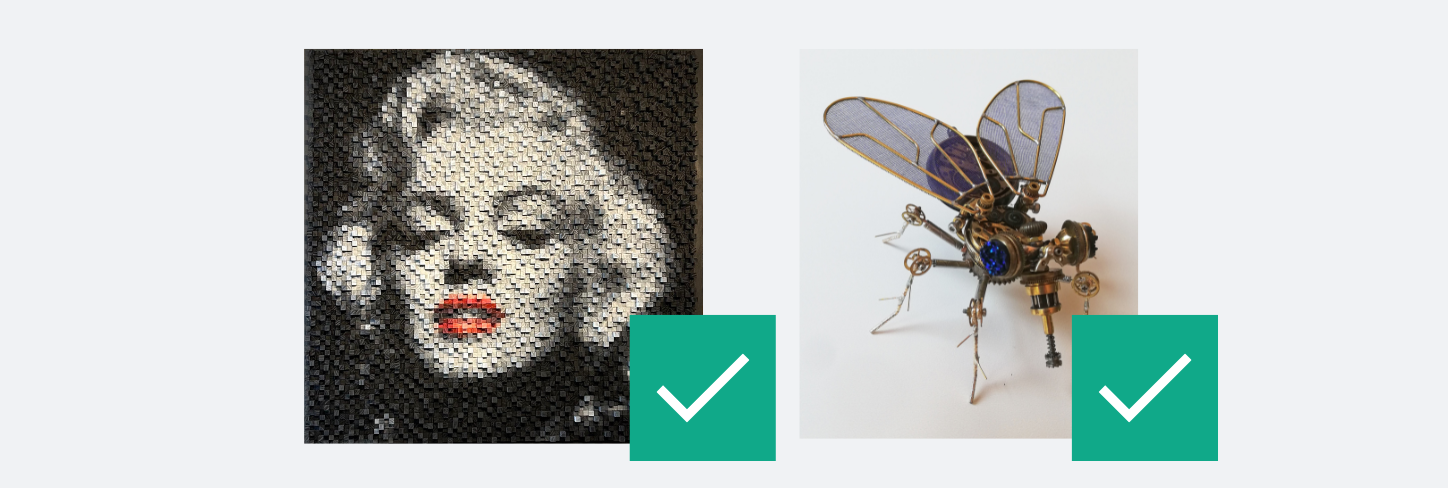
What we do not accept
To keep our auctions high-quality and trustworthy, we do not accept:
Damaged artworks
- Artworks lacking demand or valued below €150
- Works violating our terms (e.g. copyright infringement)
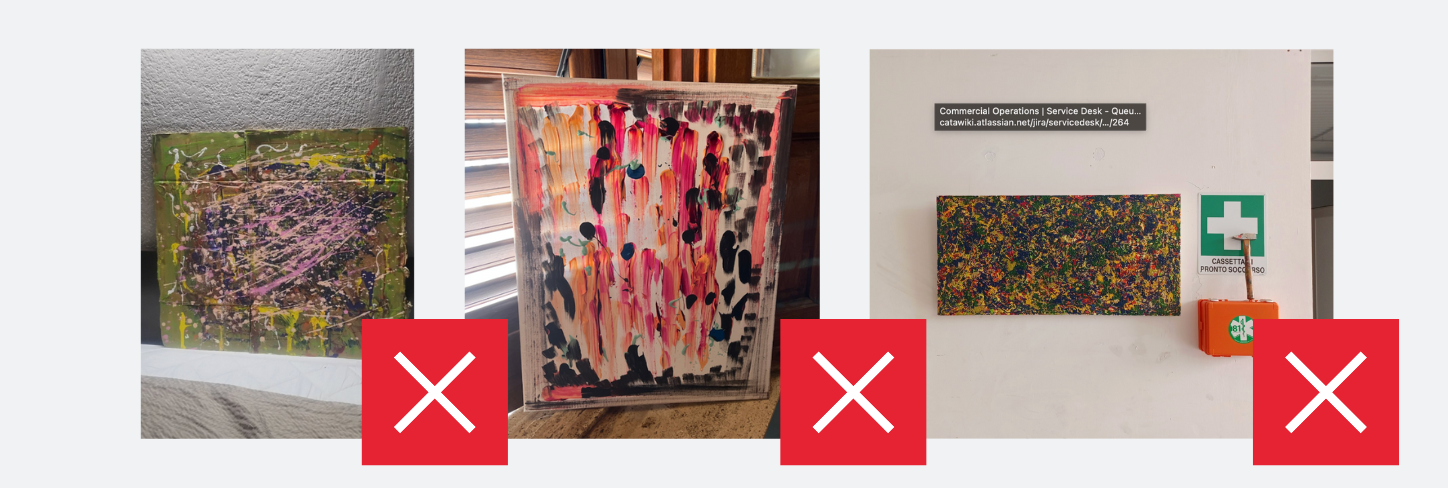
- Inappropriate or discriminatory content
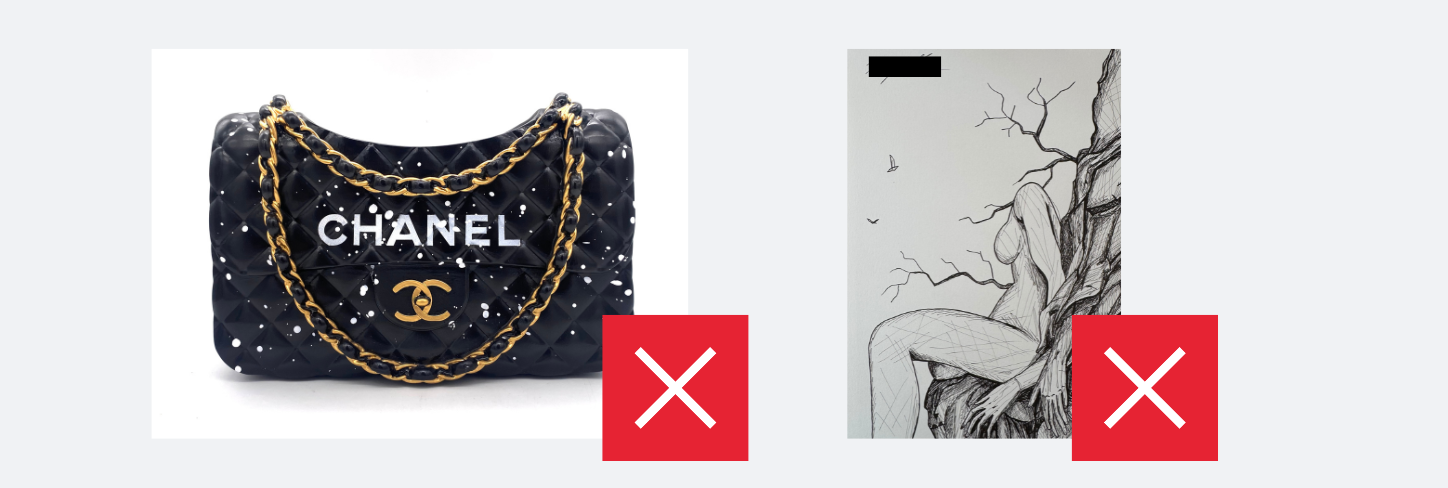
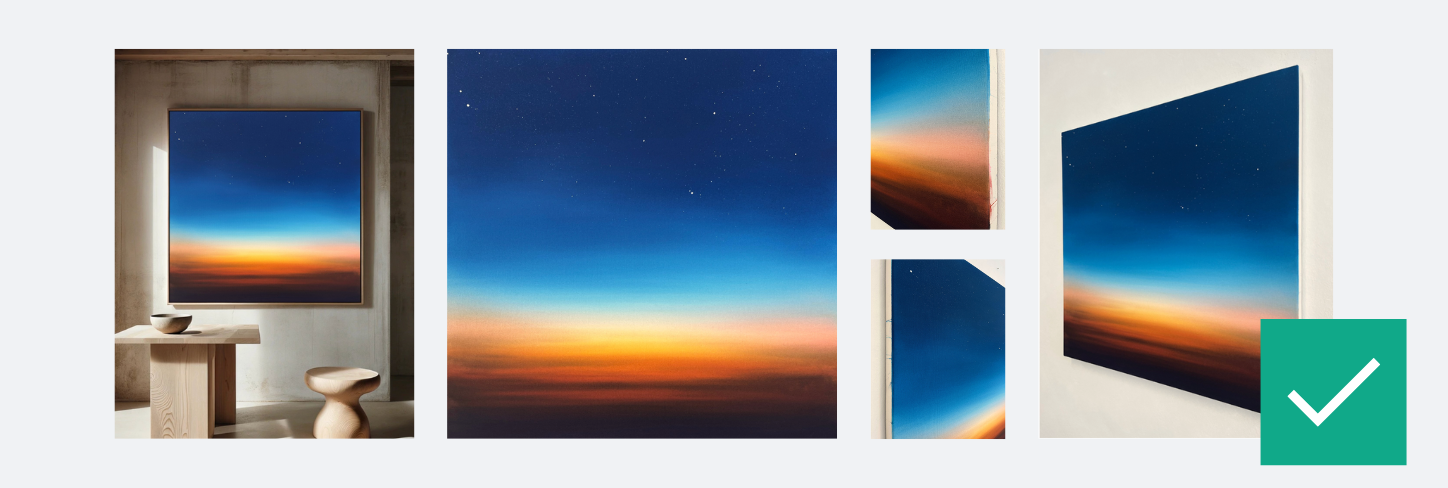
- Logos on functional objects (e.g. “LV toaster”)
- Works resembling official merchandise
- Mass-produced pieces with minimal variation
📌 Examples of rejected objects: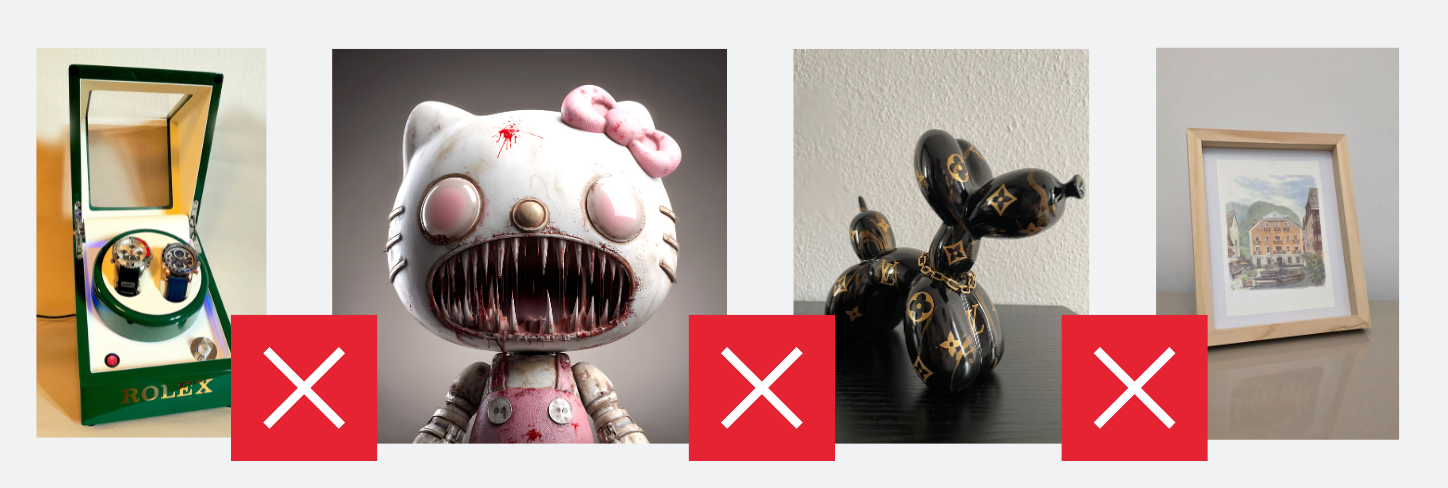
Getting your submission ready
1. Fill in all the details and write a clear description
When you submit an object, you’ll see fields to guide you in providing the right information, e.g. title of the artwork, technique, size (in cm or inches), year of creation, edition information (original or part of a series), etc. These fields ensure your listing is clear, searchable, and easy for bidders to understand.
Please also use the object description field to share:
- Artist’s biography, notable exhibitions or education
If the artwork was partially or fully generated using AI, this must be stated clearly, along with the software used
- What is included/not included (e.g. packaging, accessories)
- If the object has any flaws
- Shipping method (e.g. framed, rolled, insured)
- Import/export details if applicable
Tip: The more detail you provide, the easier it is for bidders to understand the value of your object – and the more likely it is to sell. Find here more tips on how to write a clear, accurate description.
📌 Examples of a well-written description:
Example #1:
“Collection 2025
"Ink" is a visual whisper, an ode to the body as canvas and to the mark as language, capturing the harmony between skin and tattoo, and transforming the curve of the back into a pathway of graphics that tell stories without words. In this essential and intense composition, light dances across the lines of the design and the protruding bones, evoking strength and delicacy at once. "Ink" is not just a portrait; it is a meditation on the beauty of transformation and the art of marking what lies beneath the skin.
Signed by Ivan Pili, master of contemporary figurative art, this painting is part of the most evocative vein of his work, celebrated at international events such as Art Basel Miami, Art Monaco, Artexpo New York, the Carrousel du Louvre in Paris, and the Venice and Barcelona Biennials. Found in private collections across Europe, the United States, and the United Arab Emirates, Ivan Pili reaffirms with "Ink" his ability to turn skin into poetry—conveying, with delicacy and lyricism, the magic that is born when form meets mark.
The painting is ready to hang and comes with a certificate of authenticity.
Please note that the colors in the images may differ slightly due to varying lighting conditions during photography and camera characteristics.
The artwork will be carefully protected and shipped in an elegant and sturdy package, made of extruded polystyrene to ensure maximum safety and lightweight transport.
For purchases outside the EU, shipping will be carried out within 10 working days of receipt of payment, taking into account any bureaucratic processing times”.
Example #2:
“Edition: handmade unique piece
Technique: painted without a brush, colors were applied directly with the hand.
Acrylic paints in studio quality on unprimed canvas (cotton 370 g/m²)
Canvas size: approximately 165 cm x 135 cm
Dimensions of the suitable stretcher frame: 150 cm x 120 cm x 2-4.5 cm
Signature: signed and dated on the back
Packaging: rolled and securely packaged in a sturdy tube.
Shipping: with transport insurance and tracking number, artworks over 500 EUR will be sent as express delivery upon request (worldwide delivery within 2-4 days)
The artwork is sold without a stretcher frame and without a shadow gap frame.
The painting was created using a special and unusual technique. The artist does not use brushes for his art but applies the acrylic paint directly onto the canvas with his hands. The paint is poured very thinly onto a untreated cotton fabric and massaged into the fabric. As a result, the paint penetrates deeply into the fabric, and no brush strokes are visible. The artist repeats this process several times. The paintings consist of up to ten layers of paint. This creates very delicate color transitions and nuances that are unfortunately difficult to reproduce accurately in photographs.
Please note:
- Possible color deviations are due to light, monitor and camera.
For buyers outside the EU, additional duties and fees may apply.
- Some of the images are photomontages and are for illustrative purposes. The proportions do not always correspond exactly to reality”.
2. Dimensions: be specific
To avoid confusion about artwork sizes, please specify all measurements clearly. Ensure your photos clearly reflect the measurements stated above (for example, frame depth or border visibility).
| Field | What to include | Example |
| Image area (HxW) | The actual printed or painted zone | 45 x 30 cm |
| Sheet or canvas size (H x W) | Total surface of paper of canvas | 60 x 45 cm |
| Framed dimensions (H x W x D) | If framed, include external size and depth | 64 x 49 x 3 cm |
| Orientation | Horizontal/vertical | Horizontal |
3. Great photos matter
Photos are the first thing bidders see – so make them count! We recommend including 5 high-quality images that clearly show the condition and details of your object. This helps bidders make informed decisions and increases your chances of a successful sale.
Your photos should include:
- The complete artwork
- Signature
- Details and textures
- Back side (especially for canvas works)
- Any damage or restoration
Additional images:
- Artist portraits
- Studio views
- Mockups
- Creative process
- Media articles
Tip: Use a neutral background (white or black), avoid low-quality or stock images, and aim for natural lighting. Find here more tips on how to take professional photos.
📌 Examples of good vs. bad photos:
Good photos show the artwork from multiple angles in clear lighting, highlighting texture, quality, and details — including the back if signed.
- Poor photos have bad lighting, distracting surroundings, and lack close-ups or varied views of the artwork.
4. Condition: describe honestly and in detail
Provide an accurate description of the artwork’s current state. Mention even minor imperfections so buyers know what to expect.
Please include:
- Surface characteristics (texture, craquelure, paint strokes, or paper waviness)
- Color tone variations (e.g., due to lighting or ageing)
- Any restorations, repairs, or varnishing done
- Type of edges (deckled, cut, irregular)
- Signature position and medium (front/back, pencil/paint)
- For prints: whether the ink or paper shows fading, foxing, or discoloration
Ensure the description matches visible details in the photographs. If restoration, fading, or discolouration is visible, mention it explicitly to prevent post-sale disputes.
Use this checklist before submitting: mention all visible imperfections (craquelure, foxing, tears, fading, scratches, repairs, or restorations) and make sure each appears clearly in at least one photo.
Tip: Add a close-up photo of texture and of any flaw or mark you mention. This prevents post-sale condition misunderstandings.
5. Edition and authenticity: provide complete information
To ensure buyers can trust editioned and printed works, please include all relevant information about the edition and printing process.
For all limited editions or prints, specify:
- Edition size (e.g., “3/25”)
- Printing or reproduction technique (e.g., “etching,” “lithograph,” “giclée print”, “AI print on canvas”)
- Signature and numbering details (e.g., “signed lower right in pencil”)
- Certificate of Authenticity with issuer, date, and, if applicable, archive or catalogue reference
Edition verification:
- For numbered editions, upload close-up photos showing both the signature and edition number.
Tip: Photograph all relevant documentation and close-ups of the signature and edition number.
Ready to sell? List your artworks today
Selling with us is free – commission is only applied if your object sells.
Follow these guidelines to maximise your chances of success.
Register as a seller and submit your artwork for auction now.