Joan Miro (1893-1983) - No title


16
päivät
23
tuntia
21
minuuttia
32
sekuntia
Nykyinen tarjous
€ 8
Pohjahintaa ei saavutettu

9 muuta käyttäjää seuraa tätä esinettä
 Tarjoaja 7494 Tarjoaja 7494 | 8 € | |
|---|---|---|
 Tarjoaja 8355 Tarjoaja 8355 | 3 € | |
| Tarjoaja 8355 | 2 € | |
Catawikin ostaja turva
Maksusi pidetään turvassa, kunnes saat esineesi. Näytä tiedot
Trustpilot 4.4 | 122385 arvostelua
Arvosteltu erinomaiseksi Trustpilot.
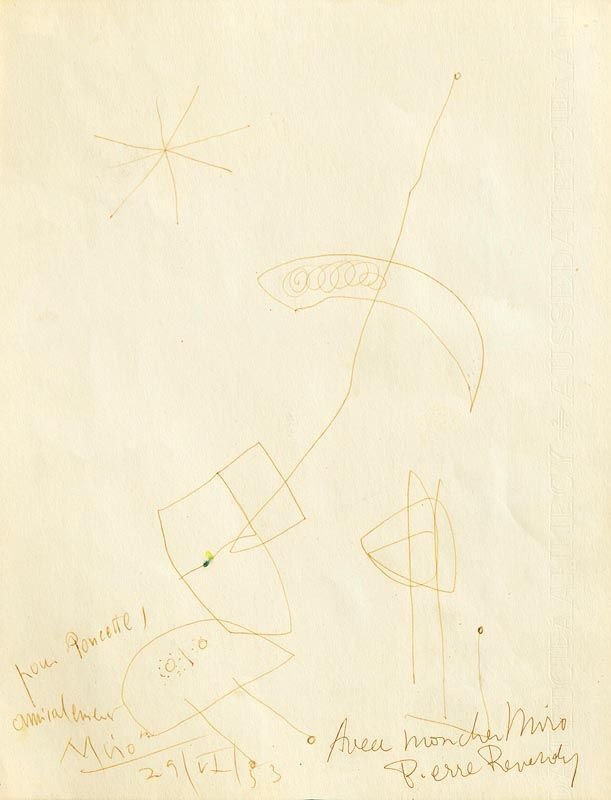
Joan Mirón vuonna 1953 kehystetty originaali, käsin signeerattu ja Pierrelle omistettu, tussin kynällä paperille tehty.
Tekoälyavusteinen yhteenveto
Myyjän antama kuvaus
Joan Miró (Barcelona, 1893 – Palma, 1983).
No title.
29/VI/1953.
Ink on paper.
32 x 25 cm and 59 x 51 cm with the frame.
Hand signed and dedicated to Pierre.
Certificate of authenticity by A.D.O.M. Paris, 18/03/2014.
CONDITION: Good condition.
PROVENANCE: Private Collection, Barcelona, Spain.
DESCRIPTION:
Joan Miró (Barcelona, 1893 – Palma, 1983) was one of the most important figures of Western art of the 20th century, and developed a personal language close to surrealism that strongly influenced both his contemporaries and subsequent generations. From his formative years at the La Llotja School and the innovative Galí Academy, Miró was involved in the circles of the Barcelona avant-garde, where he met some of his great friends: the critic Sebastià Gasch, the poet J. V. Foix, the painter Llorens Artigas and the art dealer Joan Prats. In 1918 he held his first exhibition at the Galerias Dalmau in Barcelona, and two years later he went to Paris, where he would spend the most crucial years of his artistic career, during which he would develop his own artistic language.
In the French capital, Miró became friends with André Masson, around whom the so-called Rue Blomet group, the future nucleus of surrealism, was grouped. Under the influence of surrealist poets and painters, with whom he shared many of his theoretical approaches, the young Miró matured his style, trying to transpose surrealist poetry into the visual and resorting to memory, fantasy and the irrational. His style then began to evolve towards increasingly ethereal works, where organic shapes and figures were reduced to abstract points, lines and patches of colour. In 1924 he signed the first surrealist manifesto, although the evolution of his work, too complex, did not allow him to be attributed to any particular orthodoxy. His third exhibition in Paris, in 1928, was his first great triumph: the Museum of Modern Art in New York acquired two of his works. From the following decade onwards Miró would establish himself as one of the most outstanding figures on the international art scene.
It was at this time that the artist, a nonconformist by nature, entered a phase that he called the “murder of painting,” in which he voluntarily gave up being a painter and experimented with other media, such as collage, drawing on paper of different textures or the construction of “objects” with found elements, his first approach to sculpture. Thus, although he soon resumed the practice of painting, Miró never abandoned his desire to experiment with all kinds of materials and techniques. He returned to Spain in 1941, and that same year the Museum of Modern Art in New York dedicated a retrospective to him that marked his definitive international consecration. From 1956 until his death in 1983, he lived in Palma in a sort of internal exile, while his international fame grew.
Miró received important awards such as the Grand Prix at the Venice Biennale in 1954 and from the Guggenheim Foundation in 1959, the Carnegie Prize for Painting in 1966 and the Gold Medals of the Generalitat of Catalonia (1978) and the Fine Arts Medal (1980). His work can currently be seen at the Joan Miró Foundation in Barcelona, opened in 1975, as well as in the Thyssen-Bornemisza Museum and the MNCARS in Madrid, the MoMA in New York, the National Gallery in Washington, the MNAM in Paris and the Albright-Knox Art Gallery in Buffalo, among other collections.
Myyjän tarina
Muinaisen taiteen galleria - Barcelonassa sijaitseva arkeologia yli viidentoista vuoden kokemuksella. Erikoistunut klassiseen taiteeseen, egyptiläiseen taiteeseen, aasialaiseen taiteeseen ja esikolumbiaaniseen taiteeseen. Se takaa kaikkien osien aitouden. Se osallistuu Espanjan tärkeimmille taidemessuille, kuten Feriartelle, sekä ulkomaisille messuille, BRAFA, Parcours des Mondes, Cultures Brussels.
Kaikki kappaleet lähetetään Espanjan kulttuuriministeriön myöntämällä vientiluvalla.
Toimitamme nopeasti DHL Expressin tai Direct Art Transportin kautta.
Kääntänyt Google TranslateJoan Miró (Barcelona, 1893 – Palma, 1983).
No title.
29/VI/1953.
Ink on paper.
32 x 25 cm and 59 x 51 cm with the frame.
Hand signed and dedicated to Pierre.
Certificate of authenticity by A.D.O.M. Paris, 18/03/2014.
CONDITION: Good condition.
PROVENANCE: Private Collection, Barcelona, Spain.
DESCRIPTION:
Joan Miró (Barcelona, 1893 – Palma, 1983) was one of the most important figures of Western art of the 20th century, and developed a personal language close to surrealism that strongly influenced both his contemporaries and subsequent generations. From his formative years at the La Llotja School and the innovative Galí Academy, Miró was involved in the circles of the Barcelona avant-garde, where he met some of his great friends: the critic Sebastià Gasch, the poet J. V. Foix, the painter Llorens Artigas and the art dealer Joan Prats. In 1918 he held his first exhibition at the Galerias Dalmau in Barcelona, and two years later he went to Paris, where he would spend the most crucial years of his artistic career, during which he would develop his own artistic language.
In the French capital, Miró became friends with André Masson, around whom the so-called Rue Blomet group, the future nucleus of surrealism, was grouped. Under the influence of surrealist poets and painters, with whom he shared many of his theoretical approaches, the young Miró matured his style, trying to transpose surrealist poetry into the visual and resorting to memory, fantasy and the irrational. His style then began to evolve towards increasingly ethereal works, where organic shapes and figures were reduced to abstract points, lines and patches of colour. In 1924 he signed the first surrealist manifesto, although the evolution of his work, too complex, did not allow him to be attributed to any particular orthodoxy. His third exhibition in Paris, in 1928, was his first great triumph: the Museum of Modern Art in New York acquired two of his works. From the following decade onwards Miró would establish himself as one of the most outstanding figures on the international art scene.
It was at this time that the artist, a nonconformist by nature, entered a phase that he called the “murder of painting,” in which he voluntarily gave up being a painter and experimented with other media, such as collage, drawing on paper of different textures or the construction of “objects” with found elements, his first approach to sculpture. Thus, although he soon resumed the practice of painting, Miró never abandoned his desire to experiment with all kinds of materials and techniques. He returned to Spain in 1941, and that same year the Museum of Modern Art in New York dedicated a retrospective to him that marked his definitive international consecration. From 1956 until his death in 1983, he lived in Palma in a sort of internal exile, while his international fame grew.
Miró received important awards such as the Grand Prix at the Venice Biennale in 1954 and from the Guggenheim Foundation in 1959, the Carnegie Prize for Painting in 1966 and the Gold Medals of the Generalitat of Catalonia (1978) and the Fine Arts Medal (1980). His work can currently be seen at the Joan Miró Foundation in Barcelona, opened in 1975, as well as in the Thyssen-Bornemisza Museum and the MNCARS in Madrid, the MoMA in New York, the National Gallery in Washington, the MNAM in Paris and the Albright-Knox Art Gallery in Buffalo, among other collections.
Myyjän tarina
Muinaisen taiteen galleria - Barcelonassa sijaitseva arkeologia yli viidentoista vuoden kokemuksella. Erikoistunut klassiseen taiteeseen, egyptiläiseen taiteeseen, aasialaiseen taiteeseen ja esikolumbiaaniseen taiteeseen. Se takaa kaikkien osien aitouden. Se osallistuu Espanjan tärkeimmille taidemessuille, kuten Feriartelle, sekä ulkomaisille messuille, BRAFA, Parcours des Mondes, Cultures Brussels.
Kaikki kappaleet lähetetään Espanjan kulttuuriministeriön myöntämällä vientiluvalla.
Toimitamme nopeasti DHL Expressin tai Direct Art Transportin kautta.
Kääntänyt Google TranslateTiedot
Taiteilija
Joan Miro (1893-1983)
Myydään kehysten kanssa
Kyllä
Myyjä
Galleria
Editio
Alkuperäinen
Taideteoksen nimi
No title
Tekniikka
Huopakynä
Signeeraus
Käsin signeerattu
Alkuperämaa
Espanja
Vuosi
1953
Kunto
Hyvä
Leveys
33 cm
Leveys
24 cm
Tyyli
Surrealismi
Ajanjakso
1950-1960
Myynyt käyttäjä
