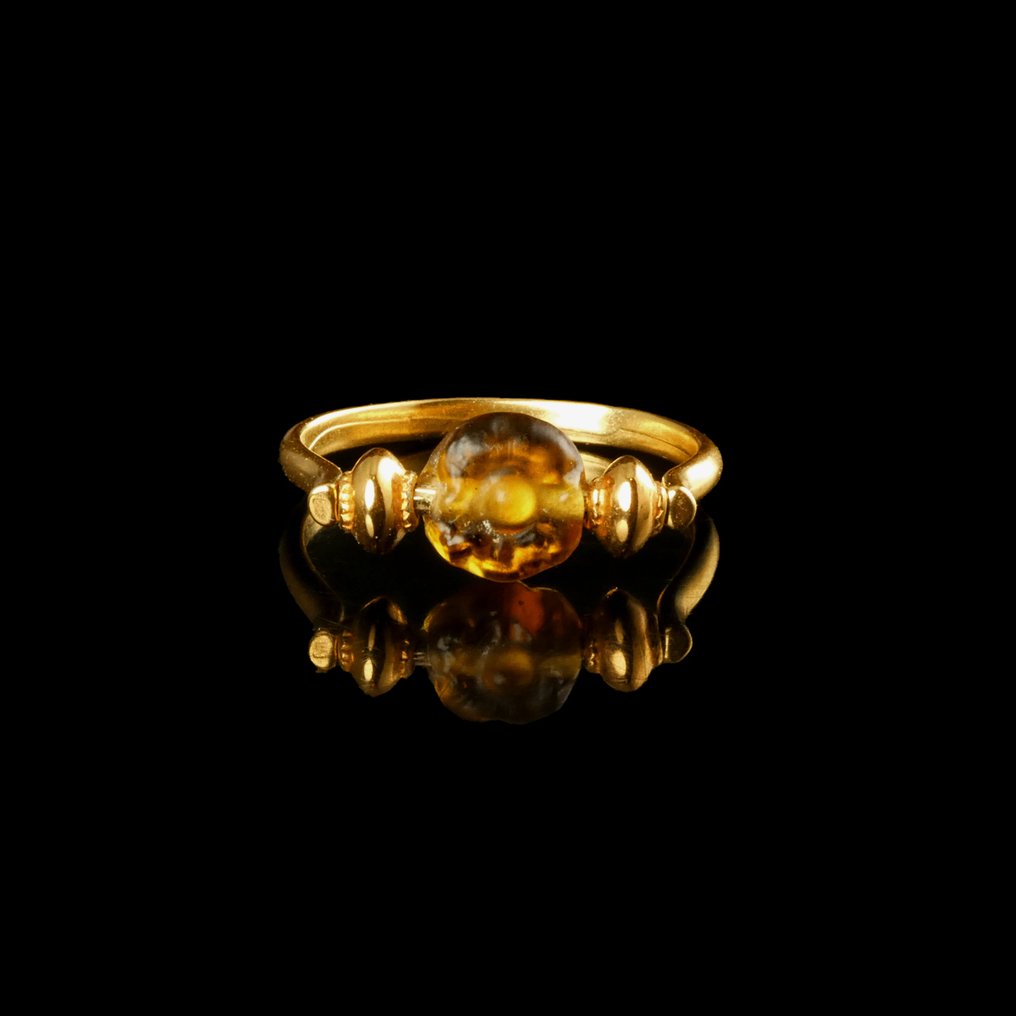
Myöhäinen Rooma / Varhainen Bysantti Koristeltu amuletin helmi renkaassa.


01
päivä
17
tuntia
39
minuuttia
19
sekuntia
Nykyinen tarjous
€ 80
Pohjahintaa ei saavutettu

asiantuntija
Valinnut Peter Reynaers
Lähes 30 vuoden kokemus ja toiminut useiden verkkotaiteen tutkimusryhmien moderaattorina.
Arvio € 160 - € 200
37 muuta käyttäjää seuraa tätä esinettä
 Tarjoaja 4101 Tarjoaja 4101 | 80 € | |
|---|---|---|
| Tarjoaja 4101 | 75 € | |
 Tarjoaja 4512 Tarjoaja 4512 | 65 € | |
Catawikin ostaja turva
Maksusi pidetään turvassa, kunnes saat esineesi. Näytä tiedot
Trustpilot 4.4 | 121899 arvostelua
Arvosteltu erinomaiseksi Trustpilot.
Renkaaseen on asennettu koristeellinen amuletinappi, myöhäisroomalainen/varhainen bysanttilainen kulttuuri, lasinen helmi modernin kultakoristetun renkaan sisällä, joka voi pyöriä, helmenn halkaisija noin 8,6 mm, ulkokuoren läpimitta noin 23,1 mm ja sisämitat noin 20,1–18,8 mm, ajoitus 4.–7. vuosisadalle j.Kr., hyväkuntoinen ja käytettävissä, helmet on uudelleenlangatettu moderneilla välikappaleilla, hankittu vuonna 2016 Iso-Britanniasta galleria/antiikkikauppiaalta; aitoustodistus saatavilla pyynnöstä.
Tekoälyavusteinen yhteenveto
Myyjän antama kuvaus
Attention: due to customs regulations we can only ship inside the European Union. Please ensure you have a valid EU shipping address before placing a bid.
Ring with a late Roman decorated amber colour glass amulet bead. The ancient bead is set on a modern gold-plated ring and is free to rotate (swivel-type).
Outside diameter: ± 23,1 mm
Inside diameter: ± 20,1 - 18,8 mm
Diameter bead: ± 8,6 mm
Condition: good condition and wearable. The ancient beads are restrung and combined with modern gold-plated spacer beads and fittings. Signs of wear consistent with age and use. See images.
Composed with beads originating from various old collections, acquired in the UK between 2016-2024.
Every ancient bead shows subtle variations and signs of age, reflecting its history and adding to the unique charm of every composition.
Certificate of Authenticity (PDF) is available upon request.
ANCIENT GLASS
Glass has always been found in nature, but the humans first created glass about 4.000 years ago. when ancient craftsmen in Mesopotamia discovered the art of mixing sand, soda and lime to make glass.
For centuries, glass was a luxury item and reserved for the upper classes.
Glassmaking centers around the Mediterranean world experimented with new techniques (casting, core-forming, mosaic glass) and with colours by adding metallic oxides (cobalt, copper, etc) to the mixture.
The Romans learned the glass-making craft after the conquest of Egypt in the 1st century BC. During the 1st century AD the glassblowing technique revolutionized the production and made it possible to produce larger quantities. By adding manganese dioxide Roman glassmakers successfully produced colourless or ‘aqua’ glass for the first time.
Roman glass became a very popular material, used for beads, glass windows, mosaic tiles, tableware pieces etc. Roman glass was traded all over the Roman Empire and far beyond to Central Africa, Scandinavia and via the Silk Route to China.
Myyjän tarina
Ole hyvä ja lue tietomme huolellisesti.
*TOIMITUSTIEDOT Due to insurance procedures, combined shipping is only possible with a single payment. (1 payment reference = 1 insured parcel.) If you accept an offer after the auction and pay separately, shipments cannot be manually combined afterward. Please ensure your shipping address is complete and correct before paying. Changes made after payment are not automatically forwarded to us.
* Todistus aitoudesta (COA) Vakuutustarkoituksiin voimme toimittaa digitaalisen todistuksen aitoudesta (PDF) jokaisesta kohteesta, jonka lähtöhinta on vähintään 100 euroa. COA on saatavilla pyynnöstä 20 päivän kuluessa huutokaupan päivämäärästä. Ohjeet toimitetaan, kun tilauksesi lähetetään. Todistuksia ei sisällytetä pakettiin.
VAKUUTUKSET & VAATIMUKSET Kaikki lähetyksemme on vakuutettu ulkopuolisella vakuutuksella. Tämä vakuutus edellyttää seuraavaa:
Seuraa verkkoseurantaa ja ilmoita viiveistä 14 päivän kuluessa lähetyspäivästä.
Vahingon sattuessa: tee varaus lähetyslapulle, säilytä kaikki pakkaukset ja lähetä meille kuvia vahingosta.
* TÄRKEÄT OSTAJAT ULKOMAILLA EU:n ULKOPUOLELLA: Emme voi lähettää maihin, jotka sijaitsevat Euroopan unionin ulkopuolella. Varmistathan, että sinulla on EU:n toimitusosoite ennen tarjouksen tekemistä. Ei poikkeuksia. Sveitsi, Norja ja Yhdistynyt kuningaskunta eivät kuulu EU:hun.
Dokumentaatiovaroitus: Aiempia laskuja ja tuonti-/vientiasiakirjoja ei jaeta asiakkaille.
Kiitos mielenkiinnostasi ja onnea tarjouskilpailuissasi!
Kääntänyt Google TranslateAttention: due to customs regulations we can only ship inside the European Union. Please ensure you have a valid EU shipping address before placing a bid.
Ring with a late Roman decorated amber colour glass amulet bead. The ancient bead is set on a modern gold-plated ring and is free to rotate (swivel-type).
Outside diameter: ± 23,1 mm
Inside diameter: ± 20,1 - 18,8 mm
Diameter bead: ± 8,6 mm
Condition: good condition and wearable. The ancient beads are restrung and combined with modern gold-plated spacer beads and fittings. Signs of wear consistent with age and use. See images.
Composed with beads originating from various old collections, acquired in the UK between 2016-2024.
Every ancient bead shows subtle variations and signs of age, reflecting its history and adding to the unique charm of every composition.
Certificate of Authenticity (PDF) is available upon request.
ANCIENT GLASS
Glass has always been found in nature, but the humans first created glass about 4.000 years ago. when ancient craftsmen in Mesopotamia discovered the art of mixing sand, soda and lime to make glass.
For centuries, glass was a luxury item and reserved for the upper classes.
Glassmaking centers around the Mediterranean world experimented with new techniques (casting, core-forming, mosaic glass) and with colours by adding metallic oxides (cobalt, copper, etc) to the mixture.
The Romans learned the glass-making craft after the conquest of Egypt in the 1st century BC. During the 1st century AD the glassblowing technique revolutionized the production and made it possible to produce larger quantities. By adding manganese dioxide Roman glassmakers successfully produced colourless or ‘aqua’ glass for the first time.
Roman glass became a very popular material, used for beads, glass windows, mosaic tiles, tableware pieces etc. Roman glass was traded all over the Roman Empire and far beyond to Central Africa, Scandinavia and via the Silk Route to China.
Myyjän tarina
Ole hyvä ja lue tietomme huolellisesti.
*TOIMITUSTIEDOT Due to insurance procedures, combined shipping is only possible with a single payment. (1 payment reference = 1 insured parcel.) If you accept an offer after the auction and pay separately, shipments cannot be manually combined afterward. Please ensure your shipping address is complete and correct before paying. Changes made after payment are not automatically forwarded to us.
* Todistus aitoudesta (COA) Vakuutustarkoituksiin voimme toimittaa digitaalisen todistuksen aitoudesta (PDF) jokaisesta kohteesta, jonka lähtöhinta on vähintään 100 euroa. COA on saatavilla pyynnöstä 20 päivän kuluessa huutokaupan päivämäärästä. Ohjeet toimitetaan, kun tilauksesi lähetetään. Todistuksia ei sisällytetä pakettiin.
VAKUUTUKSET & VAATIMUKSET Kaikki lähetyksemme on vakuutettu ulkopuolisella vakuutuksella. Tämä vakuutus edellyttää seuraavaa:
Seuraa verkkoseurantaa ja ilmoita viiveistä 14 päivän kuluessa lähetyspäivästä.
Vahingon sattuessa: tee varaus lähetyslapulle, säilytä kaikki pakkaukset ja lähetä meille kuvia vahingosta.
* TÄRKEÄT OSTAJAT ULKOMAILLA EU:n ULKOPUOLELLA: Emme voi lähettää maihin, jotka sijaitsevat Euroopan unionin ulkopuolella. Varmistathan, että sinulla on EU:n toimitusosoite ennen tarjouksen tekemistä. Ei poikkeuksia. Sveitsi, Norja ja Yhdistynyt kuningaskunta eivät kuulu EU:hun.
Dokumentaatiovaroitus: Aiempia laskuja ja tuonti-/vientiasiakirjoja ei jaeta asiakkaille.
Kiitos mielenkiinnostasi ja onnea tarjouskilpailuissasi!
Kääntänyt Google TranslateTiedot
Kulttuuri
Myöhäinen Rooma / Varhainen Bysantti
Vuosisata / Ajanjakso
4th - 7th century AD
Name of object
Ring with decorated amulet bead
Hankittu lähteestä
Galleria / antiikkimyyjä
Hankintavuosi
2016
Hankintamaa
Yhdistynyt kuningaskunta
Kunto
Hyvä
Edellinen omistaja - hankittu lähteestä
Galleria / antiikkimyyjä
Edellinen omistaja – hankintavuosi
2016
Edellinen omistaja – hankintamaa
Yhdistynyt kuningaskunta
Vakuutan, että olen hankkinut esineen laillisesti ja että saan myydä sen.
Kyllä
Myynyt käyttäjä
Vastuuvapauslauseke
Catawiki on informoinut myyjää siitä, että hänen on annettava vaaditut asiakirjat ja taattava, että: - esine on hankittu laillisesti, - myyjällä on oikeus myydä esine ja/tai viedä se maasta, - myyjä toimittaa tarvittavat alkuperätiedot ja järjestää vaaditut asiakirjat ja luvat/lisenssit soveltuvin osin ja paikallisten lakien mukaisesti, - myyjä ilmoittaa ostajalle mahdollisista viivästyksistä lupien/lisenssien saamisessa. Tekemällä tarjouksen hyväksyt, että sinulta saatetaan asuinmaastasi riippuen pyytää tuontiasiakirjoja ja että lupien/lisenssien saaminen voi aiheuttaa viivästyksiä esineesi toimituksessa.
Catawiki on informoinut myyjää siitä, että hänen on annettava vaaditut asiakirjat ja taattava, että: - esine on hankittu laillisesti, - myyjällä on oikeus myydä esine ja/tai viedä se maasta, - myyjä toimittaa tarvittavat alkuperätiedot ja järjestää vaaditut asiakirjat ja luvat/lisenssit soveltuvin osin ja paikallisten lakien mukaisesti, - myyjä ilmoittaa ostajalle mahdollisista viivästyksistä lupien/lisenssien saamisessa. Tekemällä tarjouksen hyväksyt, että sinulta saatetaan asuinmaastasi riippuen pyytää tuontiasiakirjoja ja että lupien/lisenssien saaminen voi aiheuttaa viivästyksiä esineesi toimituksessa.
