
No. 108341920

Sold
Cabassutius - Juris Canonici Theoria et Praxis - 1709
Final bid
€ 224
No reserve price
6 days ago

Cabassutius - Juris Canonici Theoria et Praxis - 1709

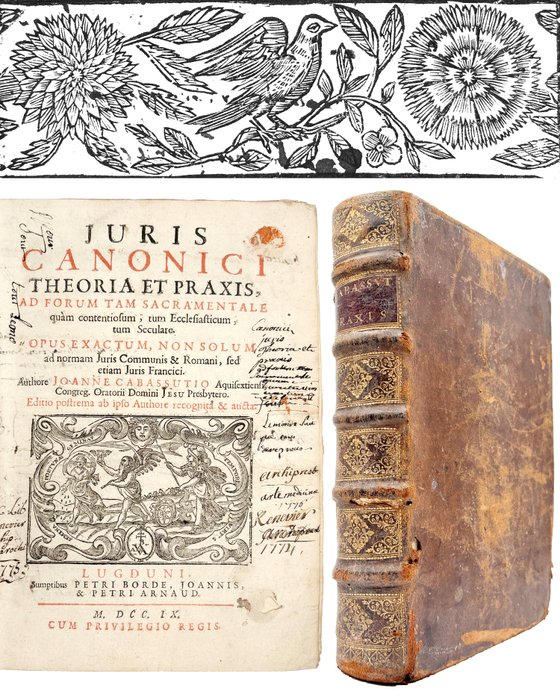
[CANON LAW – CHURCH COURTS – SACRAMENTS – ECCLESIASTICAL JURISPRUDENCE – MANUSCRIPT PROVENANCE] Very fine copy of the standard handbook of canon law from the Lyon press, 1709 – with eighteenth-century manuscript inscriptions from a French archpriest’s library “Juris Canonici Theoria et Praxis ad Forum Tam Sacramentale quàm contentiosum, tum Ecclesiasticum, tum Seculare.” Jean Cabassut (Joannes Cabassutius, 1604–1685) Lugduni (Lyon), Petrus Borde, 1709 25.5 x 19.5 cm. Title page + 5 pp. (dedication to Hieronymo Grimaldo) + 8 pp. (Ad Lectorem) + 4 pp. (Epistola) + 5 pp. (Synopsis Librorum et Capitum) + 600 pp. + 70 pp. (Index Rerum Omnium Notabilium). Contemporary leather binding. Jean Cabassut was born at Aix-en-Provence and entered the Congregation of the Oratory at the age of twenty-one, devoting himself thereafter to theology and canon law. He taught canon law at Avignon and accompanied Cardinal Grimaldi, Archbishop of Aix, to Rome; on his return to Aix he spent the remainder of his life in scholarship, producing works on church history and canon law that were read across Catholic Europe. The present volume is dedicated to his patron Grimaldi. The book appeared at a moment when canon law stood at the centre of European legal life, shaping the proceedings of ecclesiastical and secular courts alike. Cabassut set out to give a systematic account of the subject uniting theory with practice, and the structure of the work reflects that aim: it treats both the forum sacramentale – the law governing the sacraments, confession and ecclesiastical discipline – and the forum contentiosum, the law of contested proceedings, extending to disputes within the church hierarchy and between the church and secular authorities. Cabassut expounds the canonical principles, interprets papal decrees and conciliar decisions, and offers practical guidance on applying them. What distinguished his approach, and secured the book’s long life as a working reference for clergy, theologians and jurists, was his combination of theological, historical and juridical perspectives within a single framework. It was read in Rome and in the other great centres of canon law throughout Europe, and went through numerous editions – of which this Lyon printing of 1709, from the press of Petrus Borde, is one. Provenance and manuscript inscriptions. This copy carries an appealing record of its clerical ownership. The title page bears the inscription “Ex lib. Renevier archip. et parochi 1775” – “from the books of Renevier, archpriest and parish priest, 1775” – together with a further dated entry of 1770. A facing leaf carries a longer handwritten text in a mixture of Latin and French, liturgical in character: it opens with a formula recalling the doxology (“Cum Sancto Spiritu in Gloria”), repeats the solemn phrase “cum ipso et in nomine” (“with him and in his name”), and includes the line “Hoc opus commisit Juste Joannes Baptista”. Taken together the inscriptions give a vivid sense of the book’s life in the hands of a working French parish clergyman in the decades before the Revolution. (Please see the photographs; the transcription and reading of the manuscript are offered in good faith but without warranty.) Condition: Contemporary leather binding. Very good condition overall. Please see the photographs. Pages: 693 pp. in all (title + 5 + 8 + 4 + 5 + 600 + 70 pp.) This listing was created with the help of AI.

No. 108341920

Sold
Cabassutius - Juris Canonici Theoria et Praxis - 1709

Cabassutius - Juris Canonici Theoria et Praxis - 1709

[CANON LAW – CHURCH COURTS – SACRAMENTS – ECCLESIASTICAL JURISPRUDENCE – MANUSCRIPT PROVENANCE]

Very fine copy of the standard handbook of canon law from the Lyon press, 1709 – with eighteenth-century manuscript inscriptions from a French archpriest’s library

“Juris Canonici Theoria et Praxis ad Forum Tam Sacramentale quàm contentiosum, tum Ecclesiasticum, tum Seculare.”

Jean Cabassut (Joannes Cabassutius, 1604–1685)
Lugduni (Lyon), Petrus Borde, 1709

25.5 x 19.5 cm. Title page + 5 pp. (dedication to Hieronymo Grimaldo) + 8 pp. (Ad Lectorem) + 4 pp. (Epistola) + 5 pp. (Synopsis Librorum et Capitum) + 600 pp. + 70 pp. (Index Rerum Omnium Notabilium). Contemporary leather binding.

Jean Cabassut was born at Aix-en-Provence and entered the Congregation of the Oratory at the age of twenty-one, devoting himself thereafter to theology and canon law. He taught canon law at Avignon and accompanied Cardinal Grimaldi, Archbishop of Aix, to Rome; on his return to Aix he spent the remainder of his life in scholarship, producing works on church history and canon law that were read across Catholic Europe. The present volume is dedicated to his patron Grimaldi.

The book appeared at a moment when canon law stood at the centre of European legal life, shaping the proceedings of ecclesiastical and secular courts alike. Cabassut set out to give a systematic account of the subject uniting theory with practice, and the structure of the work reflects that aim: it treats both the forum sacramentale – the law governing the sacraments, confession and ecclesiastical discipline – and the forum contentiosum, the law of contested proceedings, extending to disputes within the church hierarchy and between the church and secular authorities. Cabassut expounds the canonical principles, interprets papal decrees and conciliar decisions, and offers practical guidance on applying them. What distinguished his approach, and secured the book’s long life as a working reference for clergy, theologians and jurists, was his combination of theological, historical and juridical perspectives within a single framework. It was read in Rome and in the other great centres of canon law throughout Europe, and went through numerous editions – of which this Lyon printing of 1709, from the press of Petrus Borde, is one.

Provenance and manuscript inscriptions. This copy carries an appealing record of its clerical ownership. The title page bears the inscription “Ex lib. Renevier archip. et parochi 1775” – “from the books of Renevier, archpriest and parish priest, 1775” – together with a further dated entry of 1770. A facing leaf carries a longer handwritten text in a mixture of Latin and French, liturgical in character: it opens with a formula recalling the doxology (“Cum Sancto Spiritu in Gloria”), repeats the solemn phrase “cum ipso et in nomine” (“with him and in his name”), and includes the line “Hoc opus commisit Juste Joannes Baptista”. Taken together the inscriptions give a vivid sense of the book’s life in the hands of a working French parish clergyman in the decades before the Revolution. (Please see the photographs; the transcription and reading of the manuscript are offered in good faith but without warranty.)

Condition: Contemporary leather binding. Very good condition overall. Please see the photographs.

Pages: 693 pp. in all (title + 5 + 8 + 4 + 5 + 600 + 70 pp.)

This listing was created with the help of AI.

Final bid
€ 224
No reserve price
Volker Riepenhausen
Expert
Estimate € 330 - € 400

Similar objects

  • ​
    ​
    ​
  • ​
    ​
    ​
  • ​
    ​
    ​
  • ​
    ​
    ​
  • ​
    ​
    ​
  • ​
    ​
    ​
  • ​
    ​
    ​
  • ​
    ​
    ​
  • ​
    ​
    ​
  • ​
    ​
    ​

For you in

本

  • ​
    ​
    ​
  • ​
    ​
    ​
  • ​
    ​
    ​
  • ​
    ​
    ​
  • ​
    ​
    ​
  • ​
    ​
    ​
  • ​
    ​
    ​
  • ​
    ​
    ​
  • ​
    ​
    ​
  • ​
    ​
    ​
Set a search alert
Set a search alert to get notified when new matches are available.

This object was featured in


How to buy on Catawiki

Learn more about our Buyer Protection

      1. Discover something special

      Browse through thousands of special objects selected by experts. View the photos, details and estimated value of each special object. 

      2. Place the top bid

      Find something you love and place the top bid. You can follow the auction to the end or let our system do the bidding for you. All you have to do is set a bid for the maximum amount you want to pay. 

      3. Make a secure payment

      Pay for your special object and we’ll keep your payment secure until it arrives safe and sound. We use a trusted payment system to handle all transactions. 

Have something similar to sell?

Whether you're new to online auctions or sell professionally, we can help you earn more for your special objects.

Sell your object
