
Weegee (1899–1968) - Murdered while playing Boccia

07
05
小时
26
分钟
44
开始出价
€ 1
没有保留价
Kai Brückner
专家
由Kai Brückner精选

拥有35年以上经验;前画廊拥有者及埃森Folkwang博物馆策展人。

估价  € 300 - € 400
没有出价记录

Catawiki买家保障

在您收到物品之前,您的付款将在我们这里受到安全保管。查看详细信息

Trustpilot 4.4分 | 127342条评论

Trustpilot上被评为优秀。

卖家的描述

Print from Weegee Portfolio
Exhibition Print based on the 1982 prints by Sid Kaplan,
printed 1992
Produced for
Amber Film & Photography Collective, Newcastle upon Tyne


Arthur (Usher) Fellig (June 12, 1899 – December 26, 1968), known by his pseudonym Weegee, was a photographer and photojournalist, known for his stark black and white street photography in New York City.
Weegee worked in Manhattan's Lower East Side as a press photographer during the 1930s and 1940s and developed his signature style by following the city's emergency services and documenting their activity.[2] Much of his work depicted unflinchingly realistic scenes of urban life, crime, injury and death.
He worked at night and competed with the police to be first at the scene of a crime, selling his photographs to tabloids and photographic agencies.[5] His photographs, centered around Manhattan police headquarters, were soon published by the Daily News and other tabloids, as well as more upscale publication such as Life magazine.
Most of his notable photographs were taken with very basic press photographer equipment and methods of the era, a 4×5 Speed Graphic camera preset at f/16 at 1/200 of a second, with flashbulbs and a set focus distance of ten feet.[11] He was a self-taught photographer with no formal training.

Five of his photographs were acquired by the Museum of Modern Art (MoMA) in 1943. These works were included in its exhibition Action Photography.[21] He was later included in "50 Photographs by 50 Photographers", another MoMA show organized by photographer Edward Steichen,.

Naked City (1945) was his first book of photographs. Film producer Mark Hellinger bought the rights to the title from Weegee.[21] In 1948, Weegee's aesthetic formed the foundation for Hellinger's film The Naked City. It was based on a gritty 1948 story written by Malvin Wald about the investigation into a model's murder in New York.

In the 1950s and 1960s, Weegee experimented with panoramic photographs, photo distortions and photography through prisms. Using a plastic lens, he made a famous photograph of Marilyn Monroe in which her face is grotesquely distorted yet still recognizable.
Weegee can be seen as the American counterpart to Brassaï, who photographed Paris street scenes at night. Weegee's themes of nudists, circus performers, freaks and street people were later taken up and developed by Diane Arbus in the early 1960s.
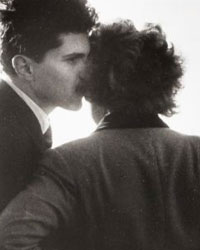
Print from Weegee Portfolio
Exhibition Print based on the 1982 prints by Sid Kaplan,
printed 1992
Produced for
Amber Film & Photography Collective, Newcastle upon Tyne


Arthur (Usher) Fellig (June 12, 1899 – December 26, 1968), known by his pseudonym Weegee, was a photographer and photojournalist, known for his stark black and white street photography in New York City.
Weegee worked in Manhattan's Lower East Side as a press photographer during the 1930s and 1940s and developed his signature style by following the city's emergency services and documenting their activity.[2] Much of his work depicted unflinchingly realistic scenes of urban life, crime, injury and death.
He worked at night and competed with the police to be first at the scene of a crime, selling his photographs to tabloids and photographic agencies.[5] His photographs, centered around Manhattan police headquarters, were soon published by the Daily News and other tabloids, as well as more upscale publication such as Life magazine.
Most of his notable photographs were taken with very basic press photographer equipment and methods of the era, a 4×5 Speed Graphic camera preset at f/16 at 1/200 of a second, with flashbulbs and a set focus distance of ten feet.[11] He was a self-taught photographer with no formal training.

Five of his photographs were acquired by the Museum of Modern Art (MoMA) in 1943. These works were included in its exhibition Action Photography.[21] He was later included in "50 Photographs by 50 Photographers", another MoMA show organized by photographer Edward Steichen,.

Naked City (1945) was his first book of photographs. Film producer Mark Hellinger bought the rights to the title from Weegee.[21] In 1948, Weegee's aesthetic formed the foundation for Hellinger's film The Naked City. It was based on a gritty 1948 story written by Malvin Wald about the investigation into a model's murder in New York.

In the 1950s and 1960s, Weegee experimented with panoramic photographs, photo distortions and photography through prisms. Using a plastic lens, he made a famous photograph of Marilyn Monroe in which her face is grotesquely distorted yet still recognizable.
Weegee can be seen as the American counterpart to Brassaï, who photographed Paris street scenes at night. Weegee's themes of nudists, circus performers, freaks and street people were later taken up and developed by Diane Arbus in the early 1960s.

详细资料

艺术家
Weegee (1899–1968)
作品名称
Murdered while playing Boccia
状态
特别精美
技术
明胶银版法印像
高度
28 cm
版本
3
宽度
21,6 cm
卖家
德国经验证
286
已售出的几件物品
81,82%
个人

类似物品

类别为您准备的

摄影