
编号 106199139

已售出
trench-watch - silver - 没有保留价 - 10714 - 中性 - 1910
最终出价
€ 91
没有保留价
4周前

trench-watch - silver - 没有保留价 - 10714 - 中性 - 1910

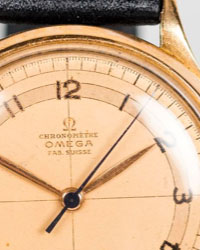
This appears to be a small vintage wristwatch, likely from the 1915–1935 period. Here are some observations based on the photo: * Porcelain/enamel dial: The white dial appears to be enamel, a common feature of higher-quality watches from the early 20th century. It has some chips around the edge, especially near 6 o’clock. * Ornate “Louis XV” style hands: These decorative hands were popular on dress watches from the 1910s and 1920s. * Wire lugs: The thin wire-style lugs are characteristic of some of the earliest wristwatches, many of which evolved from pocket watch movements. * Small case: Judging from the proportions, the case is probably around 28–32 mm, typical for the era. * Rose gold or gold-filled case: The case has a warm rose-gold color. It could be solid gold, gold-filled, or gold-plated—there isn’t enough visible evidence to determine which. From the photo of the inside of the case back, I can make out several important hallmarks: * “K&M 0.800” — This indicates the case is made of 80% silver (800 silver). The “K&M” is almost certainly the case maker’s mark rather than the watch manufacturer. * Crescent moon and crown — This is the German national silver hallmark, introduced in 1888, indicating the silver was assayed in Germany. * “1071 A” (or similar) and “6” — These appear to be production or case serial numbers used by the manufacturer. * There is also a small, worn punch to the left of the K&M mark that is difficult to identify from this angle. What this tells us * The watch case was made in Germany. * It is 800 silver, a common standard for German and Swiss pocket watches from the late 19th to early 20th century. * The case likely dates from approximately 1890–1915, though the movement inside would help narrow that down. To identify the watch itself The case back alone usually doesn’t identify the watch brand. The most useful photo would be: 1. The movement (open the inner dust cover if there is one). 2. The dial. 3. Any markings inside the dust cover. Those often reveal the maker (Junghans, Alpina, Omega, Longines, etc.) and the exact model. Funcțional!

编号 106199139

已售出
trench-watch - silver - 没有保留价 - 10714 - 中性 - 1910

trench-watch - silver - 没有保留价 - 10714 - 中性 - 1910

This appears to be a small vintage wristwatch, likely from the 1915–1935 period. Here are some observations based on the photo:

* Porcelain/enamel dial: The white dial appears to be enamel, a common feature of higher-quality watches from the early 20th century. It has some chips around the edge, especially near 6 o’clock.
* Ornate “Louis XV” style hands: These decorative hands were popular on dress watches from the 1910s and 1920s.
* Wire lugs: The thin wire-style lugs are characteristic of some of the earliest wristwatches, many of which evolved from pocket watch movements.
* Small case: Judging from the proportions, the case is probably around 28–32 mm, typical for the era.
* Rose gold or gold-filled case: The case has a warm rose-gold color. It could be solid gold, gold-filled, or gold-plated—there isn’t enough visible evidence to determine which.
From the photo of the inside of the case back, I can make out several important hallmarks:

* “K&M 0.800” — This indicates the case is made of 80% silver (800 silver). The “K&M” is almost certainly the case maker’s mark rather than the watch manufacturer.
* Crescent moon and crown — This is the German national silver hallmark, introduced in 1888, indicating the silver was assayed in Germany.
* “1071 A” (or similar) and “6” — These appear to be production or case serial numbers used by the manufacturer.
* There is also a small, worn punch to the left of the K&M mark that is difficult to identify from this angle.

What this tells us

* The watch case was made in Germany.
* It is 800 silver, a common standard for German and Swiss pocket watches from the late 19th to early 20th century.
* The case likely dates from approximately 1890–1915, though the movement inside would help narrow that down.

To identify the watch itself

The case back alone usually doesn’t identify the watch brand. The most useful photo would be:

1. The movement (open the inner dust cover if there is one).
2. The dial.
3. Any markings inside the dust cover.

Those often reveal the maker (Junghans, Alpina, Omega, Longines, etc.) and the exact model.
Funcțional!
最终出价
€ 91
没有保留价

类似物品

  • ​
    ​
    ​
  • ​
    ​
    ​
  • ​
    ​
    ​
  • ​
    ​
    ​
  • ​
    ​
    ​
  • ​
    ​
    ​
  • ​
    ​
    ​
  • ​
    ​
    ​
  • ​
    ​
    ​
  • ​
    ​
    ​

类别为您准备的

腕表

  • ​
    ​
    ​
  • ​
    ​
    ​
  • ​
    ​
    ​
  • ​
    ​
    ​
  • ​
    ​
    ​
  • ​
    ​
    ​
  • ​
    ​
    ​
  • ​
    ​
    ​
  • ​
    ​
    ​
  • ​
    ​
    ​
设置搜索提醒
设置搜索提醒,以便在有新匹配项目时随时收到通知。

该物品出现在


如何在Catawiki上购买

详细了解我们的买家保障

      1. 发现奇珍异品

      饱览数以千计的专家精选的稀奇物品。查看每件稀奇物品的照片、详情和估价。 

      2. 设置最高出价

      找到您喜欢的物品并设置最高出价。您可以关注拍卖直到最后,也可以让系统为您出价。您只需设置可接受的最高出价。 

      3. 安全支付

      当您付款拍下心仪的稀奇物品后,我们会确保货款的安全,直至物品安然交付与您。我们使用受信赖的支付系统来处理所有交易。 

有类似的东西要出售吗?

无论您是在线拍卖的新手还是专业销售,我们都可以帮助您为您的独特物品赚取更多收入。

出售您的物品