
欧洲. 2 Euro Various Years (4 coins with cancellation marks) (没有保留价)


€43 | ||
|---|---|---|
€38 | ||
€33 | ||
Catawiki买家保障
在您收到物品之前,您的付款将在我们这里受到安全保管。查看详细信息
Trustpilot 4.4分 | 140172条评论
在Trustpilot上被评为优秀。
四枚被破坏的2欧元硬币,来自卢森堡(2014)、法国(2002)、奥地利(2002)与2010年的铸币空白,单枚重量8.5克,直径25.75毫米,厚度2.2毫米,双金属镍镀铜心与铜镍环,边缘带齿状凹刻,模具磨损痕迹明显。
卖家的描述
Period: European Union (Euro) Year 2014
Luxembourg: Currency: Euro (face of Grand Duke Henri)
Type: Circulation coins
Denomination: 2 Euro
Year: 2014
Bimetallic alloy.
Nickel-plated brass.
Cuproronickel bezel
Edge inscription: serrated with concave inscription and the number 2 and two stars in a repeating sentence
Shape: Round
Obverse/Reverse arrangement: Not reversed
Weight (g) 8.5
Diameter (mm) 25.75
Thickness (mm) 2.2
Obverse: In the center, a simplified face of Grand Duke Henri facing right; On the left, vertically in concave letters in two lines: the year of issue and: LËTZEBUERG (Luxembourg); along the edge, a ring of twelve five-pointed stars – the symbol of the European Union.
On the reverse: to the left of the center, the denomination: 2, to the right: EURO; in the background of the inscription, a simplified map of Europe with the outlines of the countries – members of the European Union in 1999; in the background of the map, vertically, six parallel lines ending on both sides with five-pointed stars (the reverse is common to all euro coins).
Irregularity caused by die wear; bends in the metal are visible on the coin in the form of longitudinal lines.
During the minting of coins, the dies are subjected to high dynamic loads, which sometimes causesdamage in the form of cracks or even chips. Friction between the surfaces of the dies and the coin causes gradual wear of the dies. Despite appearances, mint damage of this type makes the 2014 Luxembourg 2 Euro coin highly sought after by collectors, as its uniqueness makes it interesting and often highly valuable due to its rarity and exceptional quality.
An interesting and unique, very rare and unusual form of the Destructed 2 Euro Luxembourg coin from 2014
Period: European Union (Euro) 2002
France: Currency: Euro (tree on a hexagonal background)
Type: Circulation coins
Denomination: 2 Euro
Year: 2002
Bimetallic alloy.
Nickel-plated brass.
Cuproronickel ring
Edge inscription: serrated with concave inscription and the number 2 and two stars in a repeating sentence
Shape: Round
Obverse/Reverse arrangement: Not reversed
Weight (g) 8.5
Diameter (mm) 25.75
Thickness (mm) 2.2
Obverse: In the field, a simplified tree on a hexagonal background; on either side of the trunk, the letters: RF (RÉPUBLIQUE FRANÇAISE - French Republic); The Republic's motto, LIBERTÉ ÉGALITÉ FRATERNITÉ (Freedom, Equality, Fraternity), is displayed along the rim; twelve five-pointed stars, the symbol of the European Union, are displayed along the edge; the lowest star divides the year of issue.
On the reverse: to the left of the center, the denomination is 2, and to the right: EURO; in the background of the inscription, a simplified map of Europe with the outlines of the European Union member states in 1999; in the background of the map, vertically, six parallel lines terminating on both sides with five-pointed stars (the reverse is common to all euro coins).
Irregularity caused by die wear; bends in the metal are visible on the coin in the form of longitudinal lines.
During the minting of coins, the dies are subjected to high dynamic loads, which sometimes causes damage in the form of cracks or even chips. Friction between the surfaces of the dies and the coin causes gradual wear of the dies. Despite appearances, mint damage, such as these 2002 France €2 coins, is highly sought after by collectors, as its uniqueness makes it interesting and often highly valuable due to its rarity and exceptional quality.
An interesting and unique, very rare and unusual form of the 2002 France €2 coi
Period: European Union (Euro) 2010
Europe Currency: Euro
Type: Circulation Coins
Denomination: 2 Euro mint blank
Year: 2010
Bimetallic alloy.
Nickel-plated brass.
Cuproronickel ring
No inscription on the edge, no ribs on the edge of the blank
Shape: Round
Obverse/Reverse Arrangement: Not Reversed
Weight (g) 8.5
Diameter (mm) 25.75
Thickness (mm) 2.2
No inscriptions on the obverse or reverse.
Irregularity caused by die wear; metal bends in the form of longitudinal lines are visible on the coin.
During the minting of coins, the dies are subjected to high dynamic loads, which sometimes causes damage in the form of cracks or even chips. Friction between the surfaces of the dies and the coin causes gradual wear of the dies. Contrary to popular belief, mint damage is highly sought after by collectors, as its unique nature makes it interesting and often highly valuable due to its rarity and exceptional quality.
An interesting and unique, very rare and unusual form of the Destructed 2 Euro coin disc from 2010.
Period: European Union (Euro) Year 2002- Austria
Europe Currency: Euro
Type: Circulation Coins
Austria: Denomination: 2 Euro
Year: 2002
Bimetallic alloy.
Nickel-plated brass.
Cuproronickel ring
Edge lettering: serrated with a concave inscription reading "2 EURO" and three stars with a repeated sequence
Shape: Round
Obverse/Reverse Arrangement: Not inverted
Weight (g) 8.5
Diameter (mm) 25.75
Thickness (mm) 2.2
Obverse: In the center, a bust of Bertha von Suttner facing left; on the left, the denomination in two lines: 2 / EURO; below, the Austrian flag; along the right edge, the year of issue; Along the edge, a ring of twelve five-pointed stars – the symbol of the European Union – is visible.
On the reverse: to the left of the center, the denomination: 2, and to the right: EURO; in the background of the inscription, a simplified map of Europe with the outlines of the countries that were members of the European Union in 1999; in the background of the map, vertically, six parallel lines terminating on both sides with five-pointed stars (the reverse is common to all euro coins).
Irregularity caused by die wear; the coin shows metal bends in the form of longitudinal lines.
During the minting of coins, the dies are subjected to high dynamic loads, which sometimes causes damage in the form of cracks or even chips. Friction between the surfaces of the dies and the coin causes gradual wear of the dies. Contrary to appearances, mint defects make these types of Austria 2 Euro coins from 2002 highly sought after by collectors, as their uniqueness makes them interesting and often very valuable due to their rarity and exceptionality.
An interesting and unique, very rare and unusual form of the Destructed Austria 2 Euro coin from 2002
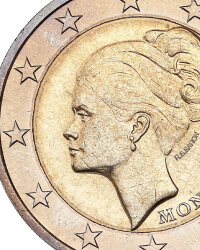
Period: European Union (Euro) Year 2014
Luxembourg: Currency: Euro (face of Grand Duke Henri)
Type: Circulation coins
Denomination: 2 Euro
Year: 2014
Bimetallic alloy.
Nickel-plated brass.
Cuproronickel bezel
Edge inscription: serrated with concave inscription and the number 2 and two stars in a repeating sentence
Shape: Round
Obverse/Reverse arrangement: Not reversed
Weight (g) 8.5
Diameter (mm) 25.75
Thickness (mm) 2.2
Obverse: In the center, a simplified face of Grand Duke Henri facing right; On the left, vertically in concave letters in two lines: the year of issue and: LËTZEBUERG (Luxembourg); along the edge, a ring of twelve five-pointed stars – the symbol of the European Union.
On the reverse: to the left of the center, the denomination: 2, to the right: EURO; in the background of the inscription, a simplified map of Europe with the outlines of the countries – members of the European Union in 1999; in the background of the map, vertically, six parallel lines ending on both sides with five-pointed stars (the reverse is common to all euro coins).
Irregularity caused by die wear; bends in the metal are visible on the coin in the form of longitudinal lines.
During the minting of coins, the dies are subjected to high dynamic loads, which sometimes causesdamage in the form of cracks or even chips. Friction between the surfaces of the dies and the coin causes gradual wear of the dies. Despite appearances, mint damage of this type makes the 2014 Luxembourg 2 Euro coin highly sought after by collectors, as its uniqueness makes it interesting and often highly valuable due to its rarity and exceptional quality.
An interesting and unique, very rare and unusual form of the Destructed 2 Euro Luxembourg coin from 2014
Period: European Union (Euro) 2002
France: Currency: Euro (tree on a hexagonal background)
Type: Circulation coins
Denomination: 2 Euro
Year: 2002
Bimetallic alloy.
Nickel-plated brass.
Cuproronickel ring
Edge inscription: serrated with concave inscription and the number 2 and two stars in a repeating sentence
Shape: Round
Obverse/Reverse arrangement: Not reversed
Weight (g) 8.5
Diameter (mm) 25.75
Thickness (mm) 2.2
Obverse: In the field, a simplified tree on a hexagonal background; on either side of the trunk, the letters: RF (RÉPUBLIQUE FRANÇAISE - French Republic); The Republic's motto, LIBERTÉ ÉGALITÉ FRATERNITÉ (Freedom, Equality, Fraternity), is displayed along the rim; twelve five-pointed stars, the symbol of the European Union, are displayed along the edge; the lowest star divides the year of issue.
On the reverse: to the left of the center, the denomination is 2, and to the right: EURO; in the background of the inscription, a simplified map of Europe with the outlines of the European Union member states in 1999; in the background of the map, vertically, six parallel lines terminating on both sides with five-pointed stars (the reverse is common to all euro coins).
Irregularity caused by die wear; bends in the metal are visible on the coin in the form of longitudinal lines.
During the minting of coins, the dies are subjected to high dynamic loads, which sometimes causes damage in the form of cracks or even chips. Friction between the surfaces of the dies and the coin causes gradual wear of the dies. Despite appearances, mint damage, such as these 2002 France €2 coins, is highly sought after by collectors, as its uniqueness makes it interesting and often highly valuable due to its rarity and exceptional quality.
An interesting and unique, very rare and unusual form of the 2002 France €2 coi
Period: European Union (Euro) 2010
Europe Currency: Euro
Type: Circulation Coins
Denomination: 2 Euro mint blank
Year: 2010
Bimetallic alloy.
Nickel-plated brass.
Cuproronickel ring
No inscription on the edge, no ribs on the edge of the blank
Shape: Round
Obverse/Reverse Arrangement: Not Reversed
Weight (g) 8.5
Diameter (mm) 25.75
Thickness (mm) 2.2
No inscriptions on the obverse or reverse.
Irregularity caused by die wear; metal bends in the form of longitudinal lines are visible on the coin.
During the minting of coins, the dies are subjected to high dynamic loads, which sometimes causes damage in the form of cracks or even chips. Friction between the surfaces of the dies and the coin causes gradual wear of the dies. Contrary to popular belief, mint damage is highly sought after by collectors, as its unique nature makes it interesting and often highly valuable due to its rarity and exceptional quality.
An interesting and unique, very rare and unusual form of the Destructed 2 Euro coin disc from 2010.
Period: European Union (Euro) Year 2002- Austria
Europe Currency: Euro
Type: Circulation Coins
Austria: Denomination: 2 Euro
Year: 2002
Bimetallic alloy.
Nickel-plated brass.
Cuproronickel ring
Edge lettering: serrated with a concave inscription reading "2 EURO" and three stars with a repeated sequence
Shape: Round
Obverse/Reverse Arrangement: Not inverted
Weight (g) 8.5
Diameter (mm) 25.75
Thickness (mm) 2.2
Obverse: In the center, a bust of Bertha von Suttner facing left; on the left, the denomination in two lines: 2 / EURO; below, the Austrian flag; along the right edge, the year of issue; Along the edge, a ring of twelve five-pointed stars – the symbol of the European Union – is visible.
On the reverse: to the left of the center, the denomination: 2, and to the right: EURO; in the background of the inscription, a simplified map of Europe with the outlines of the countries that were members of the European Union in 1999; in the background of the map, vertically, six parallel lines terminating on both sides with five-pointed stars (the reverse is common to all euro coins).
Irregularity caused by die wear; the coin shows metal bends in the form of longitudinal lines.
During the minting of coins, the dies are subjected to high dynamic loads, which sometimes causes damage in the form of cracks or even chips. Friction between the surfaces of the dies and the coin causes gradual wear of the dies. Contrary to appearances, mint defects make these types of Austria 2 Euro coins from 2002 highly sought after by collectors, as their uniqueness makes them interesting and often very valuable due to their rarity and exceptionality.
An interesting and unique, very rare and unusual form of the Destructed Austria 2 Euro coin from 2002

